Welcome to IgMin Research – an Open Access journal uniting Biology, Medicine, and Engineering. We’re dedicated to advancing global knowledge and fostering collaboration across scientific fields.
At IgMin Research, we bridge the frontiers of Biology, Medicine, and Engineering to foster interdisciplinary innovation. Our expanded scope now embraces a wide spectrum of scientific disciplines, empowering global researchers to explore, contribute, and collaborate through open access.
Welcome to IgMin, a leading platform dedicated to enhancing knowledge dissemination and professional growth across multiple fields of science, technology, and the humanities. We believe in the power of open access, collaboration, and innovation. Our goal is to provide individuals and organizations with the tools they need to succeed in the global knowledge economy.
IgMin Publications Inc., Suite 102, West Hartford, CT - 06110, USA
Widely used anthropometric indices, such as Body Mass Index (BMI), are mathematically irreversible, thus limiting interoperability between historical anthropometric datasets. This study introduces the Standard Human Index (SHI), defined as dimensionless h+(h−BSA), and evaluates its relationship with BMI. A cross-sectional analysis was conducted using a large clinical cohort (N>10k). Sex-specific and overall linear regression models revealed a strong linear correlation between SHI and BMI (R² ≈ 0.97). This relationship enables the reconstruction of paired height and weight values within biologically plausible ranges. The SHI provides a stable, mathematical framework for unifying disparate anthropometric datasets, offering a practical tool for large-scale meta-analyses and, importantly, person-oriented assessment of the human body.
Standardized anthropometric indices are foundational tools in clinical medicine [11World Health Organization. Obesity: preventing and managing the global epidemic. Report of a WHO consultation. Geneva: World Health Organization; 2000. doi:10.1016/S0140-6736(06)69251-9.]. Among them, BMI is primarily used to define normative weight categories, while body surface area (BSA) is widely applied for the indexation of physiological and therapeutic parameters [11World Health Organization. Obesity: preventing and managing the global epidemic. Report of a WHO consultation. Geneva: World Health Organization; 2000. doi:10.1016/S0140-6736(06)69251-9.-33Flint B, Das JM, Hall CA. Body Surface Area. 2025 Feb 6. In: StatPearls [Internet]. Treasure Island (FL): StatPearls Publishing; 2026 Jan–. PMID: 32644431.]. For decades, both indices have stratified risk, yet their clinical interpretation is often confounded by the complex relationship between body mass and clinical outcomes [44Romero-Corral A, Montori VM, Somers VK, Korinek J, Thomas RJ, Allison TG, Mookadam F, Lopez-Jimenez F. Association of bodyweight with total mortality and with cardiovascular events in coronary artery disease: a systematic review of cohort studies. Lancet. 2006 Aug 19;368(9536):666-78. doi: 10.1016/S0140-6736(06)69251-9. PMID: 16920472.]. This interpretive challenge is compounded by a fundamental, structural problem: the lack of interoperability among the indices themselves. Because metrics like BMI and BSA are mathematically irreversible transformations, data reported in terms of one index cannot be converted to the other. This has resulted in the fragmentation of a vast body of knowledge, creating archives of historical data that are less valid or inoperable, and making the thought of a large-scale meta-analysis, from the oldest to contemporary times, truly naive.
This paper puts forward a proposal to solve this dual problem. The Standard Human Index (SHI) is created and demonstrates a strong linear correlation with BMI. For the first time, a method based on algebraic calculation with a physical meaning makes a reconstruction of a person's original height and weight from a single index value, either BMI or BSA. This provides a universal tool to unify old and new biometric data.
The Standard Human Index (SHI) is a biometric metric defined by the formula:h + (h - BSA). In this expression, height (h) and Body Surface Area (BSA) are treated as unitless algebraic values. For calculation, BSA was derived from primary measurements of height (in meters) and weight (in kilograms) using a modification of the Mosteller formula: BSA = √([h * w] / 36) [55Mosteller RD. Simplified calculation of body-surface area. N Engl J Med. 1987 Oct 22;317(17):1098. doi: 10.1056/NEJM198710223171717. PMID: 3657876.].
Study population and data
The cohort comprises 10,147 individuals with self-reported anthropometric data, drawn from a larger population undergoing non-contrast-enhanced cardiac CT for coronary artery calcium (CAC) scoring between June 2008 and May 2025. The cohort is broadly representative of a general clinical population. Only sex, age, height, and weight were analyzed; any clinical outcomes or CT findings were considered. Data collection followed an all-comers principle, with no clinical exclusion criteria [66Sosnowski M, Parma Z, Syzdół M, Brożek G, Harpula J, Tendera M, Wojakowski W. A Novel Concept of the "Standard Human" in the Assessment of Individual Total Heart Size: Lessons from Non-Contrast-Enhanced Cardiac CT Examinations. Diagnostics (Basel). 2025 Jun 13;15(12):1502. doi: 10.3390/diagnostics15121502. PMID: 40564823; PMCID: PMC12192549.].
Ethical consideration
This retrospective study was conducted in accordance with the principles of the Declaration of Helsinki [77World Medical Association. Declaration of Helsinki. Amended by the 64th WMA General Assembly; 2013 Oct; Fortaleza, Brazil. Ferney-Voltaire (France): World Medical Association.]. In accordance with institutional guidelines for fully anonymized retrospective research, a formal Institutional Review Board approval was not required.
Data availability statement
The source data are the property of the Medical University of Silesia. The corresponding author has sole custodial responsibility to protect patient confidentiality. Due to logistical and legal constraints, not all patients from the study period were retained in the database.
Statistical analysis
The relationship between SHI and BMI was analyzed using linear regression, stratified by sex, expressed as: SHI = a + b⋅BMI, where „a” is the intercept and „b” is the slope. Cases with the extreme BMI values (<17.5 kg/m² or ≥50.0 kg/m²) were excluded. A strength of association was verified with the coefficient of determination (R²). Analyses were performed in commonly available Microsoft Excel software.
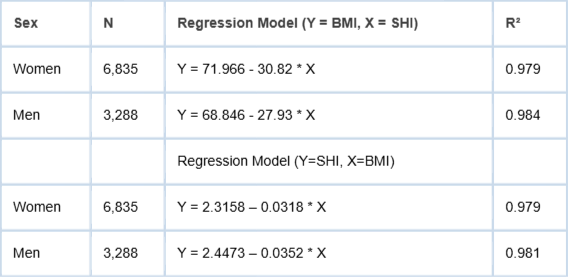
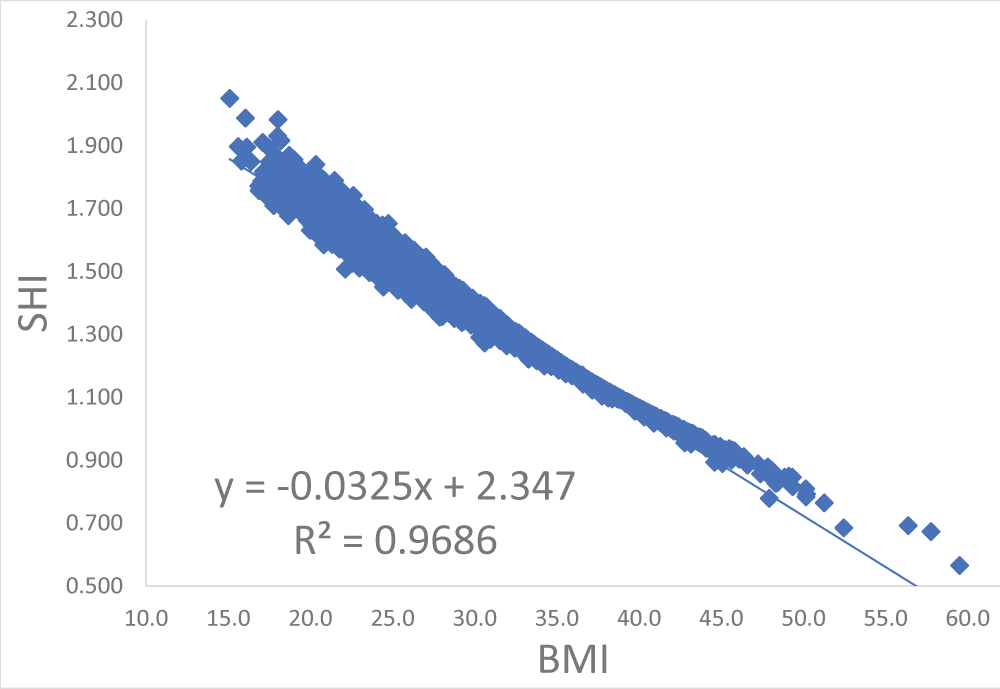
The cohort demonstrated a strong, negative linear relationship between BMI and SHI, with sex-specific regression models summarized in Table 1. High R² values (0.979–0.984) confirm the exceptional strength and robustness of this relationship. The bidirectional linear association allows precise translation between BMI and SHI. For the entire study cohort, this relationship is described by the equation: BMI = 70.871 - 29.81 * SHI, and the equation: SHI = 2.347 – 0.0325 * BMI, both with a coefficient of determination for the unified model above 0.97. These equations provide a robust translation tool between the two frameworks (Figure 1).
Table 1: Linear regression parameters for BMI and SHI, stratified by sex.
Figure 1: Scatterplot of the relationship between BMI and SHI. BMI – body mass index. SHI – standard human index. h –height (m). BSA – body surface area. The h+(h-BSA) is counted as dimensionless. R2 - coefficient of determination.
Modeling ideal biometric states
Projected BMI values were calculated for a theoretical ideal biometric state (h = BSA). For females, this yields BMI ~21.1, near the center of the healthy range. For males, a BMI of ~19.1 lies at the lower end of normal. To account for typical sex-specific differences in lean body mass, a pragmatic illustrative correction was applied: 1.1 h = BSA, yielding BMI ~24.1. It is important to note that the factor 1.1 is illustrative, not derived from this cohort, and may vary across populations (Table 2).
Table 2: Projected BMI values for the theoretical ideal SHI.
This study intentionally employed a retrospective analysis of a large, unselected real-world cohort, minimizing biases inherent in prospective studies. The high R² (~0.97–0.98), despite self-reported height and weight, validated this approach. While sex-specific differences exist, formulas derived from the entire cohort may be most useful for historical datasets. The SHI formula, h + (h – BSA), separates a deterministic component (height) from a facultative component, termed the bodyprint (BP = h – BSA), allowing the personal assessment largely lost in traditional BMI. The linear relationship between SHI and BMI suggests a fundamental hierarchy: BMI, dependent on height squared, is a derived property, while SHI, based on linear components, represents a more elemental descriptor of human form.
Over the 17-year study period, encompassing early multidetector CT scanners to modern imaging systems, the SHI–BMI relationship remained stable, suggesting this is a biological constant, not a technological artifact. Temporal biases from missing historical records likely had minimal impact on the findings. The analysis of ideal biometric states illustrates the potential of SHI for personalized benchmarking. Females’ projected BMI aligns with healthy norms; for males, the illustrative 1.1 adjustment accounts for structural differences in lean body mass. This factor is not universal and should be interpreted conceptually rather than as a population standard.
The SHI also acts as aconceptual mirror of BMI: all established relationships, rules, and interpretations from BMI are preserved within SHI, with only the direction of relationships reversed. Finally, SHI can be established in early adulthood to define an individual reference. This is in accordance with the “ideal body” conception [88Peterson CM, Thomas DM, Blackburn GL, Heymsfield SB. Universal equation for estimating ideal body weight and body weight at any BMI. Am J Clin Nutr. 2016 May;103(5):1197-203. doi: 10.3945/ajcn.115.121178. Epub 2016 Mar 30. Erratum in: Am J Clin Nutr. 2017 Mar;105(3):772. doi: 10.3945/ajcn.116.151985. PMID: 27030535; PMCID: PMC4841935.,99Karlsson T, Rask-Andersen M, Pan G, Höglund J, Wadelius C, Ek WE, Johansson Å. Contribution of genetics to visceral adiposity and its relation to cardiovascular and metabolic disease. Nat Med. 2019 Sep;25(9):1390-1395. doi: 10.1038/s41591-019-0563-7. Epub 2019 Sep 9. PMID: 31501611.]. Lifelong monitoring of deviations from this personal “bodyprint” could detect subtle, subclinical changes, such as sarcopenia or metabolic syndrome, even when BMI remains normal. This individualized insight is unavailable from BMI or BSA alone. For the future, the deterministic framework offers the scientific community a tool to unify historical data, and may have applications in genomics, e.g., re-analyzing GWAS datasets to disentangle genetic determinants of body “shape” versus “size” [99Karlsson T, Rask-Andersen M, Pan G, Höglund J, Wadelius C, Ek WE, Johansson Å. Contribution of genetics to visceral adiposity and its relation to cardiovascular and metabolic disease. Nat Med. 2019 Sep;25(9):1390-1395. doi: 10.1038/s41591-019-0563-7. Epub 2019 Sep 9. PMID: 31501611.,1010Locke AE, Kahali B, Berndt SI, Justice AE, Pers TH, Day FR, et al. Genetic studies of body mass index yield new insights for obesity biology. Nature. 2015 Feb 12;518(7538):197-206. doi: 10.1038/nature14177. PMID: 25673413; PMCID: PMC4382211.].
The Standard Human Index (SHI) provides a universal framework for the conversion and unification of anthropometric data, transforming fragmented datasets into a cohesive resource. This enables large-scale meta-analyses and supports a precise, individualized understanding of human form. SHI itself does not alter biological reality but offers an objective, deterministic tool for researchers and clinicians to apply and validate.
World Health Organization. Obesity: preventing and managing the global epidemic. Report of a WHO consultation. Geneva: World Health Organization; 2000. doi:10.1016/S0140-6736(06)69251-9.
Sweatt K, Garvey WT, Martins C. Strengths and Limitations of BMI in the Diagnosis of Obesity: What is the Path Forward? Curr Obes Rep. 2024 Sep;13(3):584-595. doi: 10.1007/s13679-024-00580-1. Epub 2024 Jul 3. Erratum in: Curr Obes Rep. 2024 Dec;13(4):831. doi: 10.1007/s13679-024-00584-x. PMID: 38958869; PMCID: PMC11306271.
Flint B, Das JM, Hall CA. Body Surface Area. 2025 Feb 6. In: StatPearls [Internet]. Treasure Island (FL): StatPearls Publishing; 2026 Jan–. PMID: 32644431.
Romero-Corral A, Montori VM, Somers VK, Korinek J, Thomas RJ, Allison TG, Mookadam F, Lopez-Jimenez F. Association of bodyweight with total mortality and with cardiovascular events in coronary artery disease: a systematic review of cohort studies. Lancet. 2006 Aug 19;368(9536):666-78. doi: 10.1016/S0140-6736(06)69251-9. PMID: 16920472.
Mosteller RD. Simplified calculation of body-surface area. N Engl J Med. 1987 Oct 22;317(17):1098. doi: 10.1056/NEJM198710223171717. PMID: 3657876.
Sosnowski M, Parma Z, Syzdół M, Brożek G, Harpula J, Tendera M, Wojakowski W. A Novel Concept of the "Standard Human" in the Assessment of Individual Total Heart Size: Lessons from Non-Contrast-Enhanced Cardiac CT Examinations. Diagnostics (Basel). 2025 Jun 13;15(12):1502. doi: 10.3390/diagnostics15121502. PMID: 40564823; PMCID: PMC12192549.
World Medical Association. Declaration of Helsinki. Amended by the 64th WMA General Assembly; 2013 Oct; Fortaleza, Brazil. Ferney-Voltaire (France): World Medical Association.
Peterson CM, Thomas DM, Blackburn GL, Heymsfield SB. Universal equation for estimating ideal body weight and body weight at any BMI. Am J Clin Nutr. 2016 May;103(5):1197-203. doi: 10.3945/ajcn.115.121178. Epub 2016 Mar 30. Erratum in: Am J Clin Nutr. 2017 Mar;105(3):772. doi: 10.3945/ajcn.116.151985. PMID: 27030535; PMCID: PMC4841935.
Karlsson T, Rask-Andersen M, Pan G, Höglund J, Wadelius C, Ek WE, Johansson Å. Contribution of genetics to visceral adiposity and its relation to cardiovascular and metabolic disease. Nat Med. 2019 Sep;25(9):1390-1395. doi: 10.1038/s41591-019-0563-7. Epub 2019 Sep 9. PMID: 31501611.
Locke AE, Kahali B, Berndt SI, Justice AE, Pers TH, Day FR, et al. Genetic studies of body mass index yield new insights for obesity biology. Nature. 2015 Feb 12;518(7538):197-206. doi: 10.1038/nature14177. PMID: 25673413; PMCID: PMC4382211.
Sosnowski M. The Standard Human Index: A Proposal for the Unification of Biometric Data. IgMin Res. March 09, 2026; 4(3): 078-080. IgMin ID: igmin335; DOI:10.61927/igmin335; Available at: igmin.link/p335
Unit of Cardiovascular Diagnostics, 3rd Chair of Cardiology, Faculty of Medicine in Katowice, Medical University of Silesia, Katowice, Poland
Address Correspondence: Maciej Sosnowski, Professor, MD, PhD, FESC, FEACVI, Unit of Cardiovascular Diagnostics, 3rd Chair of Cardiology, Faculty of Medicine in Katowice, Medical University of Silesia, Katowice, Poland, Email: [email protected]
How to cite this article: Sosnowski M. The Standard Human Index: A Proposal for the Unification of Biometric Data. IgMin Res. March 09, 2026; 4(3): 078-080. IgMin ID: igmin335; DOI:10.61927/igmin335; Available at: igmin.link/p335
Figure 1: Scatterplot of the relationship between BMI and SH...
Table 1: Linear regression parameters for BMI and SHI, stra...
Table 2: Projected BMI values for the theoretical ideal SHI...
World Health Organization. Obesity: preventing and managing the global epidemic. Report of a WHO consultation. Geneva: World Health Organization; 2000. doi:10.1016/S0140-6736(06)69251-9.
Sweatt K, Garvey WT, Martins C. Strengths and Limitations of BMI in the Diagnosis of Obesity: What is the Path Forward? Curr Obes Rep. 2024 Sep;13(3):584-595. doi: 10.1007/s13679-024-00580-1. Epub 2024 Jul 3. Erratum in: Curr Obes Rep. 2024 Dec;13(4):831. doi: 10.1007/s13679-024-00584-x. PMID: 38958869; PMCID: PMC11306271.
Flint B, Das JM, Hall CA. Body Surface Area. 2025 Feb 6. In: StatPearls [Internet]. Treasure Island (FL): StatPearls Publishing; 2026 Jan–. PMID: 32644431.
Romero-Corral A, Montori VM, Somers VK, Korinek J, Thomas RJ, Allison TG, Mookadam F, Lopez-Jimenez F. Association of bodyweight with total mortality and with cardiovascular events in coronary artery disease: a systematic review of cohort studies. Lancet. 2006 Aug 19;368(9536):666-78. doi: 10.1016/S0140-6736(06)69251-9. PMID: 16920472.
Mosteller RD. Simplified calculation of body-surface area. N Engl J Med. 1987 Oct 22;317(17):1098. doi: 10.1056/NEJM198710223171717. PMID: 3657876.
Sosnowski M, Parma Z, Syzdół M, Brożek G, Harpula J, Tendera M, Wojakowski W. A Novel Concept of the "Standard Human" in the Assessment of Individual Total Heart Size: Lessons from Non-Contrast-Enhanced Cardiac CT Examinations. Diagnostics (Basel). 2025 Jun 13;15(12):1502. doi: 10.3390/diagnostics15121502. PMID: 40564823; PMCID: PMC12192549.
World Medical Association. Declaration of Helsinki. Amended by the 64th WMA General Assembly; 2013 Oct; Fortaleza, Brazil. Ferney-Voltaire (France): World Medical Association.
Peterson CM, Thomas DM, Blackburn GL, Heymsfield SB. Universal equation for estimating ideal body weight and body weight at any BMI. Am J Clin Nutr. 2016 May;103(5):1197-203. doi: 10.3945/ajcn.115.121178. Epub 2016 Mar 30. Erratum in: Am J Clin Nutr. 2017 Mar;105(3):772. doi: 10.3945/ajcn.116.151985. PMID: 27030535; PMCID: PMC4841935.
Karlsson T, Rask-Andersen M, Pan G, Höglund J, Wadelius C, Ek WE, Johansson Å. Contribution of genetics to visceral adiposity and its relation to cardiovascular and metabolic disease. Nat Med. 2019 Sep;25(9):1390-1395. doi: 10.1038/s41591-019-0563-7. Epub 2019 Sep 9. PMID: 31501611.
Locke AE, Kahali B, Berndt SI, Justice AE, Pers TH, Day FR, et al. Genetic studies of body mass index yield new insights for obesity biology. Nature. 2015 Feb 12;518(7538):197-206. doi: 10.1038/nature14177. PMID: 25673413; PMCID: PMC4382211.






 スキャンしてリンクを取得