



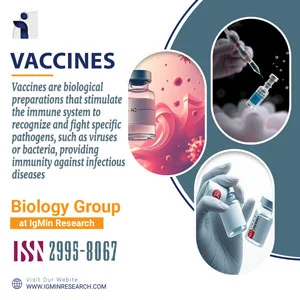
Vaccines at IgMin Research | Biology Group
We aim to foster research partnerships that contribute to a swifter expansion of global knowledge.
について
Publish Your Vaccine Research with IgMin Research
Vaccines have transformed public health, saving millions of lives every year. If you're engaged in immunology or preventive medicine, consider publishing in our peer-reviewed vaccinology journals open access to maximize your research impact.
Our platform supports global dissemination of findings and encourages submissions in all areas of vaccinology—from clinical trials and mRNA technology to vaccine safety and immunogenetics.
Why Choose Us?
- Vaccine research journal submission is streamlined with our responsive editorial system. Submit via Quick Submission
- Adhere to our Manuscript Guidelines to meet international publishing standards
- Submit vaccine research paper directly via our Main Submission Portal for fast-track peer review
Contribute to the advancement of vaccine science and reach a global audience through open-access publishing. Join our mission to support innovation in disease prevention and immunotherapy.
Why publish with us?
Global Visibility – Indexed in major databases
Fast Peer Review – Decision within 14–21 days
Open Access – Maximize readership and citation
Multidisciplinary Scope – Biology, Medicine and Engineering
Editorial Board Excellence – Global experts involved
University Library Indexing – Via OCLC
Permanent Archiving – CrossRef DOI
APC – Affordable APCs with discounts
Citation – High Citation Potential
現在トレンドになっている記事はどれですか?
研究論文
- Knowledge Discovery on Artificial Intelligence and Physical Therapy: Document Mining Analysis
- Influence of Polycarboxylate Superplasticizer on the Calorimetric and Physicomechanical Properties of Mortar
- A Comprehensive Methodology for Assessing the Business Reputation of Industrial and Production Personnel
- Biomimetic Synthesis of Calcium Carbonate in Bile in the presence of Amino Acids
- What is the Hybrid Lognormal Distribution?
- Synergistic Assessment of Supplementation of Ascorbic Acid and Massularia acuminata Extracts on Serum Electrolyte and Lipid Profile Indices of Dyslipidemia in Adult Wistar Rats Exposed to Aluminum Chloride Toxicity