

Help ?

IGMIN: あなたがここにいてくれて嬉しいです. お願いクリック '新しいクエリを作成してください' 当ウェブサイトへの初めてのご訪問で、さらに情報が必要な場合は.

すでに私たちのネットワークのメンバーで、すでに提出した質問に関する進展を追跡する必要がある場合は, クリック '私のクエリに連れて行ってください.'

Search

Organised by  IgMin Fevicon

Regional sites

Browse by Subjects

Welcome to IgMin Research – an Open Access journal uniting Biology, Medicine, and Engineering. We’re dedicated to advancing global knowledge and fostering collaboration across scientific fields.

Browse by Sections

At IgMin Research, we bridge the frontiers of Biology, Medicine, and Engineering to foster interdisciplinary innovation. Our expanded scope now embraces a wide spectrum of scientific disciplines, empowering global researchers to explore, contribute, and collaborate through open access.

Special Issues

We focus on fostering research partnerships that lead to faster, collective scientific advancements.

Members

We focus on fostering research partnerships that lead to faster, collective scientific advancements.

Articles

We focus on fostering research partnerships that lead to faster, collective scientific advancements.

Explore Content

We focus on fostering research partnerships that lead to faster, collective scientific advancements.

Identify Us

We focus on fostering research partnerships that lead to faster, collective scientific advancements.

IgMin Corporation

Welcome to IgMin, a leading platform dedicated to enhancing knowledge dissemination and professional growth across multiple fields of science, technology, and the humanities. We believe in the power of open access, collaboration, and innovation. Our goal is to provide individuals and organizations with the tools they need to succeed in the global knowledge economy.

Publications Support
[email protected]
E-Books Support
[email protected]
Webinars & Conferences Support
[email protected]
Content Writing Support
[email protected]
IT Support
[email protected]

Search

Select Language

Explore Section

Content for the explore section slider goes here.

Table of Contents

目次 at IgMin Research

We focus on fostering research partnerships that lead to faster, collective scientific advancements.

Article Explorer
Search by
Clear

All Articles
Most Recent Most Viewed Most Downloaded
5 of 253 results
Mineral Hydration as a Source of Accessible Water on Mars to Enable Human Missions at Equatorial Sites
Research Article September 14, 2026

Mineral Hydration as a Source of Accessible Water on Mars to Enable Human Missions at Equatorial Sites

ANNex: Efficient Filtered Approximate Nearest Neighbor Search via Graph-Traversal Metadata Filtering

Review Article September 30, 2026

ANNex: Efficient Filtered Approximate Nearest Neighbor Search via Graph-Traversal Metadata Filtering

The Latin American Chair
Research Article September 10, 2026

The Latin American Chair

Quadimel – A New Concept in Physics and Biology
Research Article September 03, 2026

Quadimel – A New Concept in Physics and Biology

Clinical and Comorbidity Profile of Metabolic Dysfunction-Associated Steatotic Liver Disease in Tertiary Care Setting: A Retrospective Comparative Study

Research Article September 24, 2026

Clinical and Comorbidity Profile of Metabolic Dysfunction-Associated Steatotic Liver Disease in Tertiary Care Setting: A Retrospective Comparative Study

Article Preview Metrics Cite
Published: September 14, 2026 (46d) publication certificate
Mineral Hydration as a Source of Accessible Water on Mars to Enable Human Missions at Equatorial Sites Research Article

Mineral Hydration as a Source of Accessible Water on Mars to Enable Human Missions at Equatorial Sites

Donald Rapp*

Water is a scarce commodity on Mars, yet large amounts of water are needed for crew life support, and in most human mission scenarios, even greater amounts of water are needed to produce propellants for departing Mars for the return trip to Earth. Evidence suggests that significant amounts of water occur as mineral hydration of magnesium or calcium sulfates in the accessible upper layer of Mars regolith at various scattered equatorial locations. Several sulfates occur on Mars with water content 20% to 50% of the sulfate mass. 
Several forms of hydrated sulfates are known to provide a significant share of observed water-equivalent hydrogen in the upper meter of Mars regolith. These include “Gypsum” (CaSO₄⋅2H₂O) containing 20.9% H2O by weight, and “Epsomite” (MgSO4·7H2O) (commonly known as “epsom salts”) containing 51% H2O by weight, as well as hexahydrite (MgSO4·6H2O) and starkeyite (MgSO4·4H2O). 
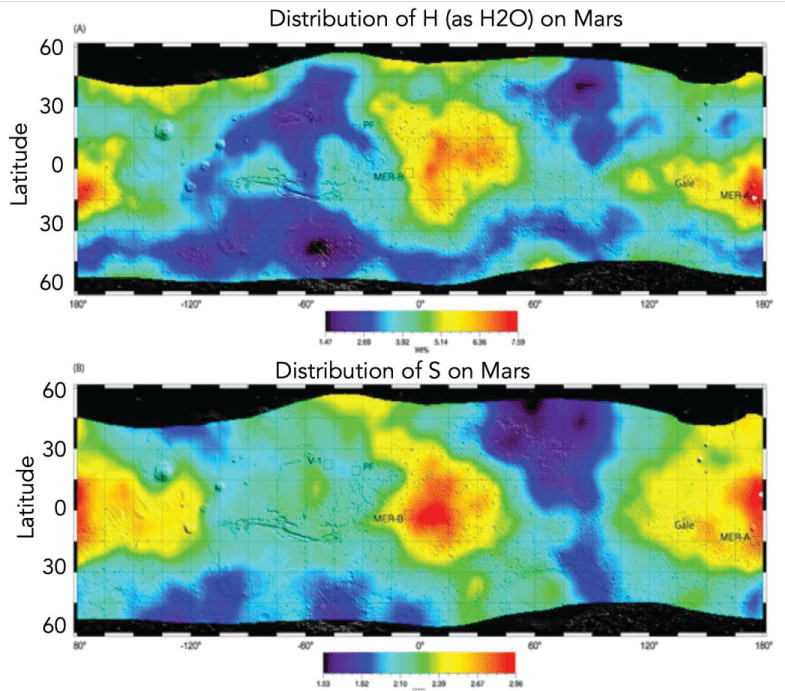
Scans using the neutron spectrometer from orbit show a remarkable correlation between the occurrence of S and H in the equatorial region, indicating that hydrated sulfates are a primary source of H2O there. Recent higher-resolution scans using the collimated neutron spectrometer show significant pockets of higher H2O content. This implies that even higher local concentrations of H2O almost surely exist within those areas, most likely as hydrated sulfates.
The power requirements to evolve H2O from a range of potential hydrated magnesium sulfates are moderate. We suggest that a human mission to Mars at equatorial latitudes based on hydrated sulfates as a source of water is a potential competitor to a mission at higher latitudes based on putative accessible ice.