Welcome to IgMin Research – an Open Access journal uniting Biology, Medicine, and Engineering. We’re dedicated to advancing global knowledge and fostering collaboration across scientific fields.
At IgMin Research, we bridge the frontiers of Biology, Medicine, and Engineering to foster interdisciplinary innovation. Our expanded scope now embraces a wide spectrum of scientific disciplines, empowering global researchers to explore, contribute, and collaborate through open access.
Welcome to IgMin, a leading platform dedicated to enhancing knowledge dissemination and professional growth across multiple fields of science, technology, and the humanities. We believe in the power of open access, collaboration, and innovation. Our goal is to provide individuals and organizations with the tools they need to succeed in the global knowledge economy.
IgMin Publications Inc., Suite 102, West Hartford, CT - 06110, USA
Since 1950, long-term and large-scale vegetation afforestation has been carried out on the Loess Plateau, China. As plants grow, the plant resources relationship changes, which leads to soil and vegetation degradation, and crops fail because of vegetation overload or waste of natural resources due to low vegetation load, which is not good for the sustainable utilization of soil water resources and agricultural high-quality in water scarcity areas. To solve these problems, the concept of soil water vegetation carrying capacity occurred. After a couple of years of research, the result showed that it is the ability of soil water resources to support vegetation, changing with vegetation type, time, and locations, expressed by the number of plant population or plant density of the indicator plant in a plant population or community. The indicator plant is a constructive species for natural vegetation and a goal or cultivated species for artificial vegetation. The soil water vegetation carrying capacity is the most important theory for sustainable utilization of soil water resources and high-quality development in water scarcity areas. Now, the research on soil water vegetation carrying capacity should be strengthened to estimate soil water vegetation carrying capacity in different vegetation types and location and regulate the plant water resources in the critical periods of plant water relationship regulation to achieve sustainable utilization of soil water resources and agriculture high-quality development and meet the people's yearning for a better life and the needs of agricultural high-quality production and increase new quality productivity. Keywords: Water scarcity areas; Soil Water resources; Soil water vegetation carrying capacity; sustainable utilization of soil water resources; agricultural high-quality development.
Since 1950, large-scale afforestation has been carried out in the Loess Plateau, especially the construction of the "Three North" shelterbelt system, which began in 1978. As plants grow in the forest, the plant resources relationship changes from an equilibrium relation between plant growth and resource use to a non-equilibrium relation, which will lead to soil degradation and crop failure because plant density is more than the Vegetation Carrying Capacity, or waste of natural resources because plant density is smaller than the Vegetation Carrying Capacity.
Soil water resources are the water stored in the soil coming from precipitation and irrigation. Vegetation is the total of the plant population and community in a region or country. The Soil Water Vegetation Carrying Capacity is the ability of Soil Water resources to support vegetation. The theory of Soil water vegetation carrying capacity is the most important theory for sustainable utilization of soil water resources and high-quality sustainable development in water scarcity areas. The concept of Soil water vegetation carrying capacity first appeared in 2000, and now, soil water vegetation carrying capacity has been developed into the theory of soil water vegetation carrying capacity, which is important for sustainable utilization of soil water resources and high-quality development in water scarcity areas. The purpose of the paper is to introduce the theory of soil water vegetation carrying capacity and promote high-quality development.
Research method
One day in 2000, when the author first talked with my colleague, he found that there were some questions about the expression of the limit of vegetation restoration, and then he proposed the term soil water vegetation carrying capacity in 2000 [1]. Because soil water vegetation carrying capacity is the most important for vegetation restoration, he have established different plant density plot of caragana in adult and young caragana shrub in the semi-arrid loess hilly region and investigate the precipitation, runoff, soil water content and plant growth [2-4], and then analyzed the relationships between plant density and soil water supply and consumption and finish the theory of soil water vegetation carrying capacity [5,6]. The detail is as follows:
The main estimation equation.
Canopy interception
Ci = P- P1-Sf
Here, Ci is the canopy interception in a period, especially in the critical periods of plant water relationship regulation in mm. P is the precipitation outside the forest in a period, especially in the critical periods of plant water relationship regulation in mm, and P1 is the precipitation inside the forest in a period, especially in the critical periods of plant water relationship regulation in mm. Sf is the Stem flow in a period, especially in the critical periods of plant water relationship regulation in mm.
The critical period for the regulation of the plant-water relationship refers to the time from when the effective soil water resources in the root zone equal the limit of the plant's utilization of soil water to the end of the failure of the regulation of the plant-water relationship. For instance, in the semi-arid loess hilly areas of China, the service of the water and soil caragana shrub is suspended at the end of September, or the fruits of the red plum and apricot ripen on July 15 [7-9].
Soil water supply (SWS)
SWS = P1-runoff-soil evaporation
Here, SWS is the soil water supply in a period, especially in the critical periods of plant water relationship regulation in mm. Ci is the canopy interception in a period, especially in the critical periods of plant water relationship regulation, in mm. P1 is the precipitation inside the forest in a period, especially in the critical periods of plant water relationship regulation in mm.
Soil water Consumption (SWC)
SWC = W2-W1+ SWS
Here, SWS is the soil water supply in a period, especially in the critical periods of plant water relationship regulation in mm.
Results
Development of vegetation carrying capacity
The research on soil water vegetation carrying capacity has gone through a long time, which can be divided into three stages: the Preparatory phase of soil water vegetation carrying capacity, the occurrence of Soil Water Vegetation Carrying Capacity, the establishment of the theory of soil water vegetation carrying capacity, and the practice of soil water vegetation carrying capacity. Expressed by the number of the plant population or the plant density of an indicator plant in a plant population or community. The indicator a plant is a constructive species for natural vegetation, and a goal or cultivated species.
Preparatory phase of soil water vegetation carrying capacity: The term carrying capacity has come from the doctrine of Thomas Robert Malthus, who considered that society could increase agricultural production only at an arithmetic rate, but the number of people to be fed increased at a geometric rate.
Therefore, to some degree, the population was likely to exceed food supplies, with calamitous results [10].
The concept of carrying capacity was first used by range managers [11] and U.S. Department of Agriculture researchers. After Verhust proposed logistic equations in 1838, Eugene Odum equated the term carrying capacity with the constant K in logistic equations, see equation 1:
(1)
The Logistic equation is obtained by integrating equation 1
(2)
Where N(t) is the density at time t, the population per unit area at time t, r is the intrinsic growth rate, r > 0, and K is an asymptote (the carrying capacity) with K > 0.
Vegetation carrying capacity
The concept of vegetation carrying capacity was first proposed by Guo in 2000 [1] to solve the serious drying of soil. Serious drying of soil eventually results in soil degradation, vegetation decline, and agricultural failure. Vegetation carrying capacity can be defined as the ability of land or natural resources to support vegetation.
Vegetation includes different plant populations or communities, and plant communities consist of different plant species within a region or a country.
Some plant communities are formed by a single plant species, called a plant population, and others are formed by many plant species that live together and form the community to use space (solar energy and temperature), soil water, or soil nutrient and so on. Soil nutrient includes soil nitrogen, soil potassium, soil phosphorus, and so on. So, Vegetation carrying capacity includes space vegetation carrying capacity, which is the carrying capacity of land or space resources for vegetation in soil water and nutrient rich regions; soil water vegetation carrying capacity (SWVCC), which is the carrying capacity of soil water resources for vegetation, and soil nutrient vegetation carrying capacity (SNVCC), which is the carrying capacity of soil nutrient resources for vegetation. SNVCC can be subdivided into soil nitrogen, potassium, phosphorus, vegetation carrying capacity, and so on.
Verhulst developed a general equation for population growth in 1838.
Odum related the carrying capacity and the asymptotic K value. Asymptotes of the logistic equation in 1953 [11]. Prof. Su put forward the optimal litter amount on the floor of an artificial forest in 1988 [12]. According to the optimal litter amount, Guo put forward the optimal cutting rate for headwater conservation forest, which showed that in the cultivation process of artificial forest, the plant growth and resources relation should be regulated according to the Vegetation Carrying Capacity [1].
The occurrence of soil water vegetation carrying capacity: With the increase in population and economic and social development, there is an increasing demand for the quantity and variety of forest ecosystem products and services, but the land ecosystem products and services produced by the original Vegetation cannot meet the need. To solve these questions and meet these demands, Most of the original vegetation all over the world has become plantation, grassland, crop and orchard, especially on the Loess Plateau, China.
Since 1950, afforestation has been carried out in the Loess Plateau, especially the construction of the "Three North" shelterbelt system, which began in 1978. As plants grow in the forest, the plant resources relationship changed from an equilibrium relation between plant growth and resource use to a non-equilibrium relation, which will lead to soil and vegetation degradation and crop failure because of overload. When plant density is more than vegetation carry capacity, it is a waste of natural resources because of low load; plant density is smaller than vegetation carry capacity [2,3,5,9,13-15].
In the 1960s, the underlying desiccated soil layer was discovered successively in semi-arid farmland, such as in the eastern Weibei Plateau of Shaanxi Province, artificial grassland in the sub-humid area of Guanzhong plain, and Ziwuling forest area in the sub-humid area of Longdong in the eastern part of Gansu, China. This phenomenon attracted the attention of many scholars [16] and so on.
In 1968, dozens of scientists, educators, economist and other scholars from around the world met in Rome and founded the Club OF Rome. The goal of its work is to focus on, explore, and study the common problems faced by mankind, so that the international community can have a deeper understanding of the plight of mankind, including social, economic, and environmental problems, and put forward new attitudes, new policies, and new systems that should be adopted to reverse the unfavorable situation. Commissioned by the Club and led by Dennis L Meadows of the Massachusetts Institute of Technology, the group rethought the long-prevailing Western theory of high growth and submitted its 1972 "Limits to Growth" study, which profoundly clarified the importance of the environment and the fundamental link between resources and population, and showing that natural resources is limit, such as soil and water resources in water-limited regions. So it is necessary to regulate the plant water relations at the right time to reduce the number of plants in plantations, grass, and crops in water-limited regions. The Soil Water Vegetation Carrying Capacity is the theoretical foundation for forest, grass, agriculture, and soil and water conservation high-quality development in water-limited regions [9,13-19].
To solve the soil degradation, vegetation decline, and crop failure or waste of nature resources and realize the sustainable utilization of soil water resources and the agricultural high quality development, Guo put forward the concept of Soil Water Vegetation Carrying Capacity in 2000 [1]. After that, Guo defined the Soil Water Vegetation Carrying Capacity [2] and put forward the estimating method of Soil Water Vegetation Carrying Capacity [3] and the initial stage to regulate plant growth and the soil water [8] and establish the theory of Soil Water Vegetation Carrying Capacity (SWVCC).
Development of soil water vegetation carrying capacity
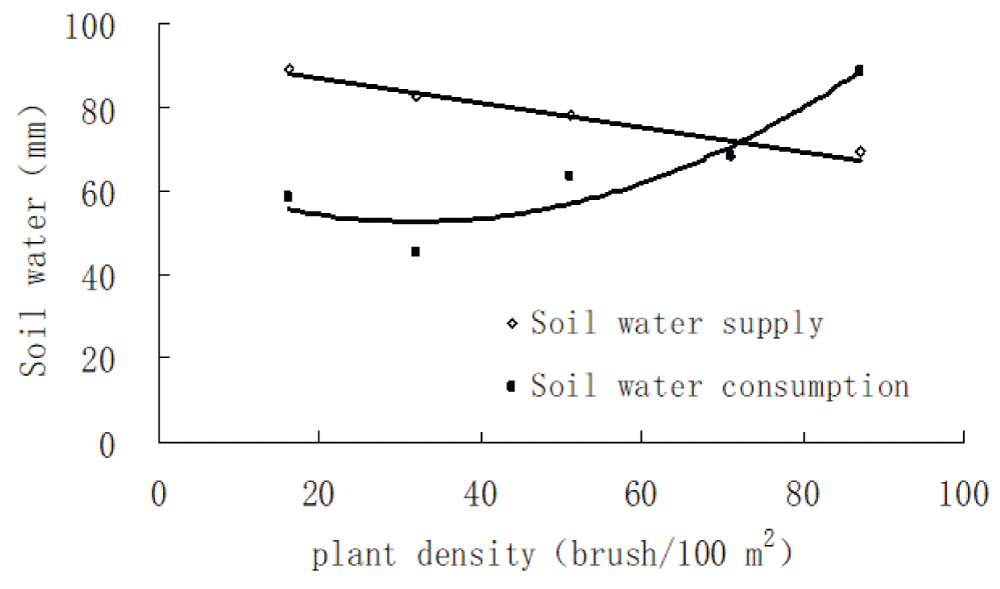
Soil Water Vegetation Carrying Capacity is the ability of soil water resources to support vegetation. Now, the Soil Water Vegetation Carrying Capacity has become the most important theory of sustainable use of soil water resources and agriculture high-quality development in water - limited regions. Vegetation includes different plant population plant communities, expressed by the number of plant populations or plant density of the indicator plant unit area in a plant population or community. The indicator plant is a construction species in a plant community for natural vegetation or cultivated plant species. Soil Water Vegetation Carrying Capacity is the most important theory. There are some estimating methods of SWVCC, but the best mode of Estimation methods of Soil Water Vegetation Carrying Capacity is the classical Carrying Capacity equation [11] and the model of plant density-soil water (Figure 1) [5,13,14,17-19].
Figure 1: The relationship between Soil water supply and consumer with plant density and the cross of them, Soil Water Vegetation Carrying Capacity.
The Soil Water Vegetation Carrying Capacity for the 16-year-old caragana shrub in the semiarid loess hilly region of China is 72 clumps per 100 m2 [5,13,14].
Use of soil water vegetation carrying capacity
If you have the data of available soil water resources, soil water supply and soil water consumer in a giving vegetation type, especially the critical period of plant water relation regulation and location, the Soil Water Vegetation Carrying Capacity in a giving vegetation type, the critical period of plant water relation regulation and location and the model of plant water relation is as followings [3,5,13,14]:
SWVCC = SWR/SWR1 (1)
Here, SWVCC is Soil Water Vegetation Carrying Capacity in a plant population or community, a period, especially the critical period of plant water relation regulation and location. SWR is the sum of soil water resources per unit area in the same period, especially the critical period of plant water relation regulation, and the same location in mm. SWR1 is the consumption per plant per day in the same period, especially the critical period of plant water relation regulation, and at the same location.
If you have the data of available soil water supply and the soil water consumption in different plants density of a vegetation type in a given time, especially the critical period of plant water relation regulation and location, the soil water -plant density model can be expressed by the following equation.
SWS = a + bx (2)
SWC = A + bx + cx2 (3)
Here, SWS is the soil water supply in mm, and SWC is the soil water consumption unit area in mm. The positive root of the set equation (2) and (3) is the Soil Water Vegetation Carrying Capacity (Figure 1). The SWVCC is the function of plant type, time and location because soil water mainly from precipitation and precipitation changes with season and years [5,12-14,20] (Figure 1). Because the plant species root distribute is deep and more than maximum infiltration depth, and some effective measure such as Mulch and ridge tillage cannot ensure corn normal growth, so we must regulate the plant water relation and get cultivated goal in semiarid loess hilly region, China. Soil Water Vegetation Carrying Capacity is the theoretical foundation of sustainable use of soil water resources and high-quality development of forest, grass, crop, and soil and water conservation in water-limited regions [13-15,17,18].
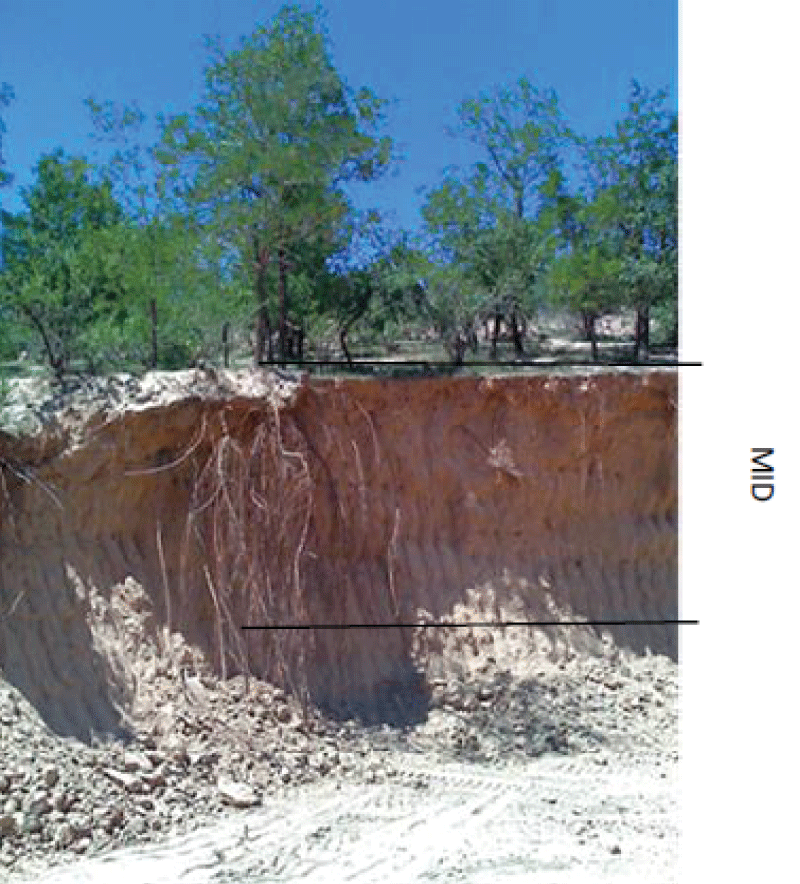
The maximum infiltration depth (MID) is 290 cm in the semiarid loess hilly regions. Mulch and ridge tillage cannot ensure corn's normal growth and obtain the maximum yield and benefit in the semiarid loess hilly region, China (Figure 2).
Figure 2: The above and the underground production relation of the Robinia (Robinia pseudoacacia L.) in a semiarid loess hilly region.
Soil water vegetation carrying capacity in the future
Since 2017, China first put forward the concept of high-quality development. As a main part of high-quality development, agricultural development has entered a high-quality development. The theoretical foundation of high-quality agricultural development is the theory of natural resources by plants, the theory of vegetation carrying capacity, and the key period of plant resources relation regulation. The theoretical foundation of high-quality agricultural development in the water-limited regions is soil water resources use limit by plants, soil water vegetation carrying capacity, and the key period of plant water relation regulation. The ending time of the key period of plant resources relationship regulation is the invalid time of plant-resources relationship regulation. When the soil water resources reach the maximum infiltration depth to soil water use, the plant water relation regulation enters a key period of plant water relation regulation. If the plant density in the key period of plant water relation regulation is more than the soil water vegetation carrying capacity, the existing plant water relation regulation must be regulated to obtain the maximum yield and benefit [13-15,17,18].
Because there is huge land area in the water-limited regions and there are a lot of vegetation types and site condition and the climate change, and different plant species have different need for site conditions in the water-limited regions, we have to establish the demonstration zone of agriculture high-quality development to estimate the soil water vegetation carrying capacity, especially the soil water vegetation carrying capacity in the critical period of plant water relationship regulation, and then take effective measures or methods to ensure plant grow well and get the cultivated goal, the maximum yield and effect to meet the people's yearning for a better life and healthy and the need of quality agricultural produce and healthy [21-23].
Acknowledgement
This project was once supported by the National Science Foundation of China (Project No: 42077079, 41271539, 41071193) and Study on high quality sustainable development of soil and water conservation (A2180021002). We thank two anonymous reviewers for their helpful suggestions.
Guo ZS. A layer-dividing approach to the soil water in forest land. In: Shao P, editor. Proceedings of Soil Physics and Ecological Environmental Construction. Shanxi: Shanxi Science and Technology Press; 2002;74–79. Available from: http://ir.igsnrr.ac.cn/handle/311030/4789
Guo Z, Shao MA. Vegetation carrying capacity of soil water and soil desiccation in artificial forestry and grassland in the semiarid regions of the Loess Plateau. Chin J Ecol. 2003;23:1640–1647. Available from: http://en.cnki.com.cn/Article_en/CJFDTOTAL-STXB200308023.htm
Guo Z, Shao MA. Mathematical model for determining the vegetation carrying capacity of soil water. J Hydrol. 2004;35(10):95–99. doi:10.3321/j.issn:0559-9350.2004.10.015
Guo ZS, Shao MA. Impact of afforestation density on soil and water conservation of the semiarid Loess Plateau. J Soil Water Conserv. 2013;68:401–410.
Guo ZS. Theory and practice of soil water carrying capacity for vegetation. Beijing: Science Press; 2014;1–104:216–241.
Guo Z. Estimating Method of Maximum Infiltration Depth and Soil Water Supply. Sci Rep. 2020 Jun 16;10(1):9726. doi: 10.1038/s41598-020-66859-0. PMID: 32546837; PMCID: PMC7297958.
Guo ZS, Li YL. Initiation stage to regulate the Caragana growth and soil water in the semiarid area of the Loess hilly region, China. Chin J Ecol. 2009;29:5721–5729.
Guo ZS, Shao MA. The process of soil moisture infiltration in artificial forests in semi-arid areas. Chin J Soil Sci. 2009;46(5):953–958.
Guo ZS. “Innovation China” agricultural high-quality production industry service group. Chin Sci Technol Achiev. 2025. doi:10.3772/j.issn.1009-5659.2025.04.003
Steiguer JED. Three theories from economics about the environment. Bioscience. 1995;45:552–557.
Price D. Carrying capacity reconsidered. Popul Environ. 1999;21:5–26. Available from: http://connection.ebscohost.com/c/articles/2319084
Su NH. Discussion on the method of determining the optimum accumulation of litter in forest land. Acta Ecol Sin. 1988;(2):147–154:155–158.
Guo ZS. Soil water carrying capacity for vegetation. Land Degrad Dev. 2021;32(14):3801–3811. doi:10.1002/ldr.3950
Guo Z. Soil hydrology process and sustainable use of soil water resources in desert regions. Water. 2021;13(17):2377. doi:10.3390/w13172377
Guo Z. Agriculture: high-quality development. Encycl Forum (Chin). 2022;(1):64–66. Available from: https://sns.wanfangdata.com.cn
Yang WZ, Shao MA. Study on soil moisture in the Loess Plateau. Beijing: Science Press; 2000;30–114.
Guo ZS. Agriculture high-quality development in semiarid loess hilly regions. J Adv Agron Crop Sci. 2023;2:1–16.
Guo ZS. New stage of agriculture development, agriculture high-quality development. J Food Technol Nutr Sci. 2024;6:197. doi:10.47363/JFTNS/2024(6)197
Guo ZS. A review of soil water carrying capacity for vegetation in water-limited regions. Sci Silvae Sin. 2011;47(5):140–144.
Guo ZS. An approach to the method of the optimal cutting rate for headwater conservation forest. In: Protection and management of mountain forests. Beijing; New York: Science Press; 1990;194–199.
Guo ZS. [Soil water resource use limit in semi-arid loess hilly area]. Ying Yong Sheng Tai Xue Bao. 2010 Dec;21(12):3029-35. Chinese. PMID: 21442986.
Guo Z. Rice carrying capacity and sustainable production of rice in resource-limited regions. Int J Agric Sci Food Technol. 2019;5(1):054–057. doi:10.17352/2455-815X.000042
Guo Z. Soil Water Vegetation Carrying Capacity and Quality Agricultural Produce. IgMin Res. January 05, 2026; 3(1): 001-005. IgMin ID: igmin326; DOI:10.61927/igmin326; Available at: igmin.link/p326
2Institute of Soil and Water Conservation, CAS & MWR, Yangling, China
Address Correspondence: Zhongsheng Guo, Northwestern A & F University, Institute of Soil and Water Conservation, CAS & MWR, Yangling, China, Email: [email protected]
How to cite this article: Guo Z. Soil Water Vegetation Carrying Capacity and Quality Agricultural Produce. IgMin Res. January 05, 2026; 3(1): 001-005. IgMin ID: igmin326; DOI:10.61927/igmin326; Available at: igmin.link/p326
Copyright: 2026 Guo Z. This is an open access article distributed under the Creative Commons Attribution License, which permits unrestricted use, distribution, and reproduction in any medium, provided the original work is properly cited.
Figure 1: The relationship between Soil water supply and con...
Figure 2: The above and the underground production relation ...
Guo ZS. A layer-dividing approach to the soil water in forest land. In: Shao P, editor. Proceedings of Soil Physics and Ecological Environmental Construction. Shanxi: Shanxi Science and Technology Press; 2002;74–79. Available from: http://ir.igsnrr.ac.cn/handle/311030/4789
Guo Z, Shao MA. Vegetation carrying capacity of soil water and soil desiccation in artificial forestry and grassland in the semiarid regions of the Loess Plateau. Chin J Ecol. 2003;23:1640–1647. Available from: http://en.cnki.com.cn/Article_en/CJFDTOTAL-STXB200308023.htm
Guo Z, Shao MA. Mathematical model for determining the vegetation carrying capacity of soil water. J Hydrol. 2004;35(10):95–99. doi:10.3321/j.issn:0559-9350.2004.10.015
Guo ZS, Shao MA. Impact of afforestation density on soil and water conservation of the semiarid Loess Plateau. J Soil Water Conserv. 2013;68:401–410.
Guo ZS. Theory and practice of soil water carrying capacity for vegetation. Beijing: Science Press; 2014;1–104:216–241.
Guo Z. Estimating Method of Maximum Infiltration Depth and Soil Water Supply. Sci Rep. 2020 Jun 16;10(1):9726. doi: 10.1038/s41598-020-66859-0. PMID: 32546837; PMCID: PMC7297958.
Guo ZS, Li YL. Initiation stage to regulate the Caragana growth and soil water in the semiarid area of the Loess hilly region, China. Chin J Ecol. 2009;29:5721–5729.
Guo ZS, Shao MA. The process of soil moisture infiltration in artificial forests in semi-arid areas. Chin J Soil Sci. 2009;46(5):953–958.
Guo ZS. “Innovation China” agricultural high-quality production industry service group. Chin Sci Technol Achiev. 2025. doi:10.3772/j.issn.1009-5659.2025.04.003
Steiguer JED. Three theories from economics about the environment. Bioscience. 1995;45:552–557.
Price D. Carrying capacity reconsidered. Popul Environ. 1999;21:5–26. Available from: http://connection.ebscohost.com/c/articles/2319084
Su NH. Discussion on the method of determining the optimum accumulation of litter in forest land. Acta Ecol Sin. 1988;(2):147–154:155–158.
Guo ZS. Soil water carrying capacity for vegetation. Land Degrad Dev. 2021;32(14):3801–3811. doi:10.1002/ldr.3950
Guo Z. Soil hydrology process and sustainable use of soil water resources in desert regions. Water. 2021;13(17):2377. doi:10.3390/w13172377
Guo Z. Agriculture: high-quality development. Encycl Forum (Chin). 2022;(1):64–66. Available from: https://sns.wanfangdata.com.cn
Yang WZ, Shao MA. Study on soil moisture in the Loess Plateau. Beijing: Science Press; 2000;30–114.
Guo ZS. Agriculture high-quality development in semiarid loess hilly regions. J Adv Agron Crop Sci. 2023;2:1–16.
Guo ZS. New stage of agriculture development, agriculture high-quality development. J Food Technol Nutr Sci. 2024;6:197. doi:10.47363/JFTNS/2024(6)197
Guo ZS. A review of soil water carrying capacity for vegetation in water-limited regions. Sci Silvae Sin. 2011;47(5):140–144.
Guo ZS. An approach to the method of the optimal cutting rate for headwater conservation forest. In: Protection and management of mountain forests. Beijing; New York: Science Press; 1990;194–199.
Guo ZS. [Soil water resource use limit in semi-arid loess hilly area]. Ying Yong Sheng Tai Xue Bao. 2010 Dec;21(12):3029-35. Chinese. PMID: 21442986.
Guo Z. Rice carrying capacity and sustainable production of rice in resource-limited regions. Int J Agric Sci Food Technol. 2019;5(1):054–057. doi:10.17352/2455-815X.000042






 スキャンしてリンクを取得