



Help ?

IGMIN: あなたがここにいてくれて嬉しいです. お願いクリック '新しいクエリを作成してください' 当ウェブサイトへの初めてのご訪問で、さらに情報が必要な場合は.

すでに私たちのネットワークのメンバーで、すでに提出した質問に関する進展を追跡する必要がある場合は, クリック '私のクエリに連れて行ってください.'

Search

Organised by  IgMin Fevicon

Regional sites

Browse by Subjects

Welcome to IgMin Research – an Open Access journal uniting Biology, Medicine, and Engineering. We’re dedicated to advancing global knowledge and fostering collaboration across scientific fields.

Browse by Sections

At IgMin Research, we bridge the frontiers of Biology, Medicine, and Engineering to foster interdisciplinary innovation. Our expanded scope now embraces a wide spectrum of scientific disciplines, empowering global researchers to explore, contribute, and collaborate through open access.

Special Issues

Our purpose is to inspire cross-field connections that drive new insights and developments.

Members

Our purpose is to inspire cross-field connections that drive new insights and developments.

Articles

Our purpose is to inspire cross-field connections that drive new insights and developments.

Explore Content

Our purpose is to inspire cross-field connections that drive new insights and developments.

Identify Us

Our purpose is to inspire cross-field connections that drive new insights and developments.

IgMin Corporation

Welcome to IgMin, a leading platform dedicated to enhancing knowledge dissemination and professional growth across multiple fields of science, technology, and the humanities. We believe in the power of open access, collaboration, and innovation. Our goal is to provide individuals and organizations with the tools they need to succeed in the global knowledge economy.

Publications Support
[email protected]
E-Books Support
[email protected]
Webinars & Conferences Support
[email protected]
Content Writing Support
[email protected]
IT Support
[email protected]

Search

Select Language

Explore Section

Content for the explore section slider goes here.

Table of Contents

目次 at IgMin Research

Our purpose is to inspire cross-field connections that drive new insights and developments.

Article Explorer
Search by
Clear

All Articles
Most Recent Most Viewed Most Downloaded
3 of 246 results
Accessible H2O on Mars – A Critical Review of Current Knowledge
Research Article November 25, 2025

Accessible H2O on Mars – A Critical Review of Current Knowledge

Effect of Additive Manufacturing Parameters on 316L Mechanical and Corrosion Behavior

Research Article November 20, 2025

Effect of Additive Manufacturing Parameters on 316L Mechanical and Corrosion Behavior

Digital Stethoscope in the Era of Artificial Intelligence: A Comprehensive Review in the Era of Evidence-based Clinical Studies

Review Article November 08, 2025

Digital Stethoscope in the Era of Artificial Intelligence: A Comprehensive Review in the Era of Evidence-based Clinical Studies

Article Preview Metrics Cite
Published: November 25, 2025 (293d) publication certificate
Accessible H2O on Mars – A Critical Review of Current Knowledge Research Article

Accessible H2O on Mars – A Critical Review of Current Knowledge

Donald Rapp*1 and Vassilis Inglezakis2

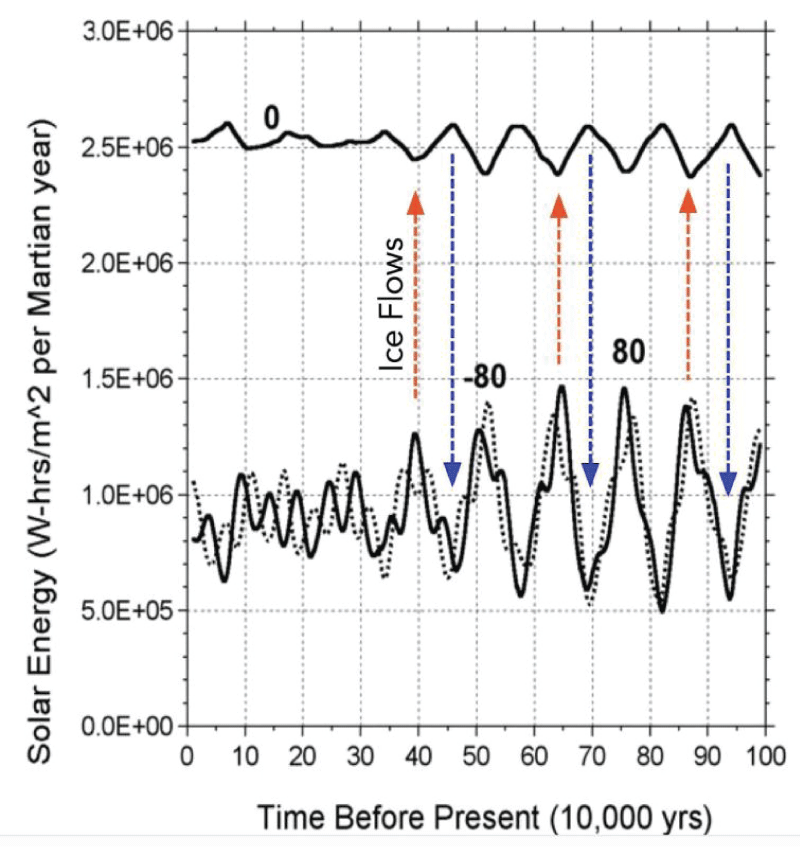
Here, we review what is known about the distribution of accessible H2O on Mars. While “Accessible” in this review implies within about 5 m of the surface, at an elevation at least 2 km lower than the MOLA Datum, and at a latitude within ±20°, possibly extendable to ±30°, we have extended our review to cover observations of  H2O at moderate depth within the latitude range ±60°. 
Twenty years ago, the neutron spectra and initial ice stability models suggested that ground ice on Mars was likely to be rare equatorward of about 50° latitude. Since then, observation after observation from orbit (using radar, photography and spectroscopy) revealed the likely presence of huge amounts of imbedded ice within the subsurface of Mars, at various depths mostly at so-called “mid-latitudes”. As a result, the pendulum has swung to the point that some enthusiastically suggest that ground ice occurs almost everywhere on Mars. We reviewed the various observations and analyses regarding H2O on Mars. Near-surface ice has been observed, spectra and radar have implied, and ground features have been interpreted to indicate that in wide areas of Mars, shallow ice apparently occurs at latitudes greater than 40° and at a few locations, persists into the 30s. The depths of such putative ice are not well known. Further study with much higher resolution might possibly reveal shallow ice at lower latitudes in unique locations. Mineral hydrates might offer a possible alternative as a supply of H2O.