Welcome to IgMin Research – an Open Access journal uniting Biology, Medicine, and Engineering. We’re dedicated to advancing global knowledge and fostering collaboration across scientific fields.
At IgMin Research, we bridge the frontiers of Biology, Medicine, and Engineering to foster interdisciplinary innovation. Our expanded scope now embraces a wide spectrum of scientific disciplines, empowering global researchers to explore, contribute, and collaborate through open access.
Welcome to IgMin, a leading platform dedicated to enhancing knowledge dissemination and professional growth across multiple fields of science, technology, and the humanities. We believe in the power of open access, collaboration, and innovation. Our goal is to provide individuals and organizations with the tools they need to succeed in the global knowledge economy.
IgMin Publications Inc., Suite 102, West Hartford, CT - 06110, USA
This paper continues the fourth instalment of a series published in ArtyHum, No. 91: “A Brief Western History of Furniture Design (Part 4): The Indo-Ibero-American Chair.” It draws on theoretical concepts developed there and connects them to the doctoral dissertation of Dr Ibar Federico Anderson, industrial designer (National University of La Plata), and to the master’s thesis of architect Gastón Eduardo Girod (University of Buenos Aires), completed at the University of Palermo. The present study revisits concepts first articulated by Anderson in ArtyHum Nos. 71 and 74, together with concepts co-authored by Anderson and Girod in previous instalments published in ArtyHum Nos. 84, 85, and 90. Taken together, these five research articles — which we refer to collectively as a Brief Western History of Furniture, and of the chair in particular — have allowed us to draw parallels between the Old Continent (Europe) and the New (America), tracing a line from the Iberian Peninsula (chiefly Spain) and its American colonies to the development of Latin American material culture. Across these publications, several theoretical concepts have been developed, several of which are resumed and deepened here, while new avenues for theoretical and methodological inquiry are opened. This article builds specifically on the previous instalment, “A Brief Western History of Furniture Design (Part 4): The Indo-Ibero-American Chair” (ArtyHum No. 91), to distil the essential character of the American chair itself. In doing so, it argues that the American chair should be read not as a derivative repetition of European stylistic categories but as the dialectical synthesis of a longer syncretic process — pre-Columbian, colonial, and Creole — and it makes explicit, for the first time in this series, the structural, gendered, and decolonial dimensions of that synthesis.
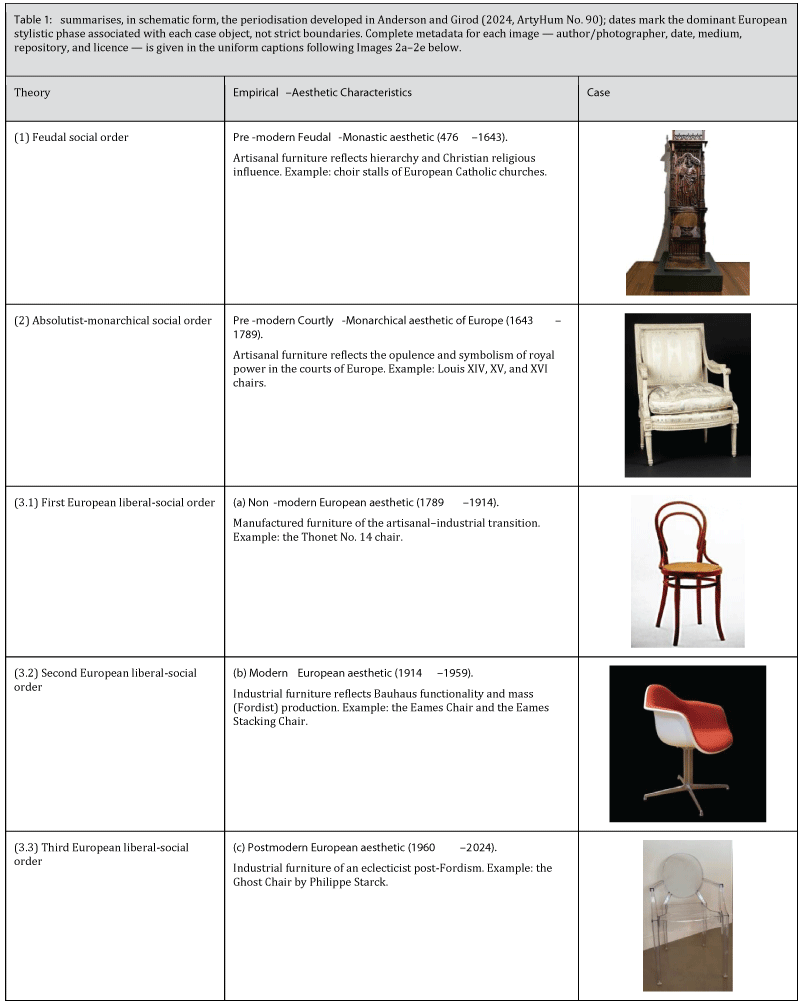
This study builds on two earlier articles published in the digital journal ArtyHum. The first is ArtyHum No. 90, titled “A Brief Western History of the Design of Furniture of Worship. The Chair (Part 3): Constructing a Theoretical Framework for the Chair as a Machine-Tool for Sitting through Pre-modernity, Modernity, and Postmodernity,” written by Anderson and Girod. From that article, we have distilled the table below, which summarises its principal findings:
Note. Table 1 summarises, in schematic form, the periodisation developed in Anderson and Girod (2024, ArtyHum No. 90); dates mark the dominant European stylistic phase associated with each case object, not strict boundaries. Complete metadata for each image — author/photographer, date, medium, repository, and licence — is given in the uniform captions following Images 2a–2e below.
Table 1: Summarises, in schematic form, the periodisation developed in Anderson and Girod (2024, ArtyHum No. 90); dates mark the dominant European stylistic phase associated with each case object, not strict boundaries. Complete metadata for each image — author/photographer, date, medium, repository, and licence — is given in the uniform captions following Images 2a–2e below.
Images 2a, 2b, 2c, 2d, and 2e. Image 2a: from the collection of the Museo Nacional de Escultura, founded in 1842 as the Provincial Museum of Fine Arts of Valladolid (Spain), this choir chair (circa 1497), originating from the New Cathedral of Plasencia, province of Cáceres, Extremadura, Spain, is carved in walnut for the upper choir stalls by Rodrigo Alemán. Photograph dated 16 January 2018, courtesy of José Luis Filpo Cabana. Image 2b: a Neoclassical beechwood chair created by the French furniture maker Georges Jacob, dated between 1780 and 1785; painted beechwood with modern upholstery. Image 2c: a chair by Michael Thonet, known as the Konsumstuhl No. 14, photographed in 1982 by Holger Ellgaard. Image 2d: the Eames Plastic Chair of 1950, photographed by Rama. The Eames Plastic Chair is broadly analogous to the 1955 Eames Stacking Chair — a claim that holds in general terms, though with a few important nuances, since the Eames Plastic Chair (1950) and the Eames Stacking Chair (1955), both designed by Charles and Ray Eames, are analogous chiefly insofar as they share the same ergonomically moulded shell in modern materials such as fibreglass and plastic. Image 2e: the transparent Louis Ghost Chair designed by Philippe Starck for the Kartell brand, photographed in 2024 by Lucie Starck (the designer’s wife). Sources: all photographs are the authors’ own (Anderson–Girod) and previously appeared in ArtyHum No. 90, p. 8. Source link: https://www.artyhum.com/revista/90/#p=8
Uniform figure metadata (added per reviewer request; standardized format — object/technique; designer or maker, date; photographer; collection or repository; licence; source):
Figure 2a.Choir chair (backstall), carved walnut. Rodrigo Alemán, c. 1497. New Cathedral of Plasencia, Cáceres, Spain; held at the Museo Nacional de Escultura, Valladolid. Photograph: José Luis Filpo Cabana, 16 January 2018. Source: Anderson–Girod archive, previously published in ArtyHum No. 90, p. 8; licence not specified by the source.
Figure 2b.Neoclassical armchair, painted beechwood. Georges Jacob, c. 1780–1785. Upholstery shown is modern (originally silk or brocade). Photograph: authors' own (Anderson–Girod), previously published in ArtyHum No. 90, p. 8.
Figure 2c.Konsumstuhl No. 14 (“Thonet chair” / “bistro chair”), steam-bent beechwood. Michael Thonet, 1859. Photograph: Holger Ellgaard, 1982. Source: Anderson–Girod archive, previously published in ArtyHum No. 90, p. 8.
Figure 2d.Eames Plastic Chair, moulded fibreglass shell on moulded plywood legs. Charles and Ray Eames, 1950. Photograph: Rama. Source: Anderson–Girod archive, previously published in ArtyHum No. 90, p. 8.
Figure 2e.Louis Ghost Chair, transparent injection-moulded polycarbonate. Philippe Starck for Kartell, 2002. Photograph: Lucie Starck, 2024. Source: Anderson–Girod archive, previously published in ArtyHum No. 90, p. 8.
The photograph in plate 2a, the Choir Chair (circa 1497) carved by the master Rodrigo Alemán, is not a simple piece of furniture but an object of worship and symbolic authority. Belonging to the upper choir stalls, it was designed for clergy during long hours of prayer and ceremony. Its robust structure, tall back, and pronounced arms reflect not only an ergonomic adaptation to ritual posture but also an institutionalised divine hierarchy: whoever sat there did so not as an individual but as a representative of God on Earth. Carved in fine walnut, its ornamentation — sober by comparison with other periods — is nonetheless steeped in religious symbolism. It is not an object of personal comfort but one of spiritual authority and communal discipline. It embodies the Feudal Social Order, in which the Church stood at the centre of power, and furniture design reflected an indissoluble fusion of the useful (sitting to pray), the beautiful (sacred craftsmanship), and the good (the virtue of religious office). It is an artefact that materialises the medieval worldview: the earthly world ordered under the divine gaze.
Plate 2b, the Neoclassical chair by Georges Jacob (1780–1785), was designed by Georges Jacob, the favoured cabinetmaker of the court of Louis XVI. This painted beechwood chair represents the climax of aristocratic refinement on the eve of the French Revolution. It belongs to the Louis XVI style, characterised by straight lines, balanced proportions, and Neoclassical motifs (garlands, columns, geometric forms inspired by Antiquity). It is a piece that rejects the exuberance of the preceding Rococo in favour of a decorous austerity — a symbol of the Enlightenment and of the “good taste” imposed by the monarchy. Although it appears simple, its craftsmanship is of the highest quality: precisely curved wood, upholstery (modern in the photograph, though originally silk or brocade), and ergonomic proportions conceived for the noble body. It was not a chair for everyone: it was an instrument of social distinction, reserved for palaces and reception halls. It reflects the Absolutist-Monarchical Social Order, in which the beauty of the object served the representation of power. Here, sitting was not a necessity but an act of protocol and the legitimation of status.
Likewise, plate 2c, the Thonet No. 14 chair (1859), designed by Michael Thonet — also known as the “Vienna chair” or “bistro chair” — is a foundational landmark of industrial design. It is not modern in the Bauhaus sense, but it was the first to apply industrial logic to furniture production: seven pieces of steam-bent wood, ten screws, and serial assembly. Its genius lay in being light, resistant, inexpensive, and easy to transport and stack. It became the chair of cafés, restaurants, and bourgeois homes throughout Europe. Thonet did not invent the machine, but he did invent the rational system of production that made it possible to manufacture more than fifty million units. It is a “non-modern” object because it still retains the warmth of craftsmanship (the manual curvature of the wood) while already operating under the logics of efficiency and standardisation. It represents the First Liberal Social Order in its ascendant phase: the bourgeoisie required furniture that was accessible, functional, and elegant. Here the chair ceases to be a symbol of power and becomes a tool of modern urban life — a precursor of functionalism without being dogmatic about it.
The image in plate 2d, the Eames Plastic Chair (1950), designed by Charles and Ray Eames, is an icon of the Modern Movement and of faith in technology and mass production. Its shell, moulded in fibreglass (later plastic) and mounted on a base of moulded plywood legs, represents the perfect synthesis of form, function, and industrial manufacture. It is not decorative: its curvature responds to human anatomy. It is not artisanal: it was conceived to be produced by the thousand, accessible to the ordinary citizen. It embodies the modern aesthetic (1914–1959): rationalist, functionalist, anti-ornamental — a product of the Bauhaus and of Fordism, of standardisation, efficiency, and the democratisation of design. Sitting in an Eames chair was not a luxury but a right of modern man, at home, at the office, or at school. It reflects the Second Liberal Social Order at the height of its industrial development: design placed at the service of a consumer society in which beauty and utility converge under the logic of assembly-line production. It is the material embodiment of the phrase “less is more.”
Plate 2e, the Louis Ghost chair by Philippe Starck (2002), designed for Kartell, is an elegant joke on the history of design. It takes the opulent, ornamented form of a Louis XV chair — a symbol of the Ancien Régime — and reproduces it in transparent acrylic, a modern, light, almost ethereal material. The result is a piece that defies every convention: it is at once classical and futuristic, solid and immaterial, decorative and minimalist. It is the quintessence of the postmodern aesthetic (1960–2024): eclecticism, irony, symbolic play, and historical rereading. It does not seek to be “useful” in the modern sense, nor “sacred” as in the Middle Ages. It seeks to provoke, to seduce, to blend in or to disappear according to context. Its transparency makes it versatile but also calls into question the very materiality of the object. In the digital age of symbolic consumption, the Ghost chair is not merely a chair: it is a cultural sign, an object of desire, a statement of style. It represents the Third Liberal Social Order in its postmodern phase, in which design no longer obeys a single logic but instead celebrates plurality, paradox, and simulation.
Second, drawing on certain images from the aforementioned article in ArtyHum No. 91, titled “A Brief Western History of Furniture Design (Part 4): The Indo-Ibero-American Chair. An Essay toward a Theoretical Framework Based on Hegelian Dialectics,” also authored by Anderson and Girod, we develop below a table analogous to the one presented above.
It should be clarified that all texts cited in the bibliography merit close, independent reading to grasp the theoretical concepts that are here merely cited or referred to by title or by brief phrase, without further elaboration; that is not the aim of the present work, which is intended to be illustrative and schematic in character.
In the article that follows this one — written by the same authors for ArtyHum No. 90 under the title “A Brief Western History of the Design of Furniture of Worship. The Chair (Part 3): Constructing a Theoretical Framework for the Chair as a Machine for Sitting through Pre-modernity, Modernity, and Postmodernity” — three (3) fundamental values were identified in the analysis of the chair, although we now recognise that there are in fact four (4). We list them here only by title, without further explanation: (1) functional use-value, (2) aesthetic use-value, (3) symbolic use-value, and (4a) capitalist use-value or (4b) capitalist exchange-value.
We briefly recall these concepts below, though we recommend returning to the full body of cited literature for a more complete understanding:
(1) Functional use-value: this is the practical, instrumental dimension of the object, referring to its capacity to satisfy a concrete, operative need within a given context. This value centres on the direct utility of the object — its fitness to be used effectively according to the physical, ergonomic, or practical demands of the user and their environment. It is not reducible to mere technical functionality but incorporates a logic of adaptation to lifestyle, mobility, durability, and everyday efficiency. Today this value is closely associated with the ergonomic, the practical, the functional, the comfortable, and the utilitarian — that is, with the sense in which an object or product genuinely serves its function. A chair serves to sit at the table to eat or to watch television in the living room (not to sleep, as a bed does); a car seat serves to allow hours of driving on the road or highway.
(2) Aesthetic use-value: this is the perceptual and sensory dimension of the object, associated with the experience of pleasure or enjoyment it generates in the user through its formal, material, chromatic, textural, and other compositional qualities (morphological and visually aesthetic features such as colour). It is not a matter of applied decoration but of the harmonious integration of form, material, and simplicity that produces an experience of beauty inherent to the object itself. This concept owes much to Art Theory and to Architecture, and is closely connected to what the user or consumer finds pleasing or desirable — something akin to the clothing each person chooses to wear.
(3) Symbolic use-value: this is the cultural, identitarian, and significative dimension of the object, through which it conveys meanings, belongings, collective memories, or social values. This value transcends both function and aesthetics by linking the object to systems of belief, group identities, traditions, or historical narratives. It acts as a vehicle of cultural meaning for a given people or society, reflecting or reinforcing social structures, ways of life, or worldviews, and thereby transforming the object into a carrier of profound cultural meaning. This value is deeply embedded in the conscious and unconscious psyche of human beings, of a given society or culture — a people situated in a particular geography — and in its socio-cultural, economic, and political patterns, its ideologies of every kind, its collective thought, and its modes of government, well beyond the merely aesthetic or artistic; it even extends into the religious, theological, and philosophical domains, where it runs very deep indeed.
(4a) Capitalist use-value / (4b) Capitalist exchange-value: this value refers to the economic dimension of the object as a commodity inserted into market relations. It does not derive directly from the object’s utility or beauty but from its capacity to be exchanged (bartered), sold, or appropriated within a pre-capitalist or capitalist economic system. The object ceases to be merely a means of use and becomes a good with a price, its valuation mediated by the dynamics of serial production, competition, branding, image, or social status (chiefly within capitalist societies). Within this framework, design may become subordinated to the logic of exchange-value, whereby functionality, aesthetics, or symbolism are instrumentalised to increase market competitiveness, privileging profitability over other intrinsic values. In communist societies, this dynamic would require separate, detailed analysis.
These four values are not necessarily mutually exclusive; rather, they may coexist, interweave, or fragment according to the historical, social, and productive context in which the object is designed, produced, and used. In general, they tend to overlap, with one value predominating over the others.
What follows is drawn from the earlier publications listed in the bibliography. The European Social Orders and their corresponding use-values (functional, aesthetic, symbolic, and capitalist exchange) are set out below.
European social orders and their use-values
(1) Feudal social order (476–1643)
Functional use-value: Objects integrated practical functionality with ritual and everyday needs. Utility was not separated from the sacred: furniture and objects served practical purposes in daily life but also within ceremonial contexts. Artisanal and vernacular methods of production ensured that beauty and utility complemented one another.
Aesthetic use-value: The feudal-monastic aesthetic did not pursue beauty for its own sake; rather, it understood the aesthetic as a dimension inherent to the cosmic and religious order. Beauty was intrinsically bound to utility from a ritualistic perspective, in which forms and designs communicated identity, hierarchy, and connection with the divine. Aesthetic sign-value was intrinsically linked to use-value, such that the aesthetic was never separated from functionality.
Symbolic use-value: Objects carried sacred and symbolic messages, fusing the beautiful and the functional within a worldview in which the good — rooted in beauty as divinity — represented the Christian God’s response to the petitions of Christian rulers. Furniture reflected the hierarchy and power of the Catholic Church, its elaborate objects representing an aristocratic way of life.
The Greek notion of kalokagathia — joining kalos (beautiful) and agathos (good) — expresses the harmony between beauty and virtue, holding that the beautiful must also be the good and the useful; objects thus carried sacred and symbolic messages, fusing the beautiful and the functional within a Christian worldview.
Capitalist exchange-value: Within this pre-modern framework, capitalist exchange-value in the strict sense did not exist — that is, the modern mercantile logic whereby objects are produced specifically to be exchanged on the market for profit and surplus value. Although forms of exchange such as barter and limited markets did exist, they did not constitute a dominant economic system based on commodity production for capital. Circulation was organised through networks of seigneurial reciprocity, state-ecclesiastical redistribution, and ritualised barter, in which objects circulated not as commodities stripped of meaning — mere abstract quantities of capitalist exchange-value — but as goods fully integrated into social structures, religious worldviews (predominantly Christian, in the European case), and relations of power with systems of government.
An object’s worth was measured not by its capacity to generate market profit but by its capacity to reinforce social hierarchy, to fulfil ritual functions, and to express collective identity within the medieval Christian worldview.
The system of government under the feudal social order in Europe (476–1643) was decentralised, based on personal bonds of vassalage and fiefdom. Political structure was organised around a rigid social hierarchy of kings, nobles, clergy, and peasants, with the king at the apex — though his authority was in practice limited, since real power was fragmented among feudal lords who governed their lands autonomously and exercised economic, political, and military control over their subjects. The Catholic Church played a central role in social and political life, closely bound up with the feudal order.
The structure of the Catholic Church was closely tied to the feudal order, in which the ecclesiastical hierarchy (bishops, clergy, monks) occupied a central place in social and political life. A close relationship bound together the productive system (the fief), the estate or order of the Catholic Church (the clergy), and the prevailing stylistic-aesthetic idiom (the Gothic) — evidence of how architecture and furniture design, such as choir chairs, reflected this unity of economic power, religion, and cultural expression.
Power was distributed through relations of vassalage between lords and vassals, in which nobles received land (fiefs) in exchange for loyalty and military service to the king, consolidating a system of reciprocal obligations that sustained the social structure. During the feudal period, ecclesiastical institutions such as cathedrals and monasteries fulfilled not only a religious function but also a social and political one, fully integrating the spiritual and the temporal. This feudal system began to decline in Europe during the fourteenth and fifteenth centuries.
Gender is embedded in this order even where it is not named: choir chairs such as that in Plate 2a served an exclusively male clerical body, and the guild workshops that produced carved furniture formally excluded women artisans, confining female participation to unwaged domestic textile and finishing work (Buckley, 1986).
(2) Absolutist-monarchical social order (1643–1789)
This social order represented a decisive transition from feudalism toward centralised forms of state power, in which the king concentrated political, religious, and symbolic authority — as exemplified by Louis XIV’s celebrated declaration, “I am the State.” This order displaced the Church as the centre of authority; the State, embodied in the figure of the monarch, became the origin of power, projected from palaces such as Versailles as a stable, immutable, and hierarchical order.
Functional use-value: Furniture adapted artisanal techniques to the needs of the court, retaining a degree of practical usability that was nonetheless subordinated to the representation of power. Objects such as the chairs of Louis XIV, XV, and XVI served not only for sitting but were designed to accommodate the elaborate, voluminous ceremonial garments of the period and to ensure the monarch’s visibility during protocolary acts. Their design combined comfort with rigidity, reflecting courtly discipline and the control of the body as an expression of status.
Aesthetic use-value: Objects manifested a courtly-monarchical aesthetic that evolved from the French Baroque (Louis XIV, 1643–1715), characterized by monumentality, sumptuousness, and the symbolism of power, toward the Rococo (Louis XV, 1723–1774), with its lighter, curving forms and decorative elegance, and finally toward the French Neoclassical (Louis XVI, 1774–1793), which recovered sobriety, geometry, and Greco-Roman motifs as expressions of order and rationality. This highly ornamented and symbolic aesthetic served as an instrument for displaying royal power, social hierarchy, and divine legitimacy, in which every detail — carving, gilding, upholstery — reinforced the grandeur of the monarch.
Symbolic use-value: Furniture carried profound symbolic value, functioning as visual emblems of absolute power. Chairs such as the throne, the fauteuil, or the bergère were not simple seats but artefacts of authority that marked social and hierarchical distinctions. The throne, in particular, embodied the monarch’s divine legitimacy and his role as intermediary between heaven and earth. Every piece of court furniture was inscribed within a ritual of representation in which the object did more than merely serve — it declared who the king was, who his subjects were, and how each was expected to behave.
Capitalist exchange-value: This order did not witness a fully developed capitalist exchange-value but rather a pre-capitalist mercantilist economy, regulated by the State and based on monopolies, trading fleets, state control of foreign commerce, and the hierarchical redistribution of wealth. Luxury objects — such as the cabinetry of Georges Jacob — did not circulate as commodities in free markets but as prestige goods produced by artisanal workshops under royal or aristocratic commission. Their value was determined not by supply and demand but by rarity, materials, symbolism, and association with power. Although an incipient market did exist, it remained subordinate to political control and did not respond to an autonomous logic of capitalist accumulation.
This period marked the triumph of state centralisation and the replacement of the Church by the State as the nucleus of the social order. Artistic forms, and furniture design in particular, reflected this new political stability and the immutability of royal power, projected from Versailles as a model of universal order. Unlike feudalism, in which power was fragmented among lords and the Church, absolutism concentrated power in a single figure, whose authority was expressed through a unitary, controlled, and symbolically potent royal aesthetic.
Court furniture likewise encoded gender hierarchy through differentiated typologies: the throne-like fauteuil was associated with the king's public authority, while the lighter bergère was associated with women's private reception rooms — a typological division between masculine-public and feminine-domestic seating that would persist well beyond the Ancien Régime (Buckley, 1986).
(3.1) First European liberal-social order (1789–1914)
Functional use-value: Functionality adapted to the needs of the emerging bourgeoisie and to the conditions of incipient industrialisation, prioritising practical rationality, urban comfort, and social mobility. Designs such as the Thonet No. 14 chair (1859) reflected a rationalised — though not rationalist — functionality, based on the steam-bending of wood, which allowed for more efficient production, lightness, resistance, and ease of transport. This model resolved concrete needs of the bourgeois urban environment — cafés, offices, and middle-class homes — which required furniture that was durable, inexpensive, and easy to maintain. Movements such as Arts and Crafts, led by figures like William Morris, reacted against the dehumanisation of industrial production, seeking to preserve artisanal quality and the ethical value of manual labour against the advance of mechanisation.
Aesthetic use-value: The non-modern bourgeois aesthetic combined artisanal elements with proto-rationalist principles, retaining a connection between the useful and the beautiful, even as that connection was already beginning to fragment. Unlike the absolutist period, in which ornament symbolised royal power, in this order aesthetics became progressively subordinated to functionality, favouring simple geometry, proportion, and economy of form. Nevertheless, many Thonet designs and those of other manufacturers of the period retained decorative details — carvings, ornamental curves — demonstrating that this was not a strictly functionalist aesthetic but a transitional one between the artisanal and the industrial, in which beauty had not yet been fully separated from utility.
Symbolic use-value: Bourgeois furniture acquired a profound symbolic value, representing social ascent, economic success, and the identity of a new dominant class. Objects such as the Thonet No. 14 chair ceased to be mere utensils and became symbols of modernity, progress, and bourgeois rationality. Its presence in cafés, homes, and public spaces communicated membership in an urban culture that was ordered, productive, and civilised, in contrast to a decadent aristocracy and a traditional peasantry. Furniture thus did more than furnish space: it affirmed a new social hierarchy grounded in labour, capital, and property.
Capitalist exchange-value: This period marked the onset of the hegemony of capitalist exchange-value in furniture design. Serial production, the use of machinery, and an incipient Taylorist-Fordist organisation of labour made it possible to manufacture standardised objects and distribute them across national and international markets. The Thonet No. 14 chair, produced in more than fifty million units, became a mass-consumption product accessible to the middle class, its market value progressively outstripping its traditional use-value. Although artisanal workshops still coexisted alongside industrial production, the artefact was no longer merely an object but a commodity whose value was determined by its capacity for exchange rather than by its symbolism or craftsmanship. This phenomenon reflects the transition toward an industrial capitalism in which design becomes subordinated to the logic of the market, standardised utility, and capital accumulation.
The bourgeois interior reproduced this division in a new register: the Thonet chair furnished the masculine public sphere of the café, while parallel domestic seating, often produced through home-based or informally waged women's labour, remained largely untheorized in contemporaneous design discourse (Buckley, 1986).
(3.2) Second European liberal-social order (1928–1959)
Functional use-value: Furniture fully adopted the principles of the European Modern Movement, whose modern bourgeois aesthetic was geometric, rationalist, functionalist, universalist, anti-historical, technologically scientistic, messianic, and democratic. Functionality became the guiding principle of design, prioritising efficiency, ergonomics, and technical rationality above any ornament or regional reference. Movements such as the Bauhaus, De Stijl, and Russian functionalism promoted the idea that the object should be, in Le Corbusier’s phrase, “a machine for sitting,” in which every element responded to a logic of use, production, and accessibility for the middle class. This rationalised approach sought to abolish the decorative past and to create a new, urban, industrial way of life.
Aesthetic use-value: The modern aesthetic was defined by a radical simplification of form, inspired by Cartesian, Newtonian, and Platonic principles — conceived as a historical phase that was normative, instrumental, vindicative, puritanical, universalist, ahistorical, scientistic, messianic, stoic, ascetic, secular, Newtonian, Cartesian, Socratic, Platonic, classicalstoic, ascetic, secular, Socratic, classical. In Europe, this aesthetic eliminated all superfluous ornament, rejecting Art Deco and the Louis XVI style as symbols of an elitist, bygone culture. Aesthetic use-value became a purely subjective, decorative element — viewed as an addition to the object rather than as essential to its functionality. Beauty no longer resided in ornament but in the purity of form, geometric proportion, and the honesty of materials.
Symbolic use-value: Symbolic value fragmented and was transformed: it ceased to be tied to local identities, traditions, or social hierarchies and instead became a symbol of progress, rationality, and belonging to an industrialised society. Furniture no longer represented the power of a monarch or the identity of a community but rather the ideal of a modern, orderly, efficient life. This symbolism was abstract and universal, projecting a social utopia in which design would democratize access to quality of life. Nevertheless, this symbolic value also became associated with social status and capitalist consumption, particularly once modern objects became icons of the urban middle class.
Capitalist exchange-value: Exchange-value became central to modernity, as objects were produced serially through Taylorist-Fordist methods and transformed into commodities within industrial capitalism; this centrality intensified as products came to be manufactured in series, on a mass scale of millions of units. Furniture became a standardised, Fordist, industrial product of high added value — represented by the pencil and the hand of the designer, who in some sense inscribed it with a signature. Mass production enabled global distribution, and design became subordinated to the logic of the market, standardised utility, and capital accumulation. Although the Modern Movement proclaimed a democratic ideal, in practice its industrialisation reinforced a new form of exchange-sign-value tied to the prestige of modern design — owning a piece designed by a well-known architect or industrial designer raised its added value and its market price.
Bauhaus functionalism proclaimed a universal user, but that user was tacitly male, adult, and able-bodied; women associated with Bauhaus workshops were in practice steered toward textiles and away from furniture and product design, a hierarchy that modernism's anti-ornamental rhetoric helped naturalise (Buckley, 1986).
(3.3) Third European liberal-social order (1960–2024)
Functional use-value: Postmodern objects do not reject functionality but displace it as the guiding principle of design, opening space for multiple functions and meanings. Postmodern design breaks with the strict functionalism of the Modern Movement, reintroducing complexity, ornamentation, irony, and historical reference as constitutive elements of the object. A single piece of furniture may serve practical, symbolic, or even artistic functions depending on context, as with the Louis Ghost chair by Philippe Starck (2002), which, although it permits sitting, privileges its aesthetic and symbolic dimension over ergonomics. Functionality ceases to be an absolute imperative and becomes instead one possibility among others, subordinated to cultural expression, ironic play, or critique of modern design.
Aesthetic use-value: Aesthetic value is reinterpreted within a framework in which the beautiful is no longer subordinated to the useful but is instead interwoven with the symbolic, the historical, and the playful, without requiring the clear unification sought in pre-modernity. The postmodern aesthetic is characterised by eclecticism, the mixing of styles, irony, and a rejection of the grand modernist narratives — the ideas of progress, universal rationality, or pure functionalism. Here, everything partakes of an ephemeral, eclectic display of materials, forms, and colours as a source of postmodern aesthetic pleasure. Designs such as the Louis Ghost chair combine innovative materials (transparent polypropylene) with forms that question the conventions of modern design, ironically reinterpreting the Louis XVI style — not to imitate it, but to decontextualise and transform it into an object of cultural critique.
Symbolic use-value: Symbolic value expands considerably, encompassing a multiplicity of cultural, social, and political meanings. Objects no longer represent fixed identities but instead become carriers of multiple, ambiguous, even contradictory messages. They are symbols of identity, status, or belonging, but also of irony, critique, or nostalgia. In postmodernity, one observes a Lyotardian, playful engagement with modern rationality, in which the object becomes a means of questioning established norms. The Louis Ghost chair, for example, symbolises not only modernity or avant-garde, contemporary design but also a reflection on materiality, visibility, and the history of design, functioning as an art object that communicates ideas about the ephemeral, the visible, and the invisible.
Capitalist exchange-value: Although capitalist exchange-value remains central to the postmodern economy, its relationship with the other values becomes more complex and ambiguous. Objects circulate not only as commodities but also as sign-values of an artistic, philosophical, communicative, critical, and cultural exchange, in which prestige, perceived authenticity, uniqueness, or environmental consciousness become new attributes of market value — attributes that, once again, drive up price. A theoretical-projectual critique of the capitalist system is thus articulated from within, without stepping outside it (that is, without becoming communist). Postmodern production combines industrial, semi-industrial, and even artisanal methods, generating a Baudrillardian simulation in which the authentic and the reproduced become confused. Exchange-value, then, no longer depends solely on mass production but also on symbolism, perceived rarity, and the cultural capital the object conveys — even as a singular, one-of-a-kind piece.
Postmodern eclecticism opened space for more plural authorship, yet the canon of celebrated postmodern furniture designers — Starck among them — remained overwhelmingly male, so that a stylistic critique of modernist universalism did not, by itself, amount to a critique of its gender politics.
Development
In the ArtyHum No. 90 article, we discussed the theoretical and analytical categories of the table above with reference to Europe. But how can these theoretical-analytical categories be transposed from Europe to America?
3.1. Theoretical justification: Hegelian dialectics and decolonial theory in the transposition from Europe to America
This transposition is not a claim that European categories apply unmodified to America; it is, rather, the deliberate object of a dialectical method. Following Hegel's account of contradiction as the root of all movement and self-development (Hegel, 1977) and of historical development as unfolding through three moments — the positing of a determination in its immediacy (thesis), its negation as something other (antithesis), and the sublation (Aufhebung) of both into a higher, more concrete unity (synthesis) (Hegel, 2010) — Anderson and Girod (2025) had already proposed, for the specific case of the Argentine Creole chair, a first application of this schema: the mythic-cosmogonic aesthetic of pre-Columbian societies functions as thesis; the Spanish absolutist-monarchical aesthetic imposed after 1492 functions as antithesis; and the silla matera of the gaucho, which negates and preserves elements of both at once, functions as synthesis. The present article generalises and extends that triad across the remaining American periods, rather than invoking it only in the title of a prior instalment, as the reviewers rightly observed was necessary for coherence and rigour.
This dialectical reading, however, does not by itself justify why a periodisation built for Europe should be assumed valid for America; that further step requires an explicit decolonial premise. Following Quijano's (2000) concept of the “coloniality of power,” the imposition of European categories of time, hierarchy, and social order onto America after 1492 was not incidental to colonisation but constitutive of it: the same imperial process that transplanted absolutist courtly furniture to the Viceroyalty of the Río de la Plata also transplanted the historical periodisation in which that furniture makes sense. Reading American material culture through European stages is therefore historically defensible for the colonial and early-liberal periods specifically because those stages were coercively imposed — not because they describe an autonomous American development. Where the European stages cease to describe an imposition and instead describe a local, syncretic outcome — as with the silla matera — the dialectical model requires a synthesis rather than a repetition, and it is precisely at that hinge that García Canclini's (1990) notion of cultural hybridity becomes indispensable: the American chair is hybrid, not colonial-derivative, and hybridity is the Hegelian synthesis translated into material culture.
Applied consistently, the schema recurs a second time within the American liberal-social order itself: the syncretic silla matera of 1789–1914 (synthesis I) is met, from 1928, by the antithesis of an imported, homogenizing industrial-Fordist rationalism — Bauhaus-derived and largely produced for urban elites — that displaces vernacular practice; the resulting tension is resolved, from 1960 onward, in a second-order synthesis: the postmodern and contemporary reinterpretation of the matera chair by designers such as Andrés Reisinger and Mariano Forte, which is neither a return to gaucho artisanry nor a passive reception of European postmodernism, but a further sublation of both. This second triad is labelled explicitly, period by period, in section 4 below.
Rather than restating what each category means for the European case — for which we refer readers to that earlier article — we develop below their corresponding American counterparts.
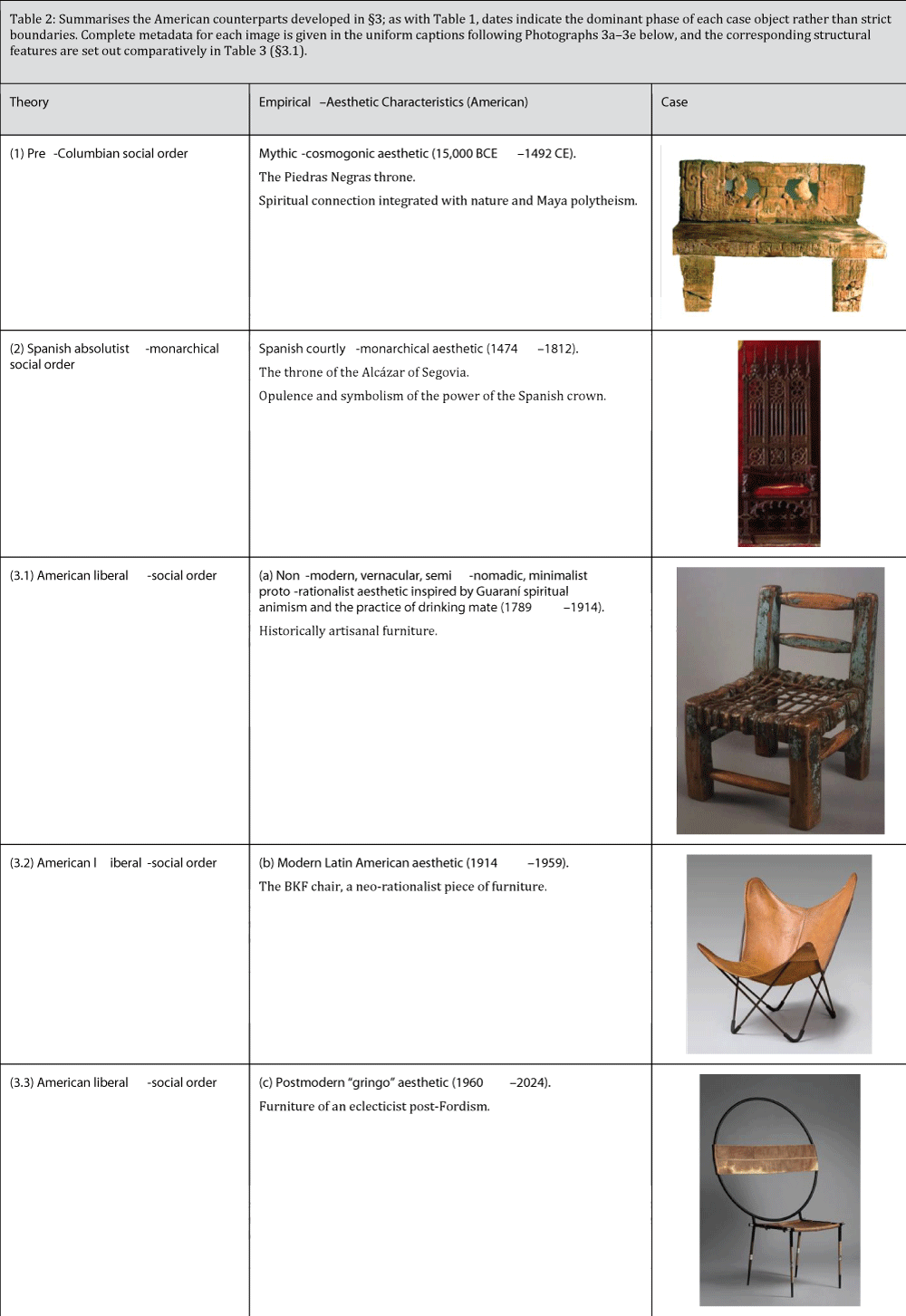
If, in Europe, we can define a (1) Feudal social order, whose European empirical-aesthetic characteristics constitute a pre-modern feudal-monastic aesthetic (476–1643), with artisanal furniture reflecting Christian religious hierarchy and influence (example: the choir chairs of European Catholic churches), then for Central America we may define a (1) Pre-Columbian social order, whose empirical-aesthetic characteristics constitute a Central American mythic-cosmogonic aesthetic (15,000 BCE–1492 CE) with a spiritual connection integrated with nature and Maya polytheism (example: the Piedras Negras throne, held at the National Museum of Archaeology and Ethnology of Guatemala).
If, in Europe, we can define a (2) Absolutist-monarchical social order, whose European empirical-aesthetic characteristics constitute a pre-modern, chiefly French, courtly-monarchical aesthetic (1643–1789), with artisanal furniture reflecting the opulence and symbolism of royal power in the courts of Europe (example: the chairs of Louis XIV, XV, and XVI), then for South America we may define a (2) Spanish absolutist-monarchical social order, whose empirical-aesthetic characteristics constitute a Spanish courtly-monarchical aesthetic transplanted onto American soil (1474–1812), marked by the opulence and symbolism of Spanish royal power (example: the throne of the Alcázar of Segovia), which would be transferred to Ibero-American colonial furniture. These ideas were imported chiefly from Spain to the local furniture of the Viceroyalty of the Río de la Plata — a political-administrative entity created by Spain in 1776, encompassing territories that today correspond to several countries, including Argentina, Uruguay, Paraguay, Bolivia, and parts of Brazil.
If, in Europe, we can define a (3.1) First European liberal-social order, whose empirical-aesthetic characteristics constitute a non-modern European aesthetic (1789–1914), with manufactured furniture of artisanal–industrial transition (example: the Thonet No. 14 chair), then for South America we may define a (3.1) American liberal-social order, whose empirical-aesthetic characteristics constitute a non-modern aesthetic that is historically artisanal (though semi-industrial in some contemporary cases), vernacular — informal and non-academic — semi-nomadic, and proto-rationalist-minimalist, inspired by Guaraní spiritual animism and the practice of drinking mate (1789–1914), exemplified by vernacular Creole DIY (“Do It Yourself”) furniture made with whatever materials and tools were available, as occurred with the silla matera — the chair designed for drinking the infusion known as yerba mate, typical of Argentina, Uruguay, Paraguay, and Brazil.
The cultural syncretism found in the vernacular, semi-nomadic, proto-rationalist artisanal chairs of local craftspeople — including the gauchos inspired by Guaraní spiritual animism — in Argentina resulted from a synthesis of Indigenous functionality (chiefly Guaraní, which bears no relation to Mesoamerican Indigenous cultures), European colonial techniques, and Creole identity: a reflection of adaptation to the environment and of the symbolic connection with rural life and the agro-export capitalist economy tied to the major world powers of the period. This subject was developed by the authors in the ArtyHum No. 85 article, titled “The Argentine Country-Style Chair (Part 2): When Art Theory Becomes a Theoretical Paradigm for Explaining the Typology of Proto-Rationalist Country-Style (or Gaucho-Style) Artisanal Chair Design in the Argentine Republic.” That study examines how the typology of gaucho chair design is linked to the Spanish and Portuguese colonies in Latin America, highlighting the influence of the colonial heritage on Creole design. It analyses several paintings and caricatures by the artist Florencio Molina Campos, which exemplify, through their iconography, this type of gaucho or matera chair, showing how their vernacular, minimalist, and proto-rationalist designs anticipate certain concepts of the European Modern Movement, such as those of the Bauhaus.
If, in Europe, we can define a (3.2) Second European liberal-social order, whose European empirical-aesthetic characteristics constitute a modern European aesthetic (1914–1959), with industrial furniture reflecting the principles of the Modern Movement — geometric, rationalist, functionalist, universalist, anti-regionalist, anti-historical, technologically scientistic, messianic, and democratic (example: the office chair for the Larkin Company headquarters, 1904, designed by Frank Lloyd Wright) — clearly reflecting the Bauhaus functionality of industrial furniture design and its relationship to the Modern Movement in architecture and to Taylorist-Fordist mass production, then for South America we may define a (3.2) American liberal-social order, whose empirical-aesthetic characteristics constitute a modern American aesthetic (1928–1959), combining the principles of the European Modern Movement with local vernacular traditions and manifested in industrial furniture that retains regional symbolic elements (example: the BKF chair, whose rationalism was adapted to local materials).
If, in Europe, we can define a (3.3) Third European liberal-social order, whose European empirical-aesthetic characteristics constitute a postmodern European aesthetic (1960–2024), with contemporary furniture that breaks with strict functionalism, characterized by eclecticism, the mixing of historical styles, irony, and a rejection of the grand modernist narratives (example: the postmodern Ghost chairs by designers such as Philippe Starck), then for South America we may define a (3.3) American liberal-social order, whose empirical-aesthetic characteristics constitute a postmodern “gringo” American aesthetic (1960–2024), marked by a critical reinterpretation of vernacular and modern design, manifested in furniture that fuses industrial design with artisanal elements, local materials, and regional symbolic references, cultural syncretism, and environmental consciousness (example: contemporary reinterpretations of the matera chair in current Argentine design, such as those produced by designers like Andrés Reisinger or Mariano Forte, who combine the proto-rationalist gaucho structure with innovative materials and a postmodern approach that engages with cultural heritage without lapsing into traditional or conventional folklore).
Note. Table 2 summarises the American counterparts developed in §3; as with Table 1, dates indicate the dominant phase of each case object rather than strict boundaries. Complete metadata for each image is given in the uniform captions following Photographs 3a–3e below, and the corresponding structural features are set out comparatively in Table 3 (§3.1).
Table 2: Summarises the American counterparts developed in §3; as with Table 1, dates indicate the dominant phase of each case object rather than strict boundaries. Complete metadata for each image is given in the uniform captions following Photographs 3a–3e below, and the corresponding structural features are set out comparatively in Table 3 (§3.1).
Photographs 3a, 3b, 3c, 3d, and 3e. Photograph 3c: a low chair (for drinking yerba mate infusion in Argentina), Carballo Collection, in Paz, Libro Monte (2011, p. 148). Photograph 3d: the B.K.F. chair (initials of the surnames of its designers: Antonio Bonet, Juan Kurchan, and Jorge Ferrari Hardoy), commonly known as the butterfly chair or Hardoy chair, designed between 1938 and 1940, with a steel frame and a single-piece leather seat, marketed by Knoll. Photograph 3e: the Aro chair, designed by Cristian Mohaded, photographed by Fabián Morassut. Sources: images drawn from various publications by the same authors of this study. Source links: ArtyHum No. 85, p. 15: https://www.artyhum.com/revista/91/#p=8
BKF chair. Photograph by Kippelboy; the image is a JPG file licensed under the Creative Commons Attribution-Share Alike 3.0 Unported license. Source: https://commons.wikimedia.org/wiki/File:BKF_Chair.jpg
Images drawn from earlier work by the same authors of this study, ArtyHum No. 84, p. 45. Source link: https://www.artyhum.com/revista/84/#p=45
Uniform figure metadata (added per reviewer request; same format as Figs. 2a–2e above; Figs. 3a and 3b reproduce Table 2's own case images and are therefore not repeated here):
Figure 3c.Low chair for drinking yerba mate (silla matera), wood and rawhide. Argentina, artisanal manufacture, n.d. Carballo Collection. Reproduced in Paz, Libro del Monte (2011, p. 148).
Figure 3d.B.K.F. chair (“butterfly” / “Hardoy” chair), welded steel rod frame with single-piece leather sling. Antonio Bonet, Juan Kurchan, and Jorge Ferrari Hardoy, 1938–1940; manufactured by Knoll. Photograph: Kippelboy. Licence: CC BY-SA 3.0 Unported. Source: https://commons.wikimedia.org/wiki/File:BKF_Chair.jpg
Figure 3e.Aro chair, mixed contemporary materials. Cristian Mohaded, n.d. Photograph: Fabián Morassut. Source: Anderson–Girod archive, previously published in ArtyHum No. 84, p. 45.
Table 3. Comparative structural typology of the chair across European and American periods (§2 and §4).
Table 3: Comparative structural typology of the chair across European and American periods (§2 and §4).
In response to the reviewers' request for a more systematic, structure-level comparison, Table 3 sets out, for the same ten case objects discussed above, the materials, joinery technique, structural elements, and ornamentation of each chair, together with an explicit indication of which features are newly introduced, retained from the preceding period, or absent (deliberately discarded) relative to it. Read together with the dialectical labels introduced in §3.1, the table makes visible, at the level of construction technique rather than only of style, how the silla matera (row 8) negates the ornamental and joinery repertoire of Spanish colonial furniture (row 7) while retaining its structural logic of a seat raised on four legs — the material register, we argue, in which the Hegelian synthesis actually occurs.
Note. As with Tables 1 and 2, dates mark the dominant phase associated with each case object rather than strict boundaries; “New,” “Retained,” and “Absent” are assessed relative to the immediately preceding row within the same column (European or American).
Each American Social Order corresponds to a set of use-values (functional, aesthetic, symbolic, and capitalist exchange).
(1) Pre-Columbian social order (15,000 BCE–1492 CE) — Thesis (§3.1)
Functional use-value: Pre-Columbian artefacts combined practical functionality with ritual needs. Objects were useful in everyday life but also within ceremonial contexts, as with the Piedras Negras throne, which served simultaneously as a seat and as an emblem of authority.
Aesthetic use-value: Maya beauty was not an end in itself but part of an integral approach in which the aesthetic, the functional, and the ritual were held together. The mythic-cosmogonic aesthetic reflected a conception in which beauty was intrinsically bound to utility from a ritualistic perspective.
Symbolic use-value: Objects carried sacred and symbolic messages, fusing the beautiful and the functional within a worldview in which the good, rooted in beauty as divinity, represented the gods’ response to the petitions of rulers.
[Condensed per reviewer request — previous paragraph restated the bullet points above in prose and has been struck through rather than silently deleted, so the change remains visible.] In sum: pre-Columbian objects fused function, aesthetics, and symbolism into a single ritual unity that pre-capitalist exchange never fractured (§3.1, Thesis).
Capitalist exchange-value: In pre-Columbian societies — the Maya, the Aztec, the Inca — capitalist exchange-value, understood as the modern mercantile logic based on impersonal markets, supply and demand, and the decomposition of the object or artefact (not “product”) into use-value and exchange-value, did not exist. Instead, systems of exchange were organised through networks of reciprocity, state redistribution, and ritualised barter, in which objects circulated not as commodities devoid of meaning but as goods integrated into social structures, mythic-cosmogonic worldviews, and relations of power. Their value was thus neither abstract nor universal but combined functionality, status, religious symbolism, and communal obligation, forming embedded economies in which the economic, the political, and the sacred were not separated — as they would come to be under capitalism — but interwoven into an indissoluble unity that rejects the dichotomy between use and exchange (pure barter, in the strict sense, did not exist), recognizing instead the complexity of systems in which exchange strengthened alliances, legitimated hierarchies, and reproduced the cosmic order.
Access to ceremonial seating such as the Piedras Negras throne was itself gendered, generally reserved for male rulership even where women held significant religious or dynastic authority within Maya political structures — an asymmetry the mythic-cosmogonic aesthetic encoded rather than resolved.
(2) Spanish absolutist-monarchical social order (1474–1812) — Antithesis (§3.1)
Functional use-value: Colonial furniture adapted European techniques to American needs, preserving functionality while incorporating local materials. The Spanish throne, transplanted to America, served to represent royal authority within the colonial context.
Aesthetic use-value: Colonial objects displayed a courtly-monarchical aesthetic reflecting the opulence and symbolism of Spanish power, adapted to the materials available in America, giving rise to a distinctive Ibero-American aesthetic.
Symbolic use-value: Colonial furniture carried profound symbolic value, representing the legitimacy of Spanish power in America and the colonial hierarchy. Symbolic value was bound up with an emerging Creole identity and with the relationship to the metropole.
Furniture and objects of the Spanish absolutist-monarchical order (1474–1812) in America reflected a functional use-value that combined European techniques with local needs, drawing on American materials such as fine woods, silver, and hides, while the throne — as a symbol of authority — was ceremonially transplanted into the colonial context to affirm the presence of the absent king. Its aesthetic use-value expressed a courtly, Baroque aesthetic imposed by the Crown, intended to display power, hierarchy, and Catholic devotion, though it progressively fused with Indigenous, African, and regional influences, giving shape to a distinct Ibero-American colonial style. Its symbolic use-value was central, since objects such as thrones, altarpieces, and ecclesiastical furniture did not merely represent the legitimacy of royal and ecclesiastical power but also reinforced the colonial structure, the distinctions between castes, and a Creole identity in tension with the metropole.
Capitalist exchange-value: This value was not fully instituted under the Spanish absolutist-monarchical order, since the colonial system operated under a mercantilist economy regulated by the imperial State, based on monopolies, trading fleets, licensed shipments (“navíos de registro”), and centralised control of commerce between metropole and colonies. Although objects acquired value within transatlantic exchange, this did not respond to an autonomous capitalist logic of accumulation, wage-based production, and free markets, but rather to a regime of extraction and hierarchical redistribution. Moreover, in peripheral regions and among Indigenous communities, forms of barter, reciprocity, and ceremonial circulation persisted, remaining outside the abstract logic of exchange-value as theorised in economic thought such as Marx’s. Therefore, although conditions emerged that would later facilitate the development of capitalism, the colonial order did not witness a fully realised capitalist exchange-value, but rather a pre-capitalist imperial economy of political domination and economic control.
Colonial furniture reproduced Iberian gender hierarchies on American soil: the throne and the confessional chair were prerogatives of Crown and Church exercised by men, while women's furniture-related labour in the colonies — embroidery, weaving, lace-making — was consistently classified as craft rather than design, a classification later feminist design history has challenged (Buckley, 1986).
(3.1) American liberal-social order (1789–1914) — Synthesis I: the silla matera (§3.1)
Functional use-value: The silla matera reflected a functionality adapted to the semi-nomadic life of the gaucho, being practical, useful, light, and transportable. Its proto-rationalist design resolved concrete practical needs of the rural American environment.
Aesthetic use-value: The minimalist geometry and simplicity of the gaucho matera chair’s design expressed a vernacular aesthetic that integrated beauty with function, in which “the aesthetic lies in a simplicity and minimalism that confers a beauty rooted in simplicity itself.”
Symbolic use-value: Vernacular furniture carried a profound symbolic value, evoking gaucho identity, rural Argentine history, and the culture of the asado criollo (Creole barbecue). Local leather and wood evoked the bond with the land and with the livestock economy.
Capitalist exchange-value: The aesthetic dimension of functionality began to fragment, giving way to mass production and utility, as in the earliest industrial adaptations of vernacular furniture. Objects began to circulate within capitalist markets, although they largely retained the character of artisanal objects rather than industrial products.
[Condensed per reviewer request — previous paragraph restated the bullet points above in prose and has been struck through rather than silently deleted, so the change remains visible.] In sum: the silla matera's functional, aesthetic, and symbolic use-values converged in a single proto-rationalist vernacular object that only began to fragment, incipiently, with early-twentieth-century mechanised reproduction (§3.1, Synthesis I).
The silla matera belonged to an emphatically masculine gaucho culture; women's parallel material culture within the same rural economy — weaving, basketry, textile production — followed a separate and historiographically marginalised trajectory that, following Buckley (1986), this study treats as constitutive of the same rural design system rather than as peripheral to it.
(3.2) American liberal-social order (1928–1959) — Antithesis II: imported industrial rationalism (§3.1)
Functional use-value: Modern American furniture adopted principles of the European Modern Movement (geometric, rationalist, functionalist) but adapted them to local needs, as with Argentine industrial chairs that reinterpreted the silla matera through modern techniques.
Aesthetic use-value: The modern aesthetic was Cartesian, universalist, anti-historical, technologically scientistic, messianic, and democratic. In America, this aesthetic merged with vernacular elements, creating a distinctive American modern aesthetic.
Symbolic use-value: Symbolic value fragmented, becoming associated more with social status and capitalist consumption than with intrinsic cultural meaning, though it retained references to local identities in objects such as Argentine industrial chairs.
Capitalist exchange-value: Exchange-value became central, as objects were produced serially and transformed into commodities within the context of American industrial capitalism. Furniture had by then clearly become an industrial product rather than merely an object.
The mid-century Argentine design milieu that produced the BKF chair was, like its European counterpart, professionally dominated by men, even as women increasingly entered design and architecture education; recovering their contributions remains an open task for Latin American design history.
(3.3) American liberal-social order (1960–2024) — Synthesis II: postmodern/contemporary reinterpretation (§3.1)
Functional use-value: Postmodern American objects carry multiple functions and meanings, in which functionality is no longer the sole measure of value. Contemporary designs reinterpret the silla matera, combining traditional functionality with technological innovation.
Aesthetic use-value: Aesthetic value is reinterpreted within a framework in which the aesthetic can be both functional and symbolic, allowing for a diversity of interpretations. Postmodern American designs fuse elements of industrial design with local aesthetic references.
Symbolic use-value: Symbolic value expands to encompass a variety of cultural and social meanings, in which objects are seen as symbols of identity, status, or belonging. Contemporary designs critically reinterpret cultural heritage without lapsing into folklore.
Capitalist exchange-value: Although exchange-value persists, its relationship with the other values becomes more complex. Postmodern American objects critique the capitalist system from within, incorporating environmental consciousness and sustainability as new market values.
This gendered reading is developed further — and extended into the decolonial and socio-cultural use-value proposed below — in the discussion of the fifth, contemporary period that follows.
As the authors of this study, we believe it would be worthwhile to introduce — in future work — new categories of analysis to those already proposed, adding a fifth category corresponding to the contemporary period from the year 2000 onward. This new periodisation would open the analysis onto current debates in design and material culture. Within this framework, the Creole chair, and contemporary furniture more broadly, can no longer be analysed solely in terms of function, aesthetics, or the market, but must also account for subjectivity, gender equity, cultural diversity, and sustainability.
The features of this fifth period are expressed in eco-design and sustainable design, which experiment with recycled materials, biomaterials, and circular-economy practices aimed at reducing environmental impact. This could well be defined as an eco-design value, or environmentally sustainable use-value — an ecological value incorporating the recycling, reuse, and reduction of environmentally polluting materials.
One also observes the consolidation of a social design oriented toward inclusion, community, and equitable access, together with a revalorization of craftsmanship through the incorporation of traditional techniques into contemporary design languages that vindicate local knowledge. This could be defined as a value of alternative, post-Taylorist, post-Fordist technological use — a theoretical concept to be developed further in future work.
Finally, the validation of the subjective and the decolonial — which questions the Eurocentric canons of design and legitimises peripheral and local narratives as sources of legitimacy — represents a continuation of the postmodern narrative.
These features place tension on, while at the same time complementing, the values proposed above. Functional use-value and aesthetic use-value are reconfigured from a sustainable standpoint; symbolic use-value is likewise resignified through subjectivity, the local, and the decolonial; while capitalist use-value or exchange-value confronts resistances and alternatives such as social economies, cooperatives, and the fair trade practised by family economies and small communities isolated from the major centres of economic and industrial power.
In this sense, we may propose a new emergent value: socio-environmental use-value, which articulates sustainability, inclusion, and artisanal practice within contemporary design.
This contribution complements the theoretical framework, which would then be organised into four historical periods — pre-modern, modern, postmodern, and contemporary — while also allowing us to rethink the values currently in dispute.
We should also not overlook the perspective of gender, which not only runs through this fifth period but constitutes a central axis distinguishing contemporaneity from earlier periods. If we consider the chair as a machine for sitting through the lens of gender, we observe that in pre-modernity the assignment of roles conditioned who made and who used each type of chair, reproducing the division between the feminine-domestic and the masculine-public spheres.
In modernity, functionalism rendered the sexed body invisible, designing for a supposedly universal user who in fact corresponded to a masculine, adult, able-bodied subject. In postmodernity, more plural critiques and readings emerge, although still largely formulated from Eurocentric centres of production.
In contemporaneity, from the 2000s onward, the gender perspective becomes a constitutive axis. The idea of the universal user is called into question, and the diversity of bodies and experiences is acknowledged; inclusive design incorporates differentiated ergonomics, accessibility, and multiple corporealities. Its intersection with the decolonial perspective reveals how gender, class, and culture intersect in the production and use of furniture, while historically feminised artisanal practices — weaving, basketry, embroidery — are revalorised as legitimate languages of contemporary design.
This perspective connects with the proposal of a new emergent value. Where we initially proposed a socio-environmental use-value, we may now speak of a socio-cultural use-value, one that integrates sustainability, inclusion, gender, diversity, and decoloniality as axes of design.
The fifth period, therefore, is not limited to eco-design but represents a moment of design imbued with political and social awareness, in which historical inequalities are made visible, and alternatives are tested that are capable of redefining the ways in which contemporary furniture is conceived, produced, and legitimated.
Anderson IF. Aesthetics and technology of the modern domestic interior landscape. Argentina: 1880–1980. Graduate School, National University of La Plata; 2008. Available from: http://sedici.unlp.edu.ar/handle/10915/36746
Anderson IF. Landscapes of industrial furniture products in Argentine domestic interiors (1880–1990). Art and Research. 2010;7:9‑14. Available from: http://sedici.unlp.edu.ar/handle/10915/39473
Anderson IF. Bourgeois collecting and interior decoration. Argentina (1860–1845). Art and Research. 2012;8:6‑9. Available from: http://sedici.unlp.edu.ar/handle/10915/39691
Anderson IF. Bourgeois aesthetics in chair design. Art and Research. 2013;9:20‑25. Available from: http://sedici.unlp.edu.ar/handle/10915/39536
Anderson IF. The Argentine Belle Époque. Art, domestic architecture and furniture design applied to bourgeois interior decoration (1860–1936). Graduate School, National University of La Plata; 2014. Available from: http://sedici.unlp.edu.ar/handle/10915/35108
Anderson IF. Industrial design and craftsmanship. A view from art history. METAL. 2015;1:65‑71. Available from: http://sedici.unlp.edu.ar/handle/10915/49553
Anderson IF. Theory and criticism of furniture design. Art and Research. 2015;11:20‑26. Available from: http://sedici.unlp.edu.ar/handle/10915/51554
Anderson IF. The history of chair and furniture design reconsidered. Design Proceedings. 2018;25:75‑86.
Anderson IF. Brief Western history of furniture design. ArtyHum. 2019;71:58‑93. Available from: https://www.artyhum.com/revista/71/#p=58
Anderson IF. Brief Western history of furniture design (Part 2). ArtyHum. 2020;74:61‑114. Available from: https://www.artyhum.com/revista/74/#p=62
Anderson IF, Girod GE. The Argentine Creole chair. ArtyHum. 2022;84:8‑65. Available from: https://www.artyhum.com/revista/84/#p=8
Anderson IF, Girod GE. The Argentine country‑style chair. ArtyHum. 2022;85:8‑65. Available from: https://www.artyhum.com/revista/85/#p=8
Anderson IF, Girod GE. Brief Western history of cult furniture: The chair (Part 3). ArtyHum. 2024;90:8‑44. Available from: https://www.artyhum.com/revista/90/#p=8
Anderson IF, Girod GE. Brief Western history of furniture design (Part 4). The Indo‑Iberoamerican chair. ArtyHum. 2025;91:9‑74. Available from: https://www.artyhum.com/revista/91/#p=9
Baudrillard J. For a critique of the political economy of the sign. Mexico: Siglo XXI Editores; 1974.
Bernatene M. The history of industrial design reconsidered. La Plata: Editorial Universidad de La Plata; 2015.
Blanco R. Argentine Chairs. Buenos Aires: CommTOOLS; 2006.
Blanco R. The chair, that design object. Madrid: Experimenta Editorial; 2019.
Bomchil S, Carreño V. Colonial furniture of the Americas and its historical circumstance. Buenos Aires: Maizal; 2011.
Buckley C. Made in patriarchy: Toward a feminist analysis of women and design. Design Issues. 1986;3(2):3‑14.
Campos Carles de Peña M. A legacy that endures in Hispanic America. Furniture of the Viceroyalty of Peru from the 17th and 18th centuries. Madrid: El Viso; 2013.
Carballo B, Paz R. A hidden art. Objects from the Argentine forest. Buenos Aires: Ediciones de Arte Gaglianone; 1998.
Carballo B, Paz R. Forest. Buenos Aires: Ediciones Arte Étnico Argentino; 2011.
Feduchi L. History of furniture. Barcelona: Editorial Blume; 1946.
Fiell C, Fiell P. 1000 Chairs. Cologne: Taschen; 1997.
Forty A. Objects of Desire: Design and Society Since 1750. London: Thames and Hudson; 1986.
García Canclini N. Hybrid cultures: Strategies for entering and exiting modernity. Mexico: Grijalbo; 1990.
Giedion S. Mechanization takes command. Barcelona: Gustavo Gili; 1978.
Girod GE. History of Furniture Design in Latin America. Research Catalog DC‑University of Palermo. 2011;1‑70. Available from: https://fido.palermo.edu/servicios_dyc/catalogo_investigacion/detalle_proyecto.php?id_proyecto=1001
Girod GE. Manifestations of traditional craft techniques in contemporary Argentine furniture design in the period 2000–2023 [Master’s thesis]. University of Palermo; 2022. Available from: https://www.palermo.edu/dyc/maestria_diseno/documentacion/GIROD.pdf
Girod GE, García de la Cárcova A, Petrocchi I. Migrations in furniture design with historical perspective. Antiquity up to the eighteenth century. Design and Communication Studies Notebooks. 2020;111:107‑122. doi:10.18682/cdc.vi111.4235
Girod GE, García de la Cárcova A, Petrocchi I. Migrations in furniture design with historical perspective. Nineteenth and twentieth centuries. Design and Communication Studies Notebooks. 2021;134:53‑69. doi:10.18682/cdc.vi134.5013
Hegel GWF. Phenomenology of spirit. Oxford: Oxford University Press; 1977. (Original work published 1807).
Hegel GWF. Encyclopedia of the philosophical sciences in basic outline, Part I: Science of logic. Cambridge: Cambridge University Press; 2010. (Original work published 1817).
Le Corbusier. Towards an architecture. Paris: Éditions Crès; 1923.
Llovet J. Ideology and methodology of design. Barcelona: Gustavo Gili; 1979.
Anderson IF, Girod GE. A Brief Western History of the Chair. The Origins of the European and American Chair. IgMin Res. July 20, 2026; 4(7): 277-291. IgMin ID: igmin352; DOI:10.61927/igmin352; Available at: igmin.link/p352
1Department of Industrial Design (DDI), Faculty of Fine Arts (FBA), National University of La Plata, Argentina
2University of Buenos Aires, Argentina
Address Correspondence: Ibar Federico Anderson, Department of Industrial Design (DDI), Faculty of Fine Arts (FBA), National University of La Plata, Argentina, Email: [email protected]
How to cite this article: Anderson IF, Girod GE. A Brief Western History of the Chair. The Origins of the European and American Chair. IgMin Res. July 20, 2026; 4(7): 277-291. IgMin ID: igmin352; DOI:10.61927/igmin352; Available at: igmin.link/p352
Table 1: Summarises, in schematic form, the periodisation d...
Table 2: Summarises the American counterparts developed in ...
Table 3: Comparative structural typology of the chair acros...
Anderson IF. Aesthetics and technology of the modern domestic interior landscape. Argentina: 1880–1980. Graduate School, National University of La Plata; 2008. Available from: http://sedici.unlp.edu.ar/handle/10915/36746
Anderson IF. Landscapes of industrial furniture products in Argentine domestic interiors (1880–1990). Art and Research. 2010;7:9‑14. Available from: http://sedici.unlp.edu.ar/handle/10915/39473
Anderson IF. Bourgeois collecting and interior decoration. Argentina (1860–1845). Art and Research. 2012;8:6‑9. Available from: http://sedici.unlp.edu.ar/handle/10915/39691
Anderson IF. Bourgeois aesthetics in chair design. Art and Research. 2013;9:20‑25. Available from: http://sedici.unlp.edu.ar/handle/10915/39536
Anderson IF. The Argentine Belle Époque. Art, domestic architecture and furniture design applied to bourgeois interior decoration (1860–1936). Graduate School, National University of La Plata; 2014. Available from: http://sedici.unlp.edu.ar/handle/10915/35108
Anderson IF. Industrial design and craftsmanship. A view from art history. METAL. 2015;1:65‑71. Available from: http://sedici.unlp.edu.ar/handle/10915/49553
Anderson IF. Theory and criticism of furniture design. Art and Research. 2015;11:20‑26. Available from: http://sedici.unlp.edu.ar/handle/10915/51554
Anderson IF. The history of chair and furniture design reconsidered. Design Proceedings. 2018;25:75‑86.
Anderson IF. Brief Western history of furniture design. ArtyHum. 2019;71:58‑93. Available from: https://www.artyhum.com/revista/71/#p=58
Anderson IF. Brief Western history of furniture design (Part 2). ArtyHum. 2020;74:61‑114. Available from: https://www.artyhum.com/revista/74/#p=62
Anderson IF, Girod GE. The Argentine Creole chair. ArtyHum. 2022;84:8‑65. Available from: https://www.artyhum.com/revista/84/#p=8
Anderson IF, Girod GE. The Argentine country‑style chair. ArtyHum. 2022;85:8‑65. Available from: https://www.artyhum.com/revista/85/#p=8
Anderson IF, Girod GE. Brief Western history of cult furniture: The chair (Part 3). ArtyHum. 2024;90:8‑44. Available from: https://www.artyhum.com/revista/90/#p=8
Anderson IF, Girod GE. Brief Western history of furniture design (Part 4). The Indo‑Iberoamerican chair. ArtyHum. 2025;91:9‑74. Available from: https://www.artyhum.com/revista/91/#p=9
Baudrillard J. For a critique of the political economy of the sign. Mexico: Siglo XXI Editores; 1974.
Bernatene M. The history of industrial design reconsidered. La Plata: Editorial Universidad de La Plata; 2015.
Blanco R. Argentine Chairs. Buenos Aires: CommTOOLS; 2006.
Blanco R. The chair, that design object. Madrid: Experimenta Editorial; 2019.
Bomchil S, Carreño V. Colonial furniture of the Americas and its historical circumstance. Buenos Aires: Maizal; 2011.
Buckley C. Made in patriarchy: Toward a feminist analysis of women and design. Design Issues. 1986;3(2):3‑14.
Campos Carles de Peña M. A legacy that endures in Hispanic America. Furniture of the Viceroyalty of Peru from the 17th and 18th centuries. Madrid: El Viso; 2013.
Carballo B, Paz R. A hidden art. Objects from the Argentine forest. Buenos Aires: Ediciones de Arte Gaglianone; 1998.
Carballo B, Paz R. Forest. Buenos Aires: Ediciones Arte Étnico Argentino; 2011.
Feduchi L. History of furniture. Barcelona: Editorial Blume; 1946.
Fiell C, Fiell P. 1000 Chairs. Cologne: Taschen; 1997.
Forty A. Objects of Desire: Design and Society Since 1750. London: Thames and Hudson; 1986.
García Canclini N. Hybrid cultures: Strategies for entering and exiting modernity. Mexico: Grijalbo; 1990.
Giedion S. Mechanization takes command. Barcelona: Gustavo Gili; 1978.
Girod GE. History of Furniture Design in Latin America. Research Catalog DC‑University of Palermo. 2011;1‑70. Available from: https://fido.palermo.edu/servicios_dyc/catalogo_investigacion/detalle_proyecto.php?id_proyecto=1001
Girod GE. Manifestations of traditional craft techniques in contemporary Argentine furniture design in the period 2000–2023 [Master’s thesis]. University of Palermo; 2022. Available from: https://www.palermo.edu/dyc/maestria_diseno/documentacion/GIROD.pdf
Girod GE, García de la Cárcova A, Petrocchi I. Migrations in furniture design with historical perspective. Antiquity up to the eighteenth century. Design and Communication Studies Notebooks. 2020;111:107‑122. doi:10.18682/cdc.vi111.4235
Girod GE, García de la Cárcova A, Petrocchi I. Migrations in furniture design with historical perspective. Nineteenth and twentieth centuries. Design and Communication Studies Notebooks. 2021;134:53‑69. doi:10.18682/cdc.vi134.5013
Hegel GWF. Phenomenology of spirit. Oxford: Oxford University Press; 1977. (Original work published 1807).
Hegel GWF. Encyclopedia of the philosophical sciences in basic outline, Part I: Science of logic. Cambridge: Cambridge University Press; 2010. (Original work published 1817).
Le Corbusier. Towards an architecture. Paris: Éditions Crès; 1923.
Llovet J. Ideology and methodology of design. Barcelona: Gustavo Gili; 1979.






 スキャンしてリンクを取得