Welcome to IgMin Research – an Open Access journal uniting Biology, Medicine, and Engineering. We’re dedicated to advancing global knowledge and fostering collaboration across scientific fields.
At IgMin Research, we bridge the frontiers of Biology, Medicine, and Engineering to foster interdisciplinary innovation. Our expanded scope now embraces a wide spectrum of scientific disciplines, empowering global researchers to explore, contribute, and collaborate through open access.
Welcome to IgMin, a leading platform dedicated to enhancing knowledge dissemination and professional growth across multiple fields of science, technology, and the humanities. We believe in the power of open access, collaboration, and innovation. Our goal is to provide individuals and organizations with the tools they need to succeed in the global knowledge economy.
IgMin Publications Inc., Suite 102, West Hartford, CT - 06110, USA
This paper reviews requirements for water supply rate for life support of human crews on deep space missions such as Mars, and approaches to provide a reliable water supply.
The literature on the required water supply flow rate to support human crews in deep-space missions is sparse. Estimates were generated in an era where saving mass was critical, and the allocations were skimpy. Here, we provide updated estimates of the suggested water supply flow rate to support human crews on deep-space missions in an era when mass in deep space is far more affordable. Water a higher flow rate of water to the crew than had previously been suggested.
It was widely believed that water recycling systems are necessary to reduce mission mass in the era of high launch costs. However, the reliability of recycling technology is inadequate, as evidenced by experience on the International Space Station. Use of spares to replace subsystems that fail was proposed to greatly improve reliability, and that works well theoretically as shown by probabilistic analysis, but the logistics of validation and implementation are problematic.
Mars mission water system designs should focus on maximizing reliability to provide crew safety. The earlier design goal of reducing launch mass by increasing water recycling closure is now less relevant because of the recent great reduction in launch cost. Reliable water supply for life support can be provided by some combination of stored water from Earth, recycling of wastewater, or use of indigenous Mars water. There is an implicit three-way trade between performance, cost, and risk depending on the mission design.
A simplified human Mars mission that uses the Starship can bring water from Earth, thus avoiding the two difficult challenges of recycling and processing indigenous Mars water, achieving high safety and reliability, and landing at an equatorial site. More ambitious human Mars missions might need recycling and/or indigenous Mars water, but they should always bring survival-level water from Earth. If indigenous water is required, that limits landing sites to around 40°N or higher altitudes.
Bringing water from Earth is the best way to supply crew requirements for limited missions likely to be the first human landings on Mars. For futuristic missions of great extent, either recycling or use of indigenous water from Mars would be needed. Both methods involve significant technical, timeline, and fiscal challenges. In any mission, as a minimum, bringing a survival level of water from Earth is strongly recommended.
Rapp (2023) reviewed the 60+ year history of planning for a human mission to Mars [11Rapp D. Human missions to Mars. 3rd ed. Heidelberg: Springer‑Praxis Books; 2023.]. In the 1990s, NASA produced Design Reference Missions DRM-1 and DRM-3 that became early standard bearers for Mars planning. These DRMs introduced important use of ISRU and continued to rely on nuclear thermal propulsion. In the same time frame, Zubrin developed the Mars Direct concept, and Caltech developed the Mars Society Mission concept [11Rapp D. Human missions to Mars. 3rd ed. Heidelberg: Springer‑Praxis Books; 2023.]. In 2009, NASA published an extensive Mars mission study known as “DRA-5”. The DRA-5 study was quite detailed and covered many aspects of a hypothetical Mars mission. The DRA-5 study remains today as a valuable reference for many aspects of a Mars mission. However, in the early 2000s, minimizing mass was a central aspect of planning space missions, and with the emergence of huge, much lower-cost launch vehicles, the need to design missions with minimum mass has evolved to a seemingly opposite paradigm based on using more mass to accomplish more, as well as to reduce risk [22Rapp D. Mars ascent propellants and life support resources—take it or make it? IgMin Res. 2024 Jul 29;2(7):673‑682. doi:10.61927/igmin232.-44Jones HW. Take material to space or make it there? In: ASCEND Conf. Las Vegas, NV; 2023.].
The SpaceX Team imagines eventually developing large settlements of many people on Mars. A first step toward that goal would be a landing of a crew of twelve for about 500 days based on the Starship [33Rapp D. Human missions to Mars using the Starship. IgMin Res. 2025 Aug 6;3(8):268‑277. doi:10.61927/igmin308.,55Maiwald V, Bauerfeind M, Fälker S, Westphal B, Bach C. About feasibility of SpaceX’s human exploration Mars mission scenario with Starship. Sci Rep. 2024;14(1):11804. Erratum in: Sci Rep. 2024 Sep 5;14(1):20718.]. [77Golombek M, Williams N, Wooster P, McEwen A, Putzig N, Bramson A, et al. SpaceX Starship landing sites on Mars. Presented at: 52nd Lunar Planet Sci Conf; 2021.]. Whether such an ambitious mission is feasible and affordable is uncertain, and one analysis suggests that it is not [55Maiwald V, Bauerfeind M, Fälker S, Westphal B, Bach C. About feasibility of SpaceX’s human exploration Mars mission scenario with Starship. Sci Rep. 2024;14(1):11804. Erratum in: Sci Rep. 2024 Sep 5;14(1):20718.].
To avoid the complexity and cost of the mission proposed by SpaceX, Rapp (2025) proposed a smaller, less ambitious Mars mission (“DRA-6”) using the Starship with a crew of six that avoids relying on Mars indigenous water, greatly simplifies production of ascent propellants, might avoid the need for recycling wastewater, and allows equatorial landing sites [33Rapp D. Human missions to Mars using the Starship. IgMin Res. 2025 Aug 6;3(8):268‑277. doi:10.61927/igmin308.].
One of the important requirements for all human missions to Mars is providing water for life support of the crew in transit to Mars, on the Mars surface, and returning from Mars. For our purposes in this paper, we will adopt Rapp’s minimum mission, with a crew of six; transit to and from Mars each requires 180 days, and the surface stay is 500 days [33Rapp D. Human missions to Mars using the Starship. IgMin Res. 2025 Aug 6;3(8):268‑277. doi:10.61927/igmin308.].
Providing water supply for life support on a human mission to Mars has been a topic of interest for more than two decades. If the daily water allotment is multiplied by the number of crewmembers and the number of days in the mission, the required mass of water builds up quickly. In the era of high launch costs, it was widely believed that recycling of liquid wastes was a necessary technology to conserve mass. NASA developed a recycling system for the International Space Station (ISS) consisting of about twenty interconnected subsystems. This system has been working for two decades at a high recycling efficiency (> 90%) but a low duty cycle (< 30%). Some subsystems require repair or replacement at quasiperiodic intervals, and these are delivered from LEO as “orbital replacement units” and installed by the ISS crew. This system lacks the lifetime and reliability for deep space missions such as a human mission to Mars. For many years, the NASA water research and development activities were mainly focused on increasing the percentage recovery, and only recently has attention begun to turn toward increasing reliability. To the extent that propellants for ascent in the return trip from Mars are produced from indigenous water on Mars, the water supply for life support would likely be combined with producing propellants. For a mission concept such as DRA-6 where indigenous Mars water is not utilized, bringing water from Earth has many advantages.
Water supply systems for long-duration missions were described by French et al. (2019) [88French MM, Lange KE. 49th Int Conf Environ Syst. Boston, MA; 2019. ICES‑2019‑236.] and Olawade et al. (2025) [99Olawade DB, Ijiwade JO, Wada OZ. Sustainable water systems in space: a review of current technologies and future prospects. Water Resour Res. 2025;62:e2025WR041273. doi:10.1029/2025WR041273.]. These papers provided a wealth of information about water supply with recycling. While both papers discussed reliability as an issue, they lacked data to evaluate subsystem failure rates. Yet, reliability looms as the central issue for water supply systems.
Harry W. Jones stands out as an independent investigator who, over twenty years, carried out many impressive analyses of the reliability of water supply systems and how to improve reliability. (See Appendix 1 for a review of many of his published papers). Of particular interest is his work on how spares could improve reliability of a system composed of subsystems, each with limited lifetime. His work provides the foundation for the present paper.
Two issues are discussed in this study. One issue is estimating the water requirements to support a crew for a human mission to Mars involving transit times to and from Mars of unknown duration but likely to be at least 180 days each way, and on the surface for about 500 days. The second issue is how to provide a reliable water supply.
Crew water supply systems for a human expedition to Mars are typically divided between internal water, hygiene water (personal and cleaning), and toilet water. The crew water requirement is typically stated as kg of water per crewmember per day. The water requirement is important because the daily requirement is multiplied by the number of crewmembers and the number of days. If the requirement were (for the sake of argument) 10 kg/CM-day, then the total water requirement for a crew of six on the Mars surface for 500 days would be 10 x 6 x 500 = 30,000 kg. For a crew of twelve as proposed by SpaceX, that would double. Providing water for life support is an important, mass-demanding aspect of a human mission to Mars.
The first question to ask is: What is the water rate requirement to support the crew? There are several references dating back over a couple of decades that provide estimates of water requirements for a lengthy space mission. Most of these references merely provide terse tables of estimated requirements without discussion of how they were estimated, or what scenarios were envisaged for the daily life of crewmembers – and how the crew comfort, health, psychological support, and efficiency of daily activities might be affected at different levels of the water supply rate. To estimate the water requirements for life support of the crew on a lengthy Mars mission, one must list the various ways that water is consumed for various functions such as drinking, bathing, cleaning or cooking, and toilet, assuming an appropriate scenario for crew life, activity and support.
An engineer might assume on paper that a crewmember can go 500 days without a genuine shower, but what does that really mean in terms of his quality of life, psychological state, and ability to function under stressful conditions?
Most of the estimates of crew water requirements in the literature originated in an era when reducing mass was critical to space missions. The allocations of water supply (kg/CM-day) were typically sparse, and though astronauts are known to endure privation, higher levels of supply might support a more efficient and satisfying experience on a very arduous (and risky) mission. With the recent advent of very large launch vehicles at much lower cost per unit mass delivered, the importance of reducing mass can be relaxed to increase crew comfort and performance. The low levels of water supply rate for the crew indicated a decade or two ago might now be regarded as counterproductive and unnecessary.
The water supply for life support in transit from Earth to Mars can be provided by either (1) providing the required mass of water from Earth, or by (2) providing a much smaller amount of water from Earth and using recycling of wastewater to make up the difference.
The water supply for the stay on the Mars surface can be provided by transporting the required mass of water from Earth, or by (2) transporting a much smaller amount of water from Earth and using recycling of wastewater to make up the difference, or by (3) utilizing indigenous water from Mars, if it is available at the landing site.
If recycling is employed, assuring adequate reliability of the recycling system is of paramount importance. Use of spares for recycling subsystems with limited lifetime might be employed to improve the reliability of the overall recycling system, but that entails significant logistic challenges to implement repair or replacement. Furthermore, validating reliability under realistic conditions on Mars before crew arrival will be difficult.
It has typically been assumed that a recycling system for wastewater would be functional on a human mission to Mars, which would reduce the requirement for fresh new water to perhaps 10% (or less) of the total required water supply rate if the recycling efficiency were 90% (or better). Since the mass of the recycling plant would be considerably less than the mass of water saved, this was viewed as a necessary mass-saving step. There are two problems with this. One is that despite more than two decades of development and testing on the International Space Station (ISS), it has proven very difficult to develop a recycling system with sufficiently high reliability to be acceptable for a long human mission to deep space. Prospects for such a long-term reliable system remain dubious. The second problem is that with the great reduction in launch costs now underway, the possibility of delivering some, or even all, the required water from Earth is no longer beyond consideration. That would argue against the use of recycling if it could be avoided.
If indigenous water can be found and processed on Mars in sufficient quantity, the need for recycling on Mars might be reduced or even discarded [66Rapp D, Inglezakis V. Accessible H2O on Mars—a critical review of current knowledge. IgMin Res. 2025 Nov 25;3(11):407‑439. doi:10.61927/igmin322.]. However, recycling might still be needed in transit to and from Mars. Rapp (2025) described a potential first human mission to Mars using water from Earth that does not require indigenous water from Mars and might not require recycling [33Rapp D. Human missions to Mars using the Starship. IgMin Res. 2025 Aug 6;3(8):268‑277. doi:10.61927/igmin308.]. Looking much further into the future, it might not be necessary to send humans to Mars at all if AI-powered robots can do the necessary work on the Mars surface. In that case, the whole water problem is avoided.
All the above considerations depend on the scale of the landing party, how far in the future the mission is carried out, how long the landing party stays on Mars, technology development between now and then, and any further discoveries of accessible water on Mars. In this paper, we are concerned with the first human landing on Mars, as described by the DRA-6 mission concept.
The remainder of this paper is organized as follows. Section 3 provides the background of estimates of crew requirements for water. Section 4 provides our current estimates of water requirements, divided into three levels starting at the survival level, and adding more water supply for a more satisfying and productive astronaut experience. Section 5 discusses recycling of wastewater, both the potential benefits and the challenges. Emphasis is on the use of spares to improve reliability. Section 6 discusses the use of indigenous water from Mars. Section 7 discusses the potential to bring water from Earth. Section 8 ends with a summary and conclusions. Appendix 1 provides a summary of many of Harry Jones’ published papers. His work over two decades provides a wealth of information, providing a foundation from which the present paper was derived.
Space mission designers deal with designing systems to meet requirements. However, crew water requirements for long-duration missions have not been clearly defined, explained, and interpreted by NASA. We can hypothesize that there is some rock-bottom level of daily water supply rate required for survival. Several investigators provided estimates for the survival-level water supply rate. Above that level, any amount of additional crew water supply adds to the comfort, convenience, and productivity of crew members. How much additional daily water supply should be provided in the mission is a matter of subjective opinion, but the impact on mission success could be significant.
Any discussion of water for life support on Mars should first discuss how much water is needed, based on what privations would be endured at various restricted levels of water supply in long missions. Several papers specify some daily allocation of water (kg/CM/day), but they typically do not explain how these estimates were derived or what level of comfort and/or deprivation for the crew would be associated with any level of water supply. Before the last decade or two, minimizing mission mass was important, and allocations for providing the crew with water were meager.
Hanford (2004) provided tabular data, but like essentially all such publications, it does not provide backup or support for its estimates [1010Hanford AJ. Advanced life support research and technology. NASA Rep. NASA/CR‑2004‑208944C; 2004.]. The data is given to 3 significant figures, yet the figures are unlikely to be credible to at the very most 1.5 figures – if at all. It is not clear why he allocated zero to dishwashing, and the laundry requirement seems excessive. A later publication by Hanford suggested an exceedingly generous 5.4 kg/CM/day for dishwashing [1111Hanford AJ. Advance life support baseline values and assumptions. NASA Rep. NASA/CR‑2004‑208941; 2006.]. Hanford assumed that neither dishwashing nor laundry would be used for an “early planetary base” but would be used for a “mature planetary base”. Since even an early Mars base might entail lengthy travel and ~500 days on Mars, it would seem to require dishwashing and laundry. The tradeoff between throw-away clothes and laundry was not discussed. If an allocation of 2.0 kg/CM/day is inserted for dishwashing, his daily total becomes 11.7 kg/CM/day without laundry and dishwashing, and 24.2 kg/CM/day with laundry and dishwashing (Table 1).
Table 1: Estimated water requirements for Mars [1010Hanford AJ. Advanced life support research and technology. NASA Rep. NASA/CR‑2004‑208944C; 2004.].
Allen et al. (2004) distinguished between potable water used for drinking, food preparation (typically food rehydration in prior missions), and oral hygiene [1212Allen CS, Burnett R, Charles J, et al. Guidelines and capabilities for designing human missions. NASA Rep. NASA/TM‑2003‑210785; 2003.]. Hygiene water was primarily “for external use, such as body cleansing, and as with the potable water, cannot be contaminated with high levels of contaminants.” Table 2 summarizes their allocation of water allotted per crew member per day for different operational states. It is difficult to interpret this table. The terms “off nominal” and “degraded” are not clear. The “hygiene nominal” figure seems high. This report provides hardly any context or backup for the cryptic table entries.
Table 2: Summary of Water Consumption per Crewmember for Operational States [1212Allen CS, Burnett R, Charles J, et al. Guidelines and capabilities for designing human missions. NASA Rep. NASA/TM‑2003‑210785; 2003.].
The 2015 NASA Life Support Baseline Values and Assumptions Document provided “anticipated usage rates” for water for short missions (up to 30 days) and longer duration missions [1313Anderson MS, Ewert MK, Keener JF. Life support baseline values and assumptions document. NASA/TP‑2015‑218570/REV1; 2015. Available from: https://ntrs.nasa.gov/citations/20180001338.]. For short missions, they merely provided a single number of 2.7 kg/CM-day “assuming minimal hygiene water”. This estimate appears low to this writer, but astronauts are used to deprivation on the ISS. For longer missions, they provided quantitative estimates of water usage rates for potential five missions, but the only missions that seem relevant here are the estimates for the Devon Island Research Station Study and the “Mature planetary base”. This data is provided in Table 3.
Table 3: Estimates of water usage for Devon Island Research Station and a “Mature planetary base”. (All figures in kg/CM-day)
JoNes et al. (2015) provided a very optimistic estimate of water usage for Moon or Mars bases based on references before the year 2000 [1414Jones HW, Hodgson EW, Kliss MH. Water system architectures for Moon and Mars bases. 45th Int Conf Environ Syst. Bellevue, WA; 2015. ICES‑2015‑049.]. See Table 4. This estimate was used again by Jones et al. in 2016 [1515Jones HW, Fisher JW, Delzeit LD, et al. Developing the water supply system for travel to Mars. 46th Int Conf Environ Syst. Vienna, Austria; 2016. ICES‑2016‑108.] and by Jones (2019) [1616Jones HW. Cost‑effective high reliability for space life support requires using storage. 49th Int Conf Environ Syst. Boston, MA; 2019. ICES‑2019‑11.].
Table 4: Estimate of water requirements for a Mars Base [1414Jones HW, Hodgson EW, Kliss MH. Water system architectures for Moon and Mars bases. 45th Int Conf Environ Syst. Bellevue, WA; 2015. ICES‑2015‑049.].
Perry et al. (2016) came up with the very optimistic 2.4 kg/CM-day for drinking and hygiene [1717Perry JL, Sargusingh MJ, Toomarian N. Guiding requirements for designing life support system architectures for crewed exploration missions beyond low‑Earth orbit. NASA Tech Rep; 2016. Available from: https://ntrs.nasa.gov/api/citations/20160012091/downloads/20160012091.pdf.].
Hoffman et al. (2017) provided data for a crew of four over 500 days, which can be converted to kg/CM-day [1818Hoffman SJ, Andrews A, Joosten BK, Watts K. A water rich Mars surface mission scenario. IEEE Aerosp Conf; 2017. doi:10.1109/AERO.2017.7943911.]. See Table 5.
Table 5: Estimated water requirements by Hoffman et al. (2017) [1818Hoffman SJ, Andrews A, Joosten BK, Watts K. A water rich Mars surface mission scenario. IEEE Aerosp Conf; 2017. doi:10.1109/AERO.2017.7943911.].
Ewert and Stromgren (2019) provided estimates of water usage based on Reference [1919Allen C, et al. Human integration design handbook. NASA/SP‑2010‑3407/REV1; 2014. Available from: https://www.nasa.gov/wp-content/uploads/2015/03/human_integration_design_handbook_revision_1.pdf.] as shown in Table 6 [2020Ewert MK, Stromgren C. Astronaut mass balance for long duration missions. 49th Int Conf Environ Syst. Boston, MA; 2019. ICES‑2019‑126.]. Their estimates seem to neglect hygiene and washing.
Table 6: Estimate of water requirements for an 82 kg astronaut [2020Ewert MK, Stromgren C. Astronaut mass balance for long duration missions. 49th Int Conf Environ Syst. Boston, MA; 2019. ICES‑2019‑126.].
Table 7: Estimated water requirements for "a more comfortable Earth-like environment" [22Rapp D. Mars ascent propellants and life support resources—take it or make it? IgMin Res. 2024 Jul 29;2(7):673‑682. doi:10.61927/igmin232.].
Jones (2020) discussed life support requirements based on experience with Space Station Freedom (SSF) and the International Space Station (ISS) [2121Jones HW. Minimum risk space habitat and life support. Int Conf Environ Syst; 2020. ICES‑2020‑222.]. Jones began with the results of Reference [1010Hanford AJ. Advanced life support research and technology. NASA Rep. NASA/CR‑2004‑208944C; 2004.] with two modifications: (1) Since Jones was interested in delivering mass from LEO, he multiplied the amount of water used by a packaging factor of about 1.2 to obtain the mass that would have to be delivered from Earth. (2) Jones attributed the data in Table 1 to design requirements for SSF. He pointed out that the habitable conditions for ISS were more stringent and the water allocations for showers, clothes washing, and dishwashing were eliminated on ISS, claiming that this reduced the water requirement to ~7 kg/CM/day. He then distinguished between an ISS water requirement of 7 kg/CM/day and “a more comfortable Earthlike environment” with a water requirement of 27.6 kg/CM/day. Obviously, one can imagine a range of possible options for water consumption on a Mars mission intermediate between the 7 kg/CM/day and the more luxurious Earth-like 27.6 kg/CM/day, but it seems likely that a 900-day mission would require “a more comfortable Earthlike environment”. Nevertheless, Jones’ figure of 27.6 kg/ CM/day seems excessive by the high laundry and dishwashing allocations recommended by some predecessors.
Rapp (2024) compromised between the extremes defined by Jones by adopting the figures shown in Table 6, with a figure of 16.7 kg/CM/day [22Rapp D. Mars ascent propellants and life support resources—take it or make it? IgMin Res. 2024 Jul 29;2(7):673‑682. doi:10.61927/igmin232.].
Heldmann et al. (2022) provided this paragraph: [2222Heldmann JL, Marinova MM, Lim DSS, Wilson D, Carrato P, Kennedy K, et al. Mission architecture using the SpaceX Starship vehicle to enable a sustained human presence on Mars. New Space. 2022 Sep 1;10(3):259‑273. doi:10.1089/space.2020.0058.].
“Based on space station experience, the amount of water required (without recycling) is estimated at 0.6 kg/h/person, which includes water for consumption, hygiene, and everyday living. This estimate will be higher for a longer-term base on Mars with fewer restrictions on water use such as using more water for personal hygiene compared with current International Space Station (ISS) protocols, and/or allowing more water for activities such as laundry and cleaning dishes…” [2222Heldmann JL, Marinova MM, Lim DSS, Wilson D, Carrato P, Kennedy K, et al. Mission architecture using the SpaceX Starship vehicle to enable a sustained human presence on Mars. New Space. 2022 Sep 1;10(3):259‑273. doi:10.1089/space.2020.0058.].
It is not clear whether this hourly requirement should be multiplied by a 12-hour awake day or an 8-hour work period. Therefore, the figure remains ambiguous. Since water on the ISS was severely rationed, a rough guess is that they would multiply 0.6 by about 8 hours to get 4.8 kg/CM-day.
Lutz and Fairhart (2022) based their estimate on a 2000 paper and came up with the same data used by Jones seven years earlier, as expressed in Table 4. [2323Lutz K, Fairhart A. Space & Mars settlement water life cycle: H2O production, infrastructure, treatment, and storage. ASCEND Conf. Las Vegas, NV; 2022. doi:10.2514/6.2022‑4231.].
There doesn’t seem to be enough information to assess a requirement for water supply to the crew of a long mission of duration ~ 900 days. Therefore, we fall back on subjective guesses corresponding to imagined quality of life at three levels of water supply. Known water requirements for various activities and operations on Earth provide rough measures that are extrapolated to a space mission.
Experience on water usage on earth
The experience in water usage on Earth is summarized below as derived from research on the Internet:
A highly efficient front-load washer uses 7 to 14 gallons of water per cycle. If we assume 10 gallons, the mass of water required per laundry cycle is 38 kg. If one might imagine doing a laundry load every ten days, the average daily usage might be around 3.8 kg.
An efficient dishwasher uses 12 kg per run. If a dishwasher is run, say, every seven days, the daily water requirement is 1.7 kg.
The average American drinks about 1.3 kg of water per day.
The average shower in the US uses about 65 kg of water over an average duration of 8.2 minutes, or about 8 kg per minute. My personal experience is that I can take a shower in 2.5 minutes using about 20 kg of water. If a crewmember on Mars was restricted to say, one 2.0-minute shower every 3 days, the water requirement would be about 5 kg/day.
The average US person uses 10-15 kg of water per day in food preparation, but we might imagine that a crewmember on Mars would get by with far less. A very rough guess is 3 kg/day.
For personal hygiene such as brushing teeth and shaving, allow about 1 kg/day.
Recommended water supply rates on Mars
The water supply can be divided into three groups:
Internal use (drinking water, food rehydration and cooking)
Relatively clean use (oral hygiene, hand wash, shaving, etc., shower)
Laundry or dish washing
It seems likely that crew activity during transit to and from Mars will be highly restricted compared to activity on Mars. The need for water will probably be less, particularly for laundry.
Mars possesses about 38% of Earth's gravity. A standard toilet relies on Earth's gravity and significant water volume to pull waste down and create a rapid siphoning effect. On Mars, the water would not generate enough gravitational force to clear the bowl effectively, leading to sanitation backups and severe splashing. Therefore, toilets on Mars would much more closely resemble zero-g space toilets rather than Earth toilets. Martian habitats will still rely on the same mechanical airflow, suction, and vacuum sealing used on the International Space Station. However, one major improvement over zero-g toilets is that users would not need complex harnesses or foot straps to stay anchored; Mars's gravity is just enough to keep you sitting in the seat. Daily use of water for a toilet is zero.
The estimated water supply for a well-provided crew on Mars is provided in Table 8. At this rate, the total water requirement for a crew of six over 500 days would be 6 x 500 x 16.0 = 48,000 kg. The requirement for one-way transit would be 180 x 6 x 12.7 = 13,700 kg.
Table 8: Estimated Crew Water Requirements for a Well Provided Crew.
If this mass requirement is problematic, a rough guess for a reduced water supply rate to provide for the crew, but with more constricted conditions, is shown in Table 9. At this rate, the total water requirement for a crew of six over 500 days would be 6 x 500 x 8.0 = 24,000 kg. The requirement for one-way transit would be 180 x 6 x 7.0 = 7,550 kg.
Table 9: Estimated crew water requirements for reduced consumption
In the case of a significant mission problem on Mars, a rough guess for a survival level is given in Table 10. At this rate, the total water requirement for a crew of six over 500 days would be 6 x 500 x 4.3 = 12,900 kg.
Table 10: Estimated crew water requirements for survival.
A summary of water requirements for a crew of six is given in Table 11.
Table 11: Total water requirements for three levels of crew accommodation.
Recycling wastewater – and use of spares to augment reliability
Introduction
There are two basic Considerations in recycling water-based wastes on a human mission to Mars. One is recovery percentage, while the other is reliability. There is extensive literature on recycling liquid wastes. Most of the work seems to emphasize increased recovery percentage. An exception is a series of papers by H. W. Jones and colleagues over twenty years [2424Jones HW. Reliability requires using direct supply, not recycling, for space life support. AIAA SciTech Forum / Int Conf Environ Syst; 2025. AIAA 2025‑4003. doi:10.2514/6.2025‑4003.]. (See Appendix 1). In addition, Owens et al. (2020, 2021) developed complex mathematical analyses of reliability to reduce the mass requirement, but it was not clear to this writer how to derive pragmatic results from the mathematics [2525Owens AC, et al. Integrated trajectory, habitat, and logistics analysis and trade study for human Mars missions. ASCEND Conf; 2020.,2626Owens AC, Cirillo WM, Piontek N, et al. Analysis and optimization of test plans for advanced exploration systems reliability and supportability. 50th Int Conf Environ Syst. 2021 Jul 12‑15. ICES‑2020‑199.]. The major problem is not in the mathematics, but rather a severe lack of measured failure rate data, and a major NASA management problem: lack of interest.
With the recent advent of large-scale launch vehicles bringing down the cost of launching material into space, the economics of recycling water waste on human missions to Mars is changing. Instead of seeking to get higher closure on recovery of wastewater, the present compelling need is for ultra-high reliability, while recovery percentage has diminished in relative value. A system with 80% recovery and 99+% reliability is valuable, while a system that has 99% recovery and 90% reliability is not useful.
After thirty or more years of NASA work on recycling systems for long-duration missions, it is still not exactly clear how NASA plans to improve or even measure reliability. Reliability is measured by the probability that the system will function as required for the duration of a mission, and that is all well and good, but how do you validate that in advance of a mission?
Each of the subsystems might be tested separately and the overall probability of survival after any period might be taken as a product of probabilities. It is not clear how to generate the wastewater inputs to these testing systems and whether those inputs accurately resemble those that would occur on Mars. Would test crews be living in imitation of Mars on Earth, generating wastes over several years? And is testing in 1 g or 0 g adequate to infer reliability at 0.38 g? This is a usual first step in estimating system failure rate, and it is well known to be wrong, to give only a lower bound on failure rate, since many failures are due to integration problems and show only at the system level. To accurately determine their reliability and their requirement for maintenance and spares, Mars systems would have to be tested for several times the mission length in both 1 and 0 g.
The wastewater recycling systems on the international space station
The ISS Water Management System (WMS) on the International Space Station (ISS) has been in operation for a few decades. There are merits and faults to WMS on the ISS, but the experience that frequent repair or replacement of components and subsystems was necessary indicates a significant level of unreliability [2727Bagdigian RM, et al. ISS environmental control and life support system mass and crewtime utilization in comparison to a long duration human space exploration mission. 45th Int Conf Environ Syst. Seattle, WA; 2015. ICES‑2015‑094.]. Highly reliable recycling systems do not yet exist.
A recent update on the ISS WMS was provided by Williamson et al. (2024) [2929Jones HW, Kliss MH. Developing an advanced life support system for the flexible path into deep space. 40th Int Conf Environ Syst. Barcelona, Spain; 2010.]. This article provided important information regarding operations of the ISS WMS. The water usage rate on the ISS was minimal for short-term occupancy: a mere 1.5 kg/CM-day – that would fall far short of adequacy for long-term missions. Nevertheless, the design of the system is representative of a hypothetical system that might serve Mars missions.
The ISS WMS is a system that comprises more than twenty subsystems, each of which is replaceable or repairable in case of faulty or terminated operation. The scale of the ISS WMS is production at 9 kg /day, which is about 10% to 30% of the scale needed for a crew of six on Mars, depending on the level of comfort provided in the Mars mission.
Over three decades of operation, occasional breakdowns occurred, necessitating repair or replacement operations, implemented by crew activity. Over the years, improvements were made in several subsystems and components that were used as replacements. Nevertheless, the ISS WMS is not a system that is turned on and runs continuously. It requires frequent servicing, some routine, with occasionally a major repair or replacement. The duty cycle was increased from 20% to 33% from 2020 to 2023 [2828Williamson J, Wilson J, Luong H. Status of ISS water management and recovery. 53rd Int Conf Environ Syst. Louisville, KY; 2024. ICES‑2024‑317.]. About 800 kg of backup water is stored in reserve on the ISS (about 90 days equivalent backup). In some ways, one could argue that the water backup is enough to provide the meager allotments of water allowed to the ISS crew, and the ISS WMS is a testbed for improving subsystems and components.
The technologies involved in the ISS WMS can be taken as a starting point to develop a more reliable and robust system design. To that end, Jones and co-workers published a series of papers analyzing the use of redundancy and spares to shore up the reliability of a fragile system. (For example, references [2929Jones HW, Kliss MH. Developing an advanced life support system for the flexible path into deep space. 40th Int Conf Environ Syst. Barcelona, Spain; 2010.-3131Jones HW. Redundancy: how many unreliable spares are needed for high reliability and confidence on a time limited mission? Pers Commun; 2021.]).
Broyan et al. (2021) provided a summary of NASA plans for developing advanced closed life support systems [3232Broyan JL, et al. NASA environmental control and life support technology development for exploration: 2020 to 2021 overview. 50th Int Conf Environ Syst. 2021 Jul 12‑15. ICES‑2021‑384.]. And while “reliability” was mentioned in about 20 places in the document, these statements only emphasized NASA’s awareness of the need. No data was presented, nor was a plan to achieve and measure reliability even defined. It is not clear what level of reliability will be needed for a human mission to Mars, or how reliability would be measured.
Broyan et al. (2021) said:
“Advanced ECLSS technology must do more than simply perform well – it must perform reliably and maintain a safe environment for the crew throughout the entire mission. In addition, the reliability, maintainability, and supportability of the system must be well understood to enable informed mission planning, including risk assessment, maintenance planning, and logistics and spares allocations.”
“After more than a decade of on-orbit operational experience, ECLSS “Orbital Replacement Units” (ORU) failure rate estimates still exhibit high uncertainty.”
“Accurate failure rate estimates are important for crew safety, and precise failure rates are important for reducing spares mass requirements… “
It was claimed the data from failures on the ISS help define the need for spares on Mars:
“Operational experience from the ISS or other on-orbit platforms provides a valuable data source for estimating the failure rates of items with flight heritage. For example, ECLSS operational experience on the ISS has already enabled a multi-ton reduction in the spares mass required for a Mars mission by reducing uncertainty and correcting overestimated failure rates, while simultaneously reducing risk by identifying and correcting underestimated failure rates.”
“ECLSS operational experience on the ISS has already enabled a multi-ton reduction in the spares mass required for a Mars mission by reducing uncertainty and correcting overestimated failure rates.”
The ISS provides a testbed for testing water processing schemes against human life emanations in zero gravity.
Presumably, proving reliability would involve some combination of lab testing and validation on Mars. But how many parallel systems would be tested in the lab with what human inputs for how long, and how can you test on Mars with humans without a proven system prior to landing a human crew? There seems to be a built-in incompatibility:
Reducing recycling risk by using spares
Before entering upon a discussion of how best to employ spares to improve reliability of WMS, it is useful to first mention the pragmatic difficulties. Presumably, replacing a subsystem on a WMS involves disconnecting and reconnecting some plumbing and electrical connections. This is presently carried out on the ISS by crewmembers. If one attempted to validate the lifetime of a WMS utilizing spares, that would not only require human wastewater inputs to the WMS, but also either humans or very capable robots to install replacements or make repairs. The WMS could not be tested on Mars prior to human landing. Presumably, while on Mars, crewmembers would make repairs or replacements. That would entail one more burden of duties for them. In addition, it is not clear how a WMS shuts down when one subsystem fails, and whether damage might occur in other subsystems because of the shutdown. Ideally, the system would simply stop running, allowing repair or replacement, followed by a new startup. There again, it is not clear what preparation is needed prior to startup when the various subsystems might be in various non-equilibrium states at the outset.
We now proceed to estimate the theoretical benefits from spares.
Basically, the problem is defined as follows:
N = number of connected subsystems in the recycling system, failure of any of which causes the entire system to fail.
p = probability of failure per subsystem for duration of the mission (assumed same for all subsystems and components – but could easily be generalized)
C = number of copies of the subsystem = original + number of spares
P = probability of failure of the overall system for the duration of the mission
Q = 1 – P = probability of success of the overall system
Presumably, the values of p for any subsystem would be obtained empirically by testing it on the ISS as part of the recycling system on the ISS in zero gravity. However, considering application to a 500-day Mars mission, that would entail testing a statistical number of identical serial subsystems, each for > 500 days on the ISS. That would require an extended research project over more than a decade with frequent visits to the ISS and many repair and replacement activities by the ISS crew. It might be possible, but the logistics and the cost would cast a shadow over the whole enterprise. Even then, one would have to assume that operation in zero g is comparable to operation in 0.38 g.
But, regardless of how much time and resources are invested in testing subsystems and components on the ISS for a long period, would we ever have sufficient data to allow a human crew to depend on an integrated system from these subsystems, in a different environment and a different gravity? That seems doubtful.
Nevertheless, if we had “p” data for each subsystem and all subsystems operated independently of one another, we can proceed with a calculation of probabilities of system success/failure (P and Q) from p and C.
Assuming the overall system fails if any single subsystem fails, and each subsystem has C redundant units available for replacement, each individual subsystem has a probability of failure p. Therefore, the probability that an individual subsystem succeeds (does not fail) is (1–p).
It is assumed that a subsystem with C equivalent units functions if at least one of its units works. The activity of a subsystem only fails if all C equivalent units fail. Because we assume that failure occurrences are independent, the probability that all C units fail is pC. Therefore, the probability that at least one unit succeeds is (1 – pC). Here, it is assumed that if a subsystem fails, the entire system shuts down for a short period. If a spare is available, it is used to replace the failed subsystem and the overall system resumes, losing a negligible amount of operating time. (This is theoretical. No description is given of how replacements are made). If no spare is available, the overall system shuts down and stays shut down.
The assumption that the probability that all C units fail is pC is an approximation that underestimates the benefit of spares for sequentially installed spares. A cold spare installed late in the mission does not experience the same operating time as the original unit. These results assume that all the C redundant units have the same probability of failure, which is true if all are continually operating. If only one is operating and the others are not used until the operating one fails, the redundant units have a lower probability of failure, and the system reliability improvement is greater than given by the calculation. This calculation provides a minimum for the improvement in reliability induced by spares.
Since the system requires all N subsystems to operate successfully, the overall system's probability of success is the product of each subsystem’s success probability.
Probability of system success = Q = (1 – pC)N.
Probability of system failure = P = 1 – (1 – pC)N.
For an example where N = 10, p = 0.01, C = 1, the proper formula provides:
P = 1 – (1 – pC)N = 1 – (1 –0.01)10 = 0.096
The probability of system failure is much higher than the probability of failure of any single unit. If you add one spare to each unit, C = 2, and the result is:
P = 1 – (1 – pC)N = 1 – (1 –0.0001)10 = 0.001
Addition of a single spare to each unit reduces the overall system probability of failure from 0.096 to 0.001. Note that the overall system probability of failure without spares is a little less than 10 times p. When one spare is added to every one of the 10 subsystems, the overall system probability of failure is 10 times p2. That is because the probability of two equivalent subsystem failures is p^2, and there are ten possibilities for this to occur.
Figure 1 shows the dependence of the probability of system failure vs. number of spares for various values of p at N = 10. The results are similar for N =20. For example, a set of 10 subsystems with 95% probability of survival per subsystem has an overall system probability of survival of 99.9% with three spares per subsystem.
Figure 1: Dependence of the probability of system failure vs. number of spares for various values of p at N = 10. The results are similar for N = 20.
The main problem with this model is that some subsystems might not be independent (as assumed).
Suppose one subsystem doesn’t randomly fail with a probability p but fails with certainty in a narrow range of lifetimes around t1 and the mission duration is tM > t1. In this case, using (tM/t1) spares for this subsystem, the probability of success of this subsystem approaches unity, and one can use the previous formalism for the remaining N-1 subsystems.
Suppose a subsystem doesn’t randomly fail with a probability p but fails with certainty in a lifetime of t1 and the mission duration is tM < t1. In this case, no spares are needed for this subsystem, and one can use the previous formalism for the remaining N-1 subsystems.
Suppose that two subsystems are coupled so that if one of them fails, the other will also. In this case, it is assumed that the overall system shuts down before the coupled subsystem is affected. If a spare is available for the failed subsystem, it replaces the failed subsystem and the overall system resumes. If no spare is available, the system stays shut down.
In addition, Jones (2012) discussed “common cause” (CC) failures, and how these can impact attempts to improve reliability [3333Jones HW. Common cause failures and ultra reliability. 42nd Int Conf Environ Syst; 2012. doi:10.2514/6.2012‑3602.]. As Jones pointed out, one form of CC failure is when there is a built-in design flaw so that the original and the spares all fail at the same time, making the spares useless. Another is when the original fails by explosion, damaging or destroying the adjacent spares. While these factors apply to space systems in general, it is not clear how this relates to water processing. However, none of Jones’ examples were related to wastewater processing.
One might also wonder whether, in the case of a subsystem failure, a reconfiguration might be possible, allowing some limited processing?
Summary for recycling
The mass of water required for life support on a human mission to Mars is considerable. In the era of much higher launch costs, recycling was adopted for Mars mission design as a means of reducing launch mass. The need for recycling is diminishing in the era of lower launch costs, as will be discussed in Sections 6 and 7.
The ISS served as a testbed for recycling systems (in zero g) for a couple of decades. The overall system works, but the subsystems require quasiperiodic repair and replacement, implemented by crew. The reliability of these systems is not adequate for a human mission to Mars. Jones (2012) contends that the cost to develop them further to a state of much higher reliability would be far greater than using spares to back up subsystems with limited lifetime [3434Jones HW. Methods and costs to achieve ultra‑reliable life support. 42nd Int Conf Environ Syst; 2012. Available from: https://ntrs.nasa.gov/api/citations/20160005781/downloads/20160005781.pdf.].
The statistical arithmetic of the probability of success/failure from using spares to back up subsystems with limited lifetime is worked out, and the improvements from use of spares are impressive. However, the logistics of utilizing spares present significant challenges. The system ought to be proven on Mars prior to launch of the human crew, but you need feed from a human crew to validate the system. Furthermore, repair and replacement by robots would have to be developed – another challenge.
The need for recycling on the surface of Mars might be obviated if water supply can be brought from Earth, or if indigenous Mars water is available at the landing site.
The need for recycling in transit will depend on whether the mass of the water supply can be included in the payload of a large launch vehicle.
The advent of new, huge, lower-cost launch vehicles such as the SpaceX Starship changed the traditional central theme of Mars missions from minimizing mass to utilizing mass to expand mission scope and reduce risk [22Rapp D. Mars ascent propellants and life support resources—take it or make it? IgMin Res. 2024 Jul 29;2(7):673‑682. doi:10.61927/igmin232.-44Jones HW. Take material to space or make it there? In: ASCEND Conf. Las Vegas, NV; 2023.]. SpaceX proposed human missions to Mars of far greater scope than had heretofore been considered feasible [33Rapp D. Human missions to Mars using the Starship. IgMin Res. 2025 Aug 6;3(8):268‑277. doi:10.61927/igmin308.,55Maiwald V, Bauerfeind M, Fälker S, Westphal B, Bach C. About feasibility of SpaceX’s human exploration Mars mission scenario with Starship. Sci Rep. 2024;14(1):11804. Erratum in: Sci Rep. 2024 Sep 5;14(1):20718.,1717Perry JL, Sargusingh MJ, Toomarian N. Guiding requirements for designing life support system architectures for crewed exploration missions beyond low‑Earth orbit. NASA Tech Rep; 2016. Available from: https://ntrs.nasa.gov/api/citations/20160012091/downloads/20160012091.pdf.,1818Hoffman SJ, Andrews A, Joosten BK, Watts K. A water rich Mars surface mission scenario. IEEE Aerosp Conf; 2017. doi:10.1109/AERO.2017.7943911.,2222Heldmann JL, Marinova MM, Lim DSS, Wilson D, Carrato P, Kennedy K, et al. Mission architecture using the SpaceX Starship vehicle to enable a sustained human presence on Mars. New Space. 2022 Sep 1;10(3):259‑273. doi:10.1089/space.2020.0058.]. The SpaceX mission concept takes a Starship from LEO to the Mars surface and returns that same Starship from Mars to LEO when the mission is completed. The ~ 100-ton Starship requires about 700 tons of propellants to depart Mars for LEO, and the propellants are made from atmospheric CO2 and putative water ice accessible in the Mars near-surface. About 315 tons of Martian water ice is required. Most of the discussion of the mission focuses on propellant production from Martian water; water for life support might as well be included.
Heldmann et al. (2022) outlined a human mission to Mars based on the SpaceX Starship in which they proposed an optimistic campaign to locate and characterize putative accessible ice resources near a potential landing site [2222Heldmann JL, Marinova MM, Lim DSS, Wilson D, Carrato P, Kennedy K, et al. Mission architecture using the SpaceX Starship vehicle to enable a sustained human presence on Mars. New Space. 2022 Sep 1;10(3):259‑273. doi:10.1089/space.2020.0058.]. Such a campaign would involve a series of observations from orbit and on the surface, leading to in situ validation of the accessibility. They did not specify the latitude of the putative landing site, but it would likely be at or higher than 40°N. While some parts of a water acquisition, storage, and distribution system might be validated prior to arrival of the crew, this approach is still hampered by a “chicken and egg” problem: You don’t want to send the crew to Mars without a validated water supply in place; You can’t validate the water supply without using humans carrying out the installation and operations. In some SpaceX press releases, they implied the water supply would be built by the crew on Mars, but this appears to be far too risky to consider seriously.
The choice of landing site for a human mission to Mars is a very important decision, primarily based on the architecture for return from Mars [77Golombek M, Williams N, Wooster P, McEwen A, Putzig N, Bramson A, et al. SpaceX Starship landing sites on Mars. Presented at: 52nd Lunar Planet Sci Conf; 2021.,3535Rapp D. Landing site selection for the first human mission to Mars. IgMin Res. 2026 Feb 9;4(2):66‑75. doi:10.61927/igmin333.]. If propellants for ascent and return to LEO must be produced from indigenous H2O deposits on Mars, that limits potential landing sites to regions where accessible H2O is likely to be found, typically latitudes at 40°N or higher [66Rapp D, Inglezakis V. Accessible H2O on Mars—a critical review of current knowledge. IgMin Res. 2025 Nov 25;3(11):407‑439. doi:10.61927/igmin322.]. The mission proposed by SpaceX requires several hundred tons of indigenous Mars H2O for propellant production, and if that mission architecture is chosen, all the water needed for life support might as well be included in the ISRU production system [33Rapp D. Human missions to Mars using the Starship. IgMin Res. 2025 Aug 6;3(8):268‑277. doi:10.61927/igmin308.]. In that case, the whole problem of recycling wastewater is avoided. While there are good reasons to prefer a more equatorial site, if the mission requires indigenous H2O, landing at a higher latitude would be necessary. The NASA community seems to have adopted the use of putative indigenous water ice on Mars as a necessary compromise [77Golombek M, Williams N, Wooster P, McEwen A, Putzig N, Bramson A, et al. SpaceX Starship landing sites on Mars. Presented at: 52nd Lunar Planet Sci Conf; 2021.,2222Heldmann JL, Marinova MM, Lim DSS, Wilson D, Carrato P, Kennedy K, et al. Mission architecture using the SpaceX Starship vehicle to enable a sustained human presence on Mars. New Space. 2022 Sep 1;10(3):259‑273. doi:10.1089/space.2020.0058.,3535Rapp D. Landing site selection for the first human mission to Mars. IgMin Res. 2026 Feb 9;4(2):66‑75. doi:10.61927/igmin333.]. The NASA community has shown a very optimistic view of the potential availability of accessible water ice on Mars, as evidenced by published papers claiming available water ice [66Rapp D, Inglezakis V. Accessible H2O on Mars—a critical review of current knowledge. IgMin Res. 2025 Nov 25;3(11):407‑439. doi:10.61927/igmin322.], landing site proposals [77Golombek M, Williams N, Wooster P, McEwen A, Putzig N, Bramson A, et al. SpaceX Starship landing sites on Mars. Presented at: 52nd Lunar Planet Sci Conf; 2021.], and mission designs [2222Heldmann JL, Marinova MM, Lim DSS, Wilson D, Carrato P, Kennedy K, et al. Mission architecture using the SpaceX Starship vehicle to enable a sustained human presence on Mars. New Space. 2022 Sep 1;10(3):259‑273. doi:10.1089/space.2020.0058.]. In contrast, Rapp and Englevakis (2025) were less optimistic for available water on Mars in the near-term [66Rapp D, Inglezakis V. Accessible H2O on Mars—a critical review of current knowledge. IgMin Res. 2025 Nov 25;3(11):407‑439. doi:10.61927/igmin322.].
Establishment of an ISRU system on Mars to produce hundreds of tons of water for propulsion and life support provides major challenges. These include:
While indications from orbit are suggestive, no reasonably accessible H2O at scale on Mars has been proven to exist on Mars at an acceptable latitude.
A campaign to discover and verify accessible H2O on Mars will be long and expensive. The 26-month interval between launches is problematic.
The physical plant to process accessible H2O on Mars and produce and store hundreds of tons of ascent propellants and crew water supply must be completely robotic because the crew should not depart Earth until ascent propellants and crew water supply are in hand on Mars.
With the emergence of huge launch vehicles at much lower cost per unit mass to orbit, enthusiastic postings on the Internet advocated greatly expanded human missions to Mars, including settlements, outposts, and cities. Widespread optimism for easily accessible water ice on Mars helped fuel this optimism [66Rapp D, Inglezakis V. Accessible H2O on Mars—a critical review of current knowledge. IgMin Res. 2025 Nov 25;3(11):407‑439. doi:10.61927/igmin322.,77Golombek M, Williams N, Wooster P, McEwen A, Putzig N, Bramson A, et al. SpaceX Starship landing sites on Mars. Presented at: 52nd Lunar Planet Sci Conf; 2021.,3535Rapp D. Landing site selection for the first human mission to Mars. IgMin Res. 2026 Feb 9;4(2):66‑75. doi:10.61927/igmin333.]. If these futuristic visions ever come to pass, the need for recycling might disappear. However, the practicality and affordability of such imaginative missions is highly questionable [33Rapp D. Human missions to Mars using the Starship. IgMin Res. 2025 Aug 6;3(8):268‑277. doi:10.61927/igmin308.,55Maiwald V, Bauerfeind M, Fälker S, Westphal B, Bach C. About feasibility of SpaceX’s human exploration Mars mission scenario with Starship. Sci Rep. 2024;14(1):11804. Erratum in: Sci Rep. 2024 Sep 5;14(1):20718.,66Rapp D, Inglezakis V. Accessible H2O on Mars—a critical review of current knowledge. IgMin Res. 2025 Nov 25;3(11):407‑439. doi:10.61927/igmin322.]. Availability of accessible water on Mars remains uncertain despite the widespread optimism [66Rapp D, Inglezakis V. Accessible H2O on Mars—a critical review of current knowledge. IgMin Res. 2025 Nov 25;3(11):407‑439. doi:10.61927/igmin322.]. It is not clear whether NASA has the budget or determination to provide ground truth to inferences based on observations from orbit.
Jones (2023) pointed out that in the era of high launch costs (prior to about 2010-2015), deep space missions were designed to minimize launch mass. Jones (2023) was a landmark paper that goes beyond life support regarding the impact of new launch vehicles on mass considerations for designing space missions [44Jones HW. Take material to space or make it there? In: ASCEND Conf. Las Vegas, NV; 2023.]. While a major change in the economics of deep space missions was taking place as launch costs plummeted, mission designers lagged. By the 2020s, launch costs had dropped by up to a factor of 20 or so, and the trade between bringing resources from Earth vs. recycling or ISRU had changed remarkably. Jones (2023) now argued that “taking it rather than making it”, as he put it, was no longer obviously in favor of “making it”.
Jones (2025) [2424Jones HW. Reliability requires using direct supply, not recycling, for space life support. AIAA SciTech Forum / Int Conf Environ Syst; 2025. AIAA 2025‑4003. doi:10.2514/6.2025‑4003.] concluded that greatly reduced launch costs make direct supply
“… less expensive than recycling for all projected future human missions. Direct supply uses flight proven tanks and cannisters that are much simpler, cheaper, and more reliable than recycling systems… Space life support should be designed to have very high reliability and minimum risk. Achieving high reliability requires using direct supply life support and precludes using complex undependable recycling systems.”
Rapp (2025) outlined a reduced mission architecture (“DRA-6”) for the first human landing on Mars that does not require indigenous H2O on Mars [33Rapp D. Human missions to Mars using the Starship. IgMin Res. 2025 Aug 6;3(8):268‑277. doi:10.61927/igmin308.,3535Rapp D. Landing site selection for the first human mission to Mars. IgMin Res. 2026 Feb 9;4(2):66‑75. doi:10.61927/igmin333.]. With this mission design, the landing site could be chosen at an equatorial latitude if other requirements are met. Such a simplified mission architecture is likely to be more affordable and practical in the short run than one requiring bringing a massive Starship home from the Mars surface. Other requirements for choice of landing site such as elevation, slope, winds, rock abundance, and radar reflectivity still apply [77Golombek M, Williams N, Wooster P, McEwen A, Putzig N, Bramson A, et al. SpaceX Starship landing sites on Mars. Presented at: 52nd Lunar Planet Sci Conf; 2021.]. Providing water for crew life support in this architecture is likely to be possible without recycling, or possibly with limited recycling of one of the cleanest water streams. A survival-level water supply for 500 days (12.9 tons) on Mars could easily be included in the 100-ton manifest of the Starship delivering material to Mars. Furthermore, it is possible that even the 24-ton water supply for the “reduced” water usage plan could be included in the 100-ton payload. Then, recycling of hygienic and cleaning water could be used to augment the water supply to further enhance the quality of life of the landed crew. There would be no requirement for indigenous Mars H2O with all the difficulties, challenges, and restrictions of landing site inherent in that system. Recycling would either be avoided or limited to hygienic and cleaning water.
Previous estimates of the required water supply for crew life support in a deep space mission such as a human mission to Mars were generated in an era where saving mass was critical, and the allocations of water supply to the crew were skimpy. Here, we provide new, updated estimates of suggested water supply flow rate to support human crews on deep space missions in an era where available mass is more plentiful. The total mass of water required for a mission is significant, but feasible in the era of huge launch vehicles like the Starship.
Our estimates were divided into three levels: well-provided, reduced, and survival levels. The well-provided level is recommended for best productivity and equanimity of the crew. It is recommended that, as a minimum, survival level water should be brought from Earth to provide near-100% assurance the crew will survive in the event of failure of other systems. Bringing reduced levels of water supply from Earth ought to be feasible for initial human missions to Mars [33Rapp D. Human missions to Mars using the Starship. IgMin Res. 2025 Aug 6;3(8):268‑277. doi:10.61927/igmin308.].
The recommended crew water supply rate is as follows:
For a 500-day stay on Mars and a 180-day transit, the total water supply is as follows:
Bringing water from Earth is the best way to supply crew requirements for limited missions [33Rapp D. Human missions to Mars using the Starship. IgMin Res. 2025 Aug 6;3(8):268‑277. doi:10.61927/igmin308.]. For futuristic missions of great extent, either recycling or, more likely, use of indigenous water from Mars would undoubtedly be needed.
Recycling of wastewater is widely believed to be needed for crew water supply for a deep space mission such as a human mission to Mars. The ISS served as a testbed for recycling systems (in zero g) for a couple of decades. However, the subsystems require quasiperiodic repair and replacement, implemented by the crew. The amount of time required by the crew is significant. The reliability of these systems is not adequate for a human mission to Mars. Jones (2012) contends that the cost to develop them further to a state of much higher reliability would be far greater than using spares to back up subsystems with limited lifetime [3434Jones HW. Methods and costs to achieve ultra‑reliable life support. 42nd Int Conf Environ Syst; 2012. Available from: https://ntrs.nasa.gov/api/citations/20160005781/downloads/20160005781.pdf.].
Additional information on recycling is available from the following references. Jones estimated that the additional mass of spares for ultra-reliability is approximately equal to the original system mass, provided that the original system reliability is not too low [3636Jones HW. Ultra reliable closed loop life support for long space missions. 41st AIAA Conf; 2010. doi:10.2514/6.2010‑6286.]. Jones (2010) further added to the discussion of using spares to improve survival probability for a lunar habitat with resupply [3737Jones HW. Life support with failures and variable supply. NASA Tech Rep; 2010. Available from: https://ntrs.nasa.gov/api/citations/20100036365/downloads/20100036365.pdf.]. Jones (2012) described a deep space life support system design approach that uses either storage or recycling or both together [3838Jones HW. Design and analysis of a flexible, reliable deep space life support system. 42nd Int Conf Environ Syst; 2012. doi:10.2514/6.2012‑3418.]. Jones (2014) pointed out that as experience with recycling on the ISS accumulated, improvements were made in the subsystems that gradually improved reliability, but not enough to assure adequate lifetime for a lengthy mission to Mars [3939Jones HW. Reliability growth in space life support systems. 44th Int Conf Environ Syst. Tucson, AZ; 2014. ICES‑2014‑075.]. Jones (2015) compared costs for recycling to costs for resupply. This is only applicable to missions in Earth orbit or the Moon, but not Mars because resupply is not an option for Mars [4040Jones HW. Life cycle cost of life support recycling and resupply for potential future long duration human space missions. 45th Int Conf Environ Syst. Bellevue, WA; 2015. ICES‑2015‑295.]. Jones (2015) claimed that it will be “far too expensive” to develop a life support system with adequate reliability for a deep space human mission [4141Jones HW. Diverse redundant systems for reliable space life support. 45th Int Conf Environ Syst. Bellevue, WA; 2015.]. Jones (2017) emphasized that a human mission to Mars will require highly reliable life support systems [4242Jones HW. Developing reliable life support for Mars. 47th Int Conf Environ Syst. Charleston, SC; 2017 Jul 16‑20. ICES‑2017‑84.]. The number of spares required to achieve a given reliability goal depends on the component failure rate. The limitations of budget, schedule, and technology make achievable reliability uncertain. Jones (2021) pointed out that in addition to reliability, which usually pertains to lifetime under steady-state conditions, robustness and resilience should also be considered for life support systems [4343Jones HW. Going beyond reliability to robustness and resilience in space life support systems. 50th Int Conf Environ Syst. 2021 Jul 12‑15. ICES‑2021‑140. Available from: https://ttu‑ir.tdl.org/items/b0c61b10‑40d6‑489b‑a814‑2ed7039cab13.]. As Jones said, robustness is the capability of performing without failure under a wide range of conditions, which can go beyond the expected range to include possible off-nominal conditions. Resilience is the ability to recover from or adapt to unanticipated damaging events, such as failures, accidents, external disruptions, and repurposing. Reliability, robustness, and resilience describe dependable performance under increasingly difficult conditions, first the specified environment, then a wider possible environment, and finally unanticipated damaging conditions. These three qualities are increasingly desirable and increasingly difficult to achieve.
The statistics of probability of success/failure from using spares to back up subsystems with limited lifetime are worked out, and the improvements using spares are impressive. However, the logistics of utilizing spares present significant challenges. The system ought to be proven on Mars before launch of the human crew, but you need feed from a human crew to validate the system. Humans shouldn’t land on Mars without a proven recycle system in place, and a recycle system can’t be validated on Mars without a human crew to provide inputs.
The need for recycling on the surface of Mars might be obviated if water supply can be brought from Earth, or if indigenous Mars water is available at the landing site. Current NASA plans for a human mission to Mars require a large source of indigenous H2O, and NASA planning is optimistic that such can be found around 40°N latitude [77Golombek M, Williams N, Wooster P, McEwen A, Putzig N, Bramson A, et al. SpaceX Starship landing sites on Mars. Presented at: 52nd Lunar Planet Sci Conf; 2021.,2222Heldmann JL, Marinova MM, Lim DSS, Wilson D, Carrato P, Kennedy K, et al. Mission architecture using the SpaceX Starship vehicle to enable a sustained human presence on Mars. New Space. 2022 Sep 1;10(3):259‑273. doi:10.1089/space.2020.0058.]. However, Rapp and Inglevakis (2025) provided a less optimistic view of water accessibility [66Rapp D, Inglezakis V. Accessible H2O on Mars—a critical review of current knowledge. IgMin Res. 2025 Nov 25;3(11):407‑439. doi:10.61927/igmin322.]. Rapp (2025) described a simplified, limited first human mission to Mars that does not require indigenous water and might not require recycling [33Rapp D. Human missions to Mars using the Starship. IgMin Res. 2025 Aug 6;3(8):268‑277. doi:10.61927/igmin308.]. This certainly ought to precede any attempt to utilize indigenous water on Mars.
The need for recycling in transit will depend on whether the water supply can be included in the payload of a large launch vehicle.
Providing the crew water supply for a deep space mission such as a human mission to Mars is not an exact science. The requirements are somewhat subjective, and the potential means to provide the required water depend on the scope of the mission. If possible, bringing water from Earth is the best by far. For missions of great scope where that is not possible, neither recycling nor use of indigenous H2O on Mars has been developed adequately. Such missions of great scope might not be feasible or affordable for a considerable time.
In this report, we have uncovered two instances where technical approaches might appear attractive in principle but implementing them in practice does not appear to be feasible because there is a “catch-22” or “experience paradox”.
In one case, the concept is to recycle wastewater to reduce the water demand for life support of the crew. The problem in implementing this is that it would be risky to send a crew to Mars relying on this system for life support if there was no prior proven end-to-end system validated on Mars using representative human water intake and effluents. But it would require humans on Mars to validate such a system, so you require humans on Mars to validate a system that supports humans on Mars.
The second case involves proposed use of indigenous water on Mars. If the mission provides life support water from indigenous Mars water sources, it would be required that life support water be acquired and stored on Mars before crew departure from Earth. But installation and operation of the water acquisition system on Mars would require crew participation, so there is a “catch-22” or “experience paradox”.
A summary of findings for different options is given in Table 12.
Table 12: Summary of pros and cons for providing water to crew on missions to Mars.
Acknowledgement
I would like to acknowledge with the greatest possible appreciation the very important critique I obtained from Harry W. Jones, who read the draft thoroughly, corrected several mistakes, and made important suggestions to improve this report.
Rapp D. Human missions to Mars. 3rd ed. Heidelberg: Springer‑Praxis Books; 2023.
Rapp D. Mars ascent propellants and life support resources—take it or make it? IgMin Res. 2024 Jul 29;2(7):673‑682. doi:10.61927/igmin232.
Rapp D. Human missions to Mars using the Starship. IgMin Res. 2025 Aug 6;3(8):268‑277. doi:10.61927/igmin308.
Jones HW. Take material to space or make it there? In: ASCEND Conf. Las Vegas, NV; 2023.
Maiwald V, Bauerfeind M, Fälker S, Westphal B, Bach C. About feasibility of SpaceX’s human exploration Mars mission scenario with Starship. Sci Rep. 2024;14(1):11804. Erratum in: Sci Rep. 2024 Sep 5;14(1):20718.
Rapp D, Inglezakis V. Accessible H2O on Mars—a critical review of current knowledge. IgMin Res. 2025 Nov 25;3(11):407‑439. doi:10.61927/igmin322.
Golombek M, Williams N, Wooster P, McEwen A, Putzig N, Bramson A, et al. SpaceX Starship landing sites on Mars. Presented at: 52nd Lunar Planet Sci Conf; 2021.
French MM, Lange KE. 49th Int Conf Environ Syst. Boston, MA; 2019. ICES‑2019‑236.
Olawade DB, Ijiwade JO, Wada OZ. Sustainable water systems in space: a review of current technologies and future prospects. Water Resour Res. 2025;62:e2025WR041273. doi:10.1029/2025WR041273.
Hanford AJ. Advanced life support research and technology. NASA Rep. NASA/CR‑2004‑208944C; 2004.
Hanford AJ. Advance life support baseline values and assumptions. NASA Rep. NASA/CR‑2004‑208941; 2006.
Allen CS, Burnett R, Charles J, et al. Guidelines and capabilities for designing human missions. NASA Rep. NASA/TM‑2003‑210785; 2003.
Anderson MS, Ewert MK, Keener JF. Life support baseline values and assumptions document. NASA/TP‑2015‑218570/REV1; 2015. Available from: https://ntrs.nasa.gov/citations/20180001338.
Jones HW, Hodgson EW, Kliss MH. Water system architectures for Moon and Mars bases. 45th Int Conf Environ Syst. Bellevue, WA; 2015. ICES‑2015‑049.
Jones HW, Fisher JW, Delzeit LD, et al. Developing the water supply system for travel to Mars. 46th Int Conf Environ Syst. Vienna, Austria; 2016. ICES‑2016‑108.
Jones HW. Cost‑effective high reliability for space life support requires using storage. 49th Int Conf Environ Syst. Boston, MA; 2019. ICES‑2019‑11.
Perry JL, Sargusingh MJ, Toomarian N. Guiding requirements for designing life support system architectures for crewed exploration missions beyond low‑Earth orbit. NASA Tech Rep; 2016. Available from: https://ntrs.nasa.gov/api/citations/20160012091/downloads/20160012091.pdf.
Hoffman SJ, Andrews A, Joosten BK, Watts K. A water rich Mars surface mission scenario. IEEE Aerosp Conf; 2017. doi:10.1109/AERO.2017.7943911.
Allen C, et al. Human integration design handbook. NASA/SP‑2010‑3407/REV1; 2014. Available from: https://www.nasa.gov/wp-content/uploads/2015/03/human_integration_design_handbook_revision_1.pdf.
Ewert MK, Stromgren C. Astronaut mass balance for long duration missions. 49th Int Conf Environ Syst. Boston, MA; 2019. ICES‑2019‑126.
Jones HW. Minimum risk space habitat and life support. Int Conf Environ Syst; 2020. ICES‑2020‑222.
Heldmann JL, Marinova MM, Lim DSS, Wilson D, Carrato P, Kennedy K, et al. Mission architecture using the SpaceX Starship vehicle to enable a sustained human presence on Mars. New Space. 2022 Sep 1;10(3):259‑273. doi:10.1089/space.2020.0058.
Lutz K, Fairhart A. Space & Mars settlement water life cycle: H2O production, infrastructure, treatment, and storage. ASCEND Conf. Las Vegas, NV; 2022. doi:10.2514/6.2022‑4231.
Jones HW. Reliability requires using direct supply, not recycling, for space life support. AIAA SciTech Forum / Int Conf Environ Syst; 2025. AIAA 2025‑4003. doi:10.2514/6.2025‑4003.
Owens AC, et al. Integrated trajectory, habitat, and logistics analysis and trade study for human Mars missions. ASCEND Conf; 2020.
Owens AC, Cirillo WM, Piontek N, et al. Analysis and optimization of test plans for advanced exploration systems reliability and supportability. 50th Int Conf Environ Syst. 2021 Jul 12‑15. ICES‑2020‑199.
Bagdigian RM, et al. ISS environmental control and life support system mass and crewtime utilization in comparison to a long duration human space exploration mission. 45th Int Conf Environ Syst. Seattle, WA; 2015. ICES‑2015‑094.
Williamson J, Wilson J, Luong H. Status of ISS water management and recovery. 53rd Int Conf Environ Syst. Louisville, KY; 2024. ICES‑2024‑317.
Jones HW, Kliss MH. Developing an advanced life support system for the flexible path into deep space. 40th Int Conf Environ Syst. Barcelona, Spain; 2010.
Jones HW, Hodgson EW, Kliss MH. Life support for deep space and Mars. 44th Int Conf Environ Syst. Tucson, AZ; 2014. ICES‑2014‑074.
Jones HW. Redundancy: how many unreliable spares are needed for high reliability and confidence on a time limited mission? Pers Commun; 2021.
Broyan JL, et al. NASA environmental control and life support technology development for exploration: 2020 to 2021 overview. 50th Int Conf Environ Syst. 2021 Jul 12‑15. ICES‑2021‑384.
Jones HW. Common cause failures and ultra reliability. 42nd Int Conf Environ Syst; 2012. doi:10.2514/6.2012‑3602.
Jones HW. Methods and costs to achieve ultra‑reliable life support. 42nd Int Conf Environ Syst; 2012. Available from: https://ntrs.nasa.gov/api/citations/20160005781/downloads/20160005781.pdf.
Rapp D. Landing site selection for the first human mission to Mars. IgMin Res. 2026 Feb 9;4(2):66‑75. doi:10.61927/igmin333.
Jones HW. Ultra reliable closed loop life support for long space missions. 41st AIAA Conf; 2010. doi:10.2514/6.2010‑6286.
Jones HW. Life support with failures and variable supply. NASA Tech Rep; 2010. Available from: https://ntrs.nasa.gov/api/citations/20100036365/downloads/20100036365.pdf.
Jones HW. Design and analysis of a flexible, reliable deep space life support system. 42nd Int Conf Environ Syst; 2012. doi:10.2514/6.2012‑3418.
Jones HW. Reliability growth in space life support systems. 44th Int Conf Environ Syst. Tucson, AZ; 2014. ICES‑2014‑075.
Jones HW. Life cycle cost of life support recycling and resupply for potential future long duration human space missions. 45th Int Conf Environ Syst. Bellevue, WA; 2015. ICES‑2015‑295.
Jones HW. Diverse redundant systems for reliable space life support. 45th Int Conf Environ Syst. Bellevue, WA; 2015.
Jones HW. Developing reliable life support for Mars. 47th Int Conf Environ Syst. Charleston, SC; 2017 Jul 16‑20. ICES‑2017‑84.
Jones HW. Going beyond reliability to robustness and resilience in space life support systems. 50th Int Conf Environ Syst. 2021 Jul 12‑15. ICES‑2021‑140. Available from: https://ttu‑ir.tdl.org/items/b0c61b10‑40d6‑489b‑a814‑2ed7039cab13.
Rapp D. Reliability of Water for Life Support for a Near-Term Human Mission to Mars: Requirements, Earth Supply, Recycling, Storage and Mars Indigenous Water. IgMin Res. May 27, 2026; 4(7): 292-305. IgMin ID: igmin353; DOI:10.61927/igmin353; Available at: igmin.link/p353
Address Correspondence: Donald Rapp, Independent Researcher, South Pasadena, CA, USA, Email: [email protected]
How to cite this article: Rapp D. Reliability of Water for Life Support for a Near-Term Human Mission to Mars: Requirements, Earth Supply, Recycling, Storage and Mars Indigenous Water. IgMin Res. May 27, 2026; 4(7): 292-305. IgMin ID: igmin353; DOI:10.61927/igmin353; Available at: igmin.link/p353
Figure 1: Dependence of the probability of system failure vs...
Table 1: Estimated water requirements for Mars [10]....
Table 2: Summary of Water Consumption per Crewmember for Op...
Table 3: Estimates of water usage for Devon Island Research...
Table 4: Estimate of water requirements for a Mars Base [14...
Table 5: Estimated water requirements by Hoffman et al. (20...
Table 6: Estimate of water requirements for an 82 kg astron...
" class="figure-thumb">
Table 7: Estimated water requirements for "a more comfortab...
Table 8: Estimated Crew Water Requirements for a Well Provi...
Table 9: Estimated crew water requirements for reduced cons...
Table 10: Estimated crew water requirements for survival....
Table 11: Total water requirements for three levels of crew ...
Table 12: Summary of pros and cons for providing water to cr...
13: ...
14: ...
Rapp D. Human missions to Mars. 3rd ed. Heidelberg: Springer‑Praxis Books; 2023.
Rapp D. Mars ascent propellants and life support resources—take it or make it? IgMin Res. 2024 Jul 29;2(7):673‑682. doi:10.61927/igmin232.
Rapp D. Human missions to Mars using the Starship. IgMin Res. 2025 Aug 6;3(8):268‑277. doi:10.61927/igmin308.
Jones HW. Take material to space or make it there? In: ASCEND Conf. Las Vegas, NV; 2023.
Maiwald V, Bauerfeind M, Fälker S, Westphal B, Bach C. About feasibility of SpaceX’s human exploration Mars mission scenario with Starship. Sci Rep. 2024;14(1):11804. Erratum in: Sci Rep. 2024 Sep 5;14(1):20718.
Rapp D, Inglezakis V. Accessible H2O on Mars—a critical review of current knowledge. IgMin Res. 2025 Nov 25;3(11):407‑439. doi:10.61927/igmin322.
Golombek M, Williams N, Wooster P, McEwen A, Putzig N, Bramson A, et al. SpaceX Starship landing sites on Mars. Presented at: 52nd Lunar Planet Sci Conf; 2021.
French MM, Lange KE. 49th Int Conf Environ Syst. Boston, MA; 2019. ICES‑2019‑236.
Olawade DB, Ijiwade JO, Wada OZ. Sustainable water systems in space: a review of current technologies and future prospects. Water Resour Res. 2025;62:e2025WR041273. doi:10.1029/2025WR041273.
Hanford AJ. Advanced life support research and technology. NASA Rep. NASA/CR‑2004‑208944C; 2004.
Hanford AJ. Advance life support baseline values and assumptions. NASA Rep. NASA/CR‑2004‑208941; 2006.
Allen CS, Burnett R, Charles J, et al. Guidelines and capabilities for designing human missions. NASA Rep. NASA/TM‑2003‑210785; 2003.
Anderson MS, Ewert MK, Keener JF. Life support baseline values and assumptions document. NASA/TP‑2015‑218570/REV1; 2015. Available from: https://ntrs.nasa.gov/citations/20180001338.
Jones HW, Hodgson EW, Kliss MH. Water system architectures for Moon and Mars bases. 45th Int Conf Environ Syst. Bellevue, WA; 2015. ICES‑2015‑049.
Jones HW, Fisher JW, Delzeit LD, et al. Developing the water supply system for travel to Mars. 46th Int Conf Environ Syst. Vienna, Austria; 2016. ICES‑2016‑108.
Jones HW. Cost‑effective high reliability for space life support requires using storage. 49th Int Conf Environ Syst. Boston, MA; 2019. ICES‑2019‑11.
Perry JL, Sargusingh MJ, Toomarian N. Guiding requirements for designing life support system architectures for crewed exploration missions beyond low‑Earth orbit. NASA Tech Rep; 2016. Available from: https://ntrs.nasa.gov/api/citations/20160012091/downloads/20160012091.pdf.
Hoffman SJ, Andrews A, Joosten BK, Watts K. A water rich Mars surface mission scenario. IEEE Aerosp Conf; 2017. doi:10.1109/AERO.2017.7943911.
Allen C, et al. Human integration design handbook. NASA/SP‑2010‑3407/REV1; 2014. Available from: https://www.nasa.gov/wp-content/uploads/2015/03/human_integration_design_handbook_revision_1.pdf.
Ewert MK, Stromgren C. Astronaut mass balance for long duration missions. 49th Int Conf Environ Syst. Boston, MA; 2019. ICES‑2019‑126.
Jones HW. Minimum risk space habitat and life support. Int Conf Environ Syst; 2020. ICES‑2020‑222.
Heldmann JL, Marinova MM, Lim DSS, Wilson D, Carrato P, Kennedy K, et al. Mission architecture using the SpaceX Starship vehicle to enable a sustained human presence on Mars. New Space. 2022 Sep 1;10(3):259‑273. doi:10.1089/space.2020.0058.
Lutz K, Fairhart A. Space & Mars settlement water life cycle: H2O production, infrastructure, treatment, and storage. ASCEND Conf. Las Vegas, NV; 2022. doi:10.2514/6.2022‑4231.
Jones HW. Reliability requires using direct supply, not recycling, for space life support. AIAA SciTech Forum / Int Conf Environ Syst; 2025. AIAA 2025‑4003. doi:10.2514/6.2025‑4003.
Owens AC, et al. Integrated trajectory, habitat, and logistics analysis and trade study for human Mars missions. ASCEND Conf; 2020.
Owens AC, Cirillo WM, Piontek N, et al. Analysis and optimization of test plans for advanced exploration systems reliability and supportability. 50th Int Conf Environ Syst. 2021 Jul 12‑15. ICES‑2020‑199.
Bagdigian RM, et al. ISS environmental control and life support system mass and crewtime utilization in comparison to a long duration human space exploration mission. 45th Int Conf Environ Syst. Seattle, WA; 2015. ICES‑2015‑094.
Williamson J, Wilson J, Luong H. Status of ISS water management and recovery. 53rd Int Conf Environ Syst. Louisville, KY; 2024. ICES‑2024‑317.
Jones HW, Kliss MH. Developing an advanced life support system for the flexible path into deep space. 40th Int Conf Environ Syst. Barcelona, Spain; 2010.
Jones HW, Hodgson EW, Kliss MH. Life support for deep space and Mars. 44th Int Conf Environ Syst. Tucson, AZ; 2014. ICES‑2014‑074.
Jones HW. Redundancy: how many unreliable spares are needed for high reliability and confidence on a time limited mission? Pers Commun; 2021.
Broyan JL, et al. NASA environmental control and life support technology development for exploration: 2020 to 2021 overview. 50th Int Conf Environ Syst. 2021 Jul 12‑15. ICES‑2021‑384.
Jones HW. Common cause failures and ultra reliability. 42nd Int Conf Environ Syst; 2012. doi:10.2514/6.2012‑3602.
Jones HW. Methods and costs to achieve ultra‑reliable life support. 42nd Int Conf Environ Syst; 2012. Available from: https://ntrs.nasa.gov/api/citations/20160005781/downloads/20160005781.pdf.
Rapp D. Landing site selection for the first human mission to Mars. IgMin Res. 2026 Feb 9;4(2):66‑75. doi:10.61927/igmin333.
Jones HW. Ultra reliable closed loop life support for long space missions. 41st AIAA Conf; 2010. doi:10.2514/6.2010‑6286.
Jones HW. Life support with failures and variable supply. NASA Tech Rep; 2010. Available from: https://ntrs.nasa.gov/api/citations/20100036365/downloads/20100036365.pdf.
Jones HW. Design and analysis of a flexible, reliable deep space life support system. 42nd Int Conf Environ Syst; 2012. doi:10.2514/6.2012‑3418.
Jones HW. Reliability growth in space life support systems. 44th Int Conf Environ Syst. Tucson, AZ; 2014. ICES‑2014‑075.
Jones HW. Life cycle cost of life support recycling and resupply for potential future long duration human space missions. 45th Int Conf Environ Syst. Bellevue, WA; 2015. ICES‑2015‑295.
Jones HW. Diverse redundant systems for reliable space life support. 45th Int Conf Environ Syst. Bellevue, WA; 2015.
Jones HW. Developing reliable life support for Mars. 47th Int Conf Environ Syst. Charleston, SC; 2017 Jul 16‑20. ICES‑2017‑84.
Jones HW. Going beyond reliability to robustness and resilience in space life support systems. 50th Int Conf Environ Syst. 2021 Jul 12‑15. ICES‑2021‑140. Available from: https://ttu‑ir.tdl.org/items/b0c61b10‑40d6‑489b‑a814‑2ed7039cab13.






 スキャンしてリンクを取得
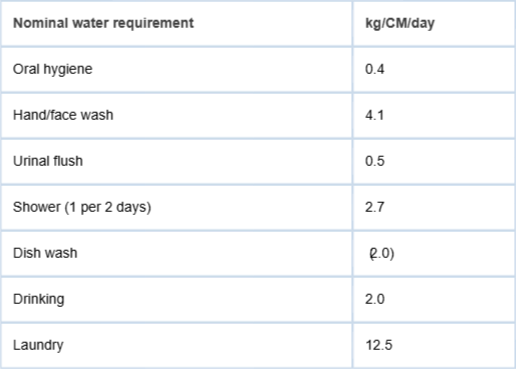
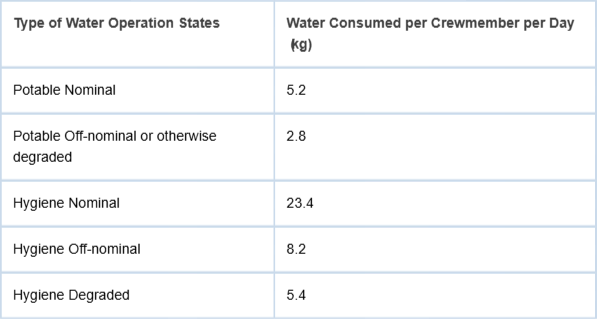


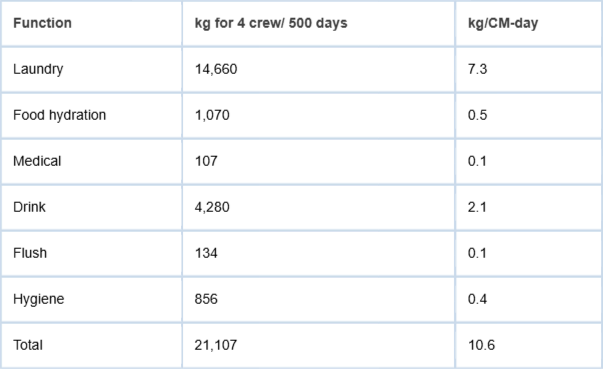

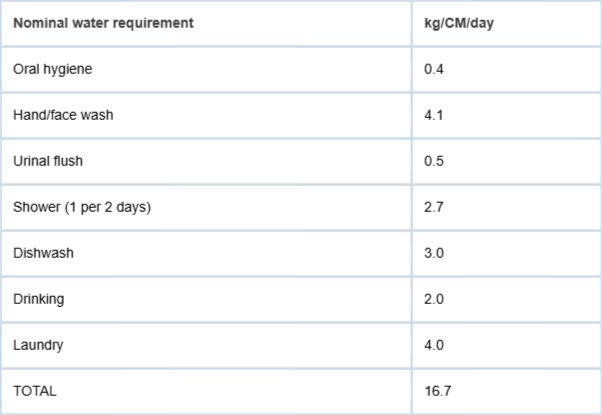



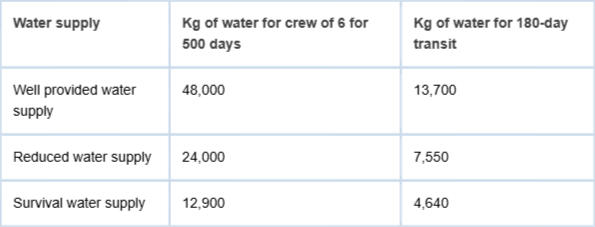
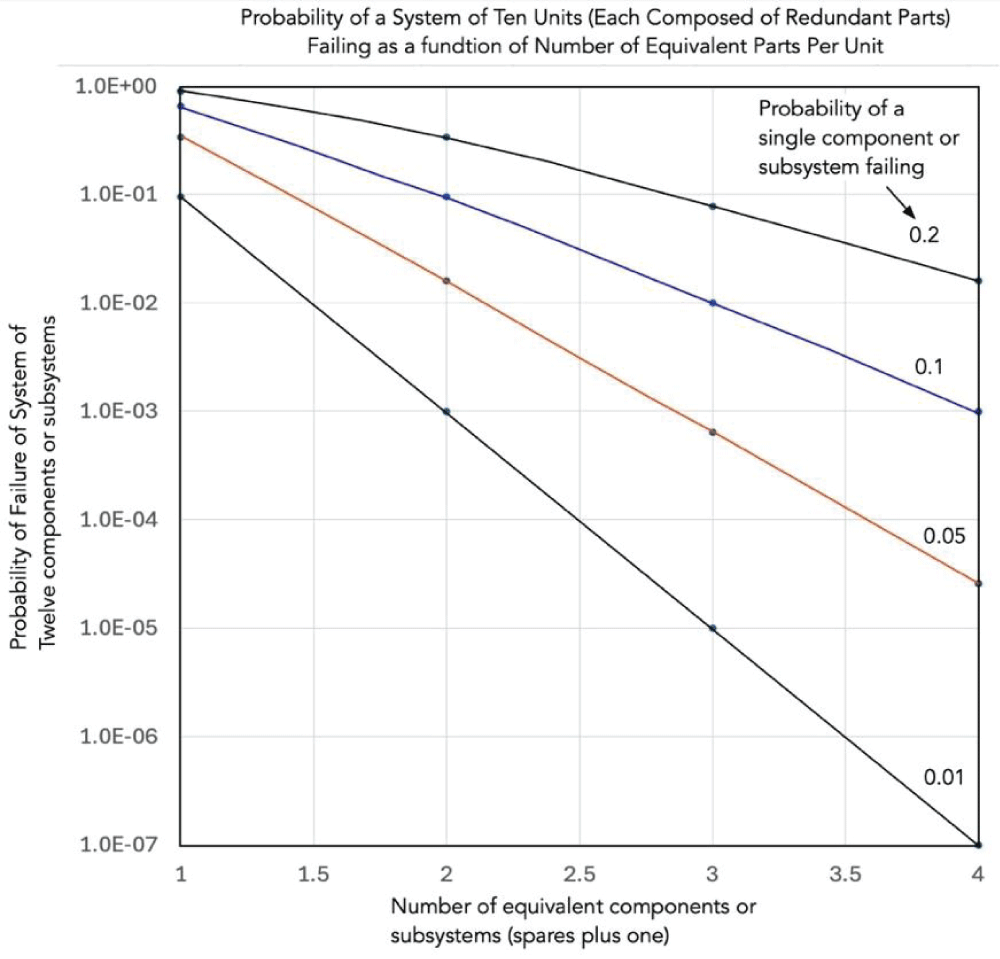

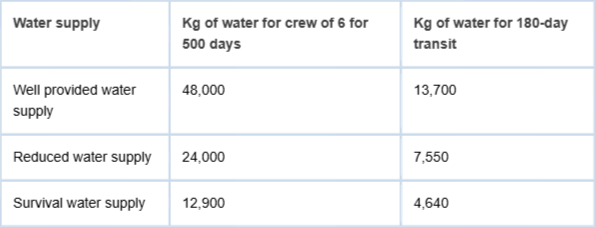


![<p>Estimated water requirements for Mars [10].</p>](https://www.igminresearch.jp/articles/fulltext/table_images/igmin353/Table1.png)
![<p>Summary of Water Consumption per Crewmember for Operational States [12].</p>](https://www.igminresearch.jp/articles/fulltext/table_images/igmin353/Table2.png)
![<p>Estimate of water requirements for a Mars Base [14].</p>](https://www.igminresearch.jp/articles/fulltext/table_images/igmin353/Table4.png)
![<p>Estimated water requirements by Hoffman et al. (2017) [18].</p>](https://www.igminresearch.jp/articles/fulltext/table_images/igmin353/Table5.png)
![<p>Estimate of water requirements for an 82 kg astronaut [20].</p>](https://www.igminresearch.jp/articles/fulltext/table_images/igmin353/Table6.png)
 " class="figure-thumb">