Welcome to IgMin Research – an Open Access journal uniting Biology, Medicine, and Engineering. We’re dedicated to advancing global knowledge and fostering collaboration across scientific fields.
At IgMin Research, we bridge the frontiers of Biology, Medicine, and Engineering to foster interdisciplinary innovation. Our expanded scope now embraces a wide spectrum of scientific disciplines, empowering global researchers to explore, contribute, and collaborate through open access.
Welcome to IgMin, a leading platform dedicated to enhancing knowledge dissemination and professional growth across multiple fields of science, technology, and the humanities. We believe in the power of open access, collaboration, and innovation. Our goal is to provide individuals and organizations with the tools they need to succeed in the global knowledge economy.
IgMin Publications Inc., Suite 102, West Hartford, CT - 06110, USA
Micromobility has emerged as an important element of sustainable urban transport, offering an effective solution for first- and last-mile connectivity. Despite the growing adoption of shared electric vehicles, many existing fleet deployment and routing methods continue to prioritise minimising travel distance while paying limited attention to the impact of road topography on energy consumption. This omission is particularly relevant in cities with varying terrain, where elevation changes can significantly affect battery usage and overall operational efficiency. This paper introduces a physics-informed optimisation framework that incorporates terrain-related energy demand into micromobility fleet deployment. Instead of relying solely on travel distance, the proposed approach estimates the energy required for vehicle movement by accounting for rolling resistance, aerodynamic drag, gravitational effects caused by road slopes, and energy recovery through regenerative braking on downhill sections. These energy calculations are embedded within a graph-based optimisation model whose objective is to identify routes with the lowest total energy consumption. To assess the effectiveness of the proposed methodology, a case study was conducted using selected road segments from the Vilnius street network that represent different topographical characteristics. The simulation results indicate that road elevation has a substantial influence on vehicle energy requirements. They also reveal that the shortest path does not always correspond to the most energy-efficient one. In several scenarios, longer routes consumed less energy because of more favourable elevation profiles and the additional benefits provided by regenerative braking. Compared with traditional distance-based routing strategies, the proposed framework offers a more accurate representation of real-world energy consumption, leading to better-informed fleet deployment decisions. The methodology is suitable for integration into real-time fleet management systems and smart city platforms, where it can contribute to lower energy consumption, improved battery utilisation, and more sustainable operation of shared micromobility services.
The rapid growth of micromobility services, such as electric scooters and electric bicycles, has fundamentally transformed urban transportation systems, particularly with regard to “last-mile” connectivity [1]. These systems offer flexible, low-emission mobility solutions and are increasingly being integrated into smart city infrastructure [2]. However, effective fleet management remains a critical challenge, particularly in densely populated urban areas characterised by dynamic demand patterns and heterogeneous topographical conditions [3]. Existing research on the deployment of micromobility fleets primarily focuses on demand forecasting, vehicle reallocation strategies, and reducing operational costs [4]. Most optimisation methods rely on simplified distance-based cost functions, without accounting for the physical dynamics of vehicle movement. In particular, the impact of terrain-such as changes in elevation and road gradients-on energy consumption is often ignored, despite its significant influence on the operation of electric vehicles [5]. This shortcoming is particularly relevant in cities with varied topography, where uphill and downhill sections can significantly alter energy requirements. Failure to take these factors into account can lead to suboptimal deployment decisions, increased operating costs, and inefficient battery usage. To address this gap, this paper proposes an optimisation system for the deployment of a micromobility vehicle fleet, in which the decision-making process explicitly accounts for the energy consumption determined by terrain conditions. The objective of this article is to develop and evaluate a physics-based optimisation model for the deployment of a micromobility vehicle fleet which, unlike traditional distance-based methods, integrates terrain-induced energy consumption and the effects of regenerative braking into route planning, to reduce overall energy costs and improve the efficiency of last-mile transport systems in urban environments. A physics-based energy model is integrated into the optimisation formula, allowing for a more accurate assessment of the operational costs associated with vehicle deployment [6]. The proposed method is evaluated through a simulation in an urban environment, comparing traditional distance-based allocation strategies with an energy-conscious model. The results demonstrate the potential to improve energy efficiency and ensure more sustainable operation of the vehicle fleet.
The optimisation of last-mile micromobility transport systems is becoming an increasingly relevant area of research aimed at addressing issues of urban mobility, energy efficiency, and sustainability. Existing research can be divided into several main areas: fleet allocation optimisation, demand forecasting, real-time decision-making, energy cost modelling, and the integration of topography and physical factors into optimisation models. Fleet allocation problems in micromobility systems are most often formulated as spatio-temporal optimisation problems with demand uncertainty. Giordano and Chow [2] examine the formation of service areas for electric scooter services and the allocation of vehicles, incorporating the concept of elastic demand. Their analysis shows that demand is not static-it depends on system coverage and availability, so deployment decisions must be iteratively aligned with demand models. Jin et al. [3] extend this approach by incorporating battery swapping strategies. The authors demonstrate that energy management becomes an integral part of allocation optimisation, as vehicle availability directly depends on battery condition. In this context, the allocation problem transforms into an integrated logistics and energy management task. Efficient fleet allocation is impossible without accurate demand forecasting. Porat et al. [4] propose a comprehensive set of machine learning methods, ranging from classical regression techniques to deep neural networks. The authors emphasise that demand for micromobility is characterised by complex spatial and temporal dependencies. Additionally, state-of-the-art spatio-temporal neural networks, such as multi-level attention models, allow for even more accurate modelling of demand distribution across different urban districts. Such models are capable of identifying latent structures, such as periodicity, seasonality, or location-specific factors, and are particularly important for real-time optimisation systems. Traditional static optimisation methods are increasingly being replaced by real-time decision-making systems. Bányai, Veres & Bányai [6] propose a real-time optimisation methodology for micromobility-based last-mile logistics. Their model integrates dynamic data, such as changes in demand and transport status, allowing for the rapid adaptation of solutions. This approach is particularly important in urban environments, where conditions are constantly changing. Real-time optimisation not only allows for more efficient allocation of vehicles but also reduces energy consumption and emissions, which is a key goal of sustainable cities. Energy consumption is one of the key factors determining the efficiency of micromobility systems. Korzilius et al. [5] examine the design of electric micromobility vehicles, emphasising the impact of terrain on energy consumption. Their results show that even small gradients can significantly increase energy consumption, so this aspect must be integrated into optimisation models. Similar insights are presented in the broader context of electric vehicles. Liu & Zhang [7] analyse route optimisation considering charging and battery-swapping opportunities, while Xiong et al. [8] propose a comprehensive energy consumption model that incorporates drive losses and traffic conditions. These studies show that energy costs depend on many factors, so simple distance-based models are insufficient. Recent research is increasingly focusing on the modelling of three-dimensional environments. Lai et al. [9] propose energy-model-based route planning in 3D environments that integrates terrain data. This allows for a more accurate assessment of energy requirements under real-world conditions. Snoeck et al. [10] also emphasise that energy estimation for last-mile routes must be based on detailed environmental data, including elevation changes. Such models are particularly relevant for cities with complex topography, where energy consumption can vary significantly depending on the route. In recent years, increasing attention has been paid to physics-based artificial intelligence models. Lim et al. [11] present a physics-based neural network (PINN) designed to predict the dynamics of electric vehicles. In a subsequent paper, Lim et al. [12] propose a more advanced model that integrates neural operators and reinforcement learning, enabling real-time navigation optimisation. Such methods are particularly promising because they allow for the integration of data-driven and physics-based models, thereby increasing the accuracy and reliability of predictions. In addition to energy consumption, it is important to assess energy recovery. Kropiwnicki et al. [13] analyse regenerative braking processes in urban conditions and demonstrate that this technology can significantly reduce overall energy demand. This is particularly relevant in topographically complex areas where frequent braking and acceleration cycles occur. The operation of micromobility systems is also shaped by the regulatory environment. In their review, Yang et al. [14] examine policies in North American cities and emphasise that appropriate regulation can promote more efficient vehicle distribution and greater system accessibility. In summary, it can be said that models for fleet allocation, demand forecasting, and energy consumption are widely discussed in the literature. However, there is still a lack of integrated solutions that simultaneously combine:
Real-time optimisation;
Accurate energy consumption models;
The influence of terrain (3D environment);
And dynamic demand.
The integration of terrain-induced energy costs into fleet allocation models in the context of micromobility has been studied to a very limited extent. This gap is critical for the development of efficient and sustainable last-mile transportation systems, and therefore provides a basis for further research. Recent scientific literature indicates rapid progress in research on micromobility systems, particularly regarding the integration of artificial intelligence, real-time optimisation, and energy management. The latest studies emphasise integrated fleet management that accounts for energy constraints and dynamic demand. Protogyrou & Hajibabai [15] propose a heuristic method that simultaneously solves the problem of vehicle relocation and charging by combining routing and infrastructure placement tasks. This method allows for more efficient allocation of limited resources, especially in the presence of battery constraints. The use of autonomous micromobility vehicles is also examined. Tan et al. [16] propose a hierarchical reinforcement learning model that allows a portion of the vehicles to self-rebalance in real time, thereby reducing the imbalance between supply and demand. This approach significantly improves system efficiency, especially under dynamic demand conditions. Real-time optimisation remains one of the most important areas of research. The latest methods focus on continuously updating the system’s status and making decisions based on the “rolling horizon” principle. The method proposed by Bányai et al. [17] allows for the dynamic reallocation of the vehicle fleet based on zone load and emission targets, ensuring both operational stability and sustainability. Additionally, Bányai et al. [17] examine the optimisation of asymmetric logistics problems in the context of micromobility, demonstrating that real-world urban conditions (e.g., one-way traffic distribution) must be incorporated into models to achieve more effective solutions. In the field of demand forecasting, new methods increasingly rely on graph neural networks and deep learning architectures. Zin et al. [18] propose a hybrid graph convolutional and recurrent model that enables accurate forecasting of micromobility demand by accounting for spatial relationships between different urban zones. Other studies analyse real-world usage data. Trautwein et al. [19] present a data-driven analysis of micromobility usage, highlighting how demand depends on urban structure and user behaviour. Similarly, He & Kluger [20] apply deep clustering methods to identify hidden travel patterns and improve system planning. Empirical studies show that demand for micromobility is heavily concentrated in central urban areas and exhibits clear temporal patterns, which makes it difficult to distribute vehicles evenly [21]. The studies also examine infrastructure planning. De Bartolomeo et al. [22] propose a model for the optimal layout of parking zones when transitioning from “dockless” to “docked” systems. The study shows that infrastructure solutions directly affect the efficiency of vehicle distribution and the use of urban space. Some studies analyse the integration of micromobility with other transportation systems. Koumleh & Paparella [23] propose a network flow model that combines autonomous transportation systems and micromobility, demonstrating that the interaction of these systems can reduce overall transportation system imbalances. Scientific reviews indicate that artificial intelligence is becoming a central component of micromobility systems. In their systematic review, Yan et al. [24] emphasise that machine learning is widely applied to demand forecasting, energy management, and safety assurance, but challenges remain in integrating these methods into real-time systems. Research shows a clear trend toward a shift from static to dynamic, data-driven, and real-time optimisation solutions in micromobility systems. The greatest progress has been made in the following areas:
Real-time fleet management;
Advanced demand forecasting models;
Application of AI and reinforcement learning;
Integration of energy and battery management.
However, despite this progress, there is still a lack of research that simultaneously integrates terrain-induced energy consumption into fleet allocation models. Most studies analyse either demand, energy, or optimisation, but their comprehensive integration remains limited. This confirms the relevance and scientific novelty of the topic under consideration.
Research methodology
In this article, the energy consumption of micromobility vehicles is modelled based on the physical principles of motion, with the aim of reflecting real-world operating conditions in an urban environment as accurately as possible. Unlike traditional models, in which energy is often approximated solely as a function of distance, this article breaks down energy consumption into separate components corresponding to the primary forces affecting motion. First, rolling resistance is evaluated, which arises from tyre deformation and interaction with the road surface. This force is considered constant under specific conditions and depends on the vehicle’s mass and the properties of the road surface. Second, aerodynamic drag is included, which depends on the vehicle’s speed, shape, and environmental parameters. Although speeds are relatively low in the context of micromobility, the aerodynamic component still has a significant impact on the overall energy balance. The most important part of the model is the inclusion of terrain, which allows for the assessment of the impact of elevation changes on energy consumption. During ascent, the vehicle must overcome gravitational force, so energy consumption increases proportionally to the change in elevation. Meanwhile, during descent, it becomes possible to recover some of the energy that would otherwise be lost. Thus, the overall energy model depends not only on distance but also on the elevation profile of the route. Such multi-factor modelling allows for a more accurate assessment of actual energy costs and provides a basis for further optimisation. The energy function must become sensitive to changes in terrain, meaning that even small differences in elevation can have a significant impact on the final results. The vehicle allocation problem is formulated in this article as a minimum-cost flow optimisation problem, where the objective is to minimise total energy costs across the entire network (e.g., electric scooters or bicycles). The solution seeks to find a distribution of transport flows that minimises total energy consumption. This problem can be solved using classical optimisation methods, such as linear programming or minimum-cost flow algorithms. In a real-time context, the algorithm can be extended to include dynamic demand and continuously updated data on the status of vehicles. In this case, optimisation is performed iteratively, periodically recalculating the optimal distribution based on the latest information. The experiment is conducted using a synthetic urban network, which allows for the control of key parameters and a clear assessment of the influence of terrain and regenerative braking. The network consists of several nodes and the edges connecting them, to which distances and elevation changes are assigned. During the simulation, energy consumption is calculated for each possible route using both the classical model (without terrain) and the proposed model with terrain and regeneration. The resulting values are used to solve the optimisation problem and compare the results of the different models. The parameters used in the experiment are selected based on typical characteristics of micromobility vehicles to ensure the realism of the results. The simulation allows us to assess how optimal routes and total energy costs change depending on the complexity of the terrain. For a micromobility vehicle (e.g., an electric scooter or bicycle), energy costs can be modelled through forces:
Total energy:
(1)
where:
d – distance;
Ftotal – the sum of all forces.
Force components:
Ftotal = Frolling + Faero + Fslope (2)
Rolling resistance:
(3)
where:
Cr - coefficient of friction
m – mass (kg)
g – gravity
Air resistance:
(4)
where:
ρ - air density
C - drag coefficient
A – frontal area
v – average speed [25].
Gravity (gradient) force:
(5)
where:
θij – the slope of the path between i and j
Terrain assessment: slope calculated using elevation data:
(6)
where:
hi, hj – node heights
Discrete form (for practical simulation):
(7)
The final energy formula for a section with relief:
[26]. (8)
The energy recovered during regeneration is calculated using the following formula:
(9)
where:
ηregen – regenerative efficiency [27].
In the distribution optimisation model, the urban transport network will be modelled as a directed graph:
G = (V,E)
where:
V - set of nodes (stops, zones)
E - set of edges (paths)
Variables in the solution:
xij = how many vehicles were transferred from i to j
Target function with terrain:
(10)
where:
Eij – energy between points (with a gradient)
Classic model (without terrain):
(11)
This model is based solely on distance and ignores the effect of terrain.
To assess the practical applicability of the proposed energy-based optimisation model, an experimental analysis was conducted using a section of Vilnius’s urban transport network. Vilnius is a suitable case study due to its uneven terrain, where elevation differences significantly affect the energy consumption of micromobility vehicles. The proposed methodology is applied in an urban environment characterised by uneven terrain, which allows for the assessment of the impact of slope on energy consumption. This article addresses the problem of allocating micromobility vehicles within an urban network to minimise total energy consumption, taking into account the impact of terrain. The solution procedure consists of several sequential steps.
Step 1 – Network design
First, the urban transportation network is designed: a set of nodes is defined as G = (V, E)
V – zones/stops;
E – the roads between them.
The following data will be used:
Distance Matrix dij (from the road network);
Elevation data, gradients θij.
The objective is to find a distribution of traffic flows that minimises total energy consumption:
For comparison, we will use a classical model that does not include terrain:
Classical model (without terrain):
Assumptions: Constant average speed, vehicles of the same type, static demand during the period under consideration. Experimental environment: the city infrastructure is modelled as a directed graph. Three street segments in Vilnius were selected for the experiment, reflecting different types of terrain; the route is divided into 3 segments and presented in Table 1.
Table 1: Routes.
Route
Street
Distance
Change in height
1 – 2
Subačiaus str. / sharp rise
500 m
+15 m
1 – 3
Gedimino Avenue/descent into a lower zone
800 m
+10 m
2 – 3
Maironio str. / descent
400 m
−12 m
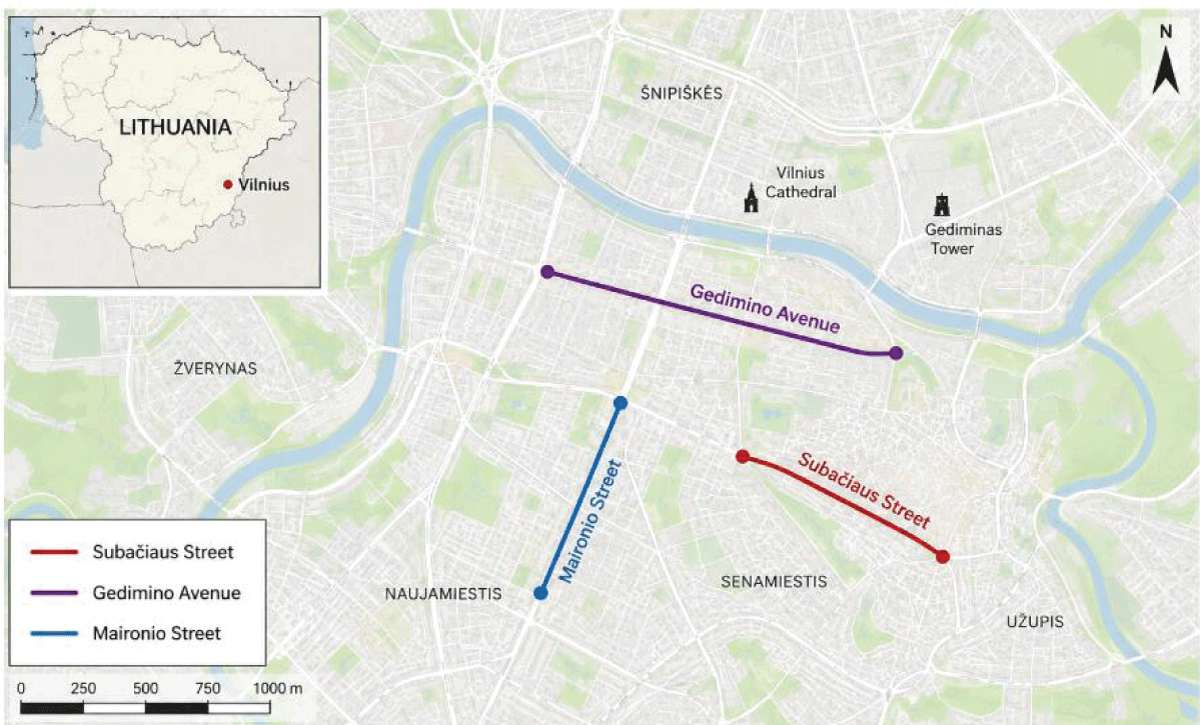
The analysed street segments are located in different parts of the Vilnius road network, as shown in Figure 1. These locations were selected to represent varying terrain conditions for the experimental evaluation.
Figure 1: Location of the analysed street segments within the Vilnius road network.
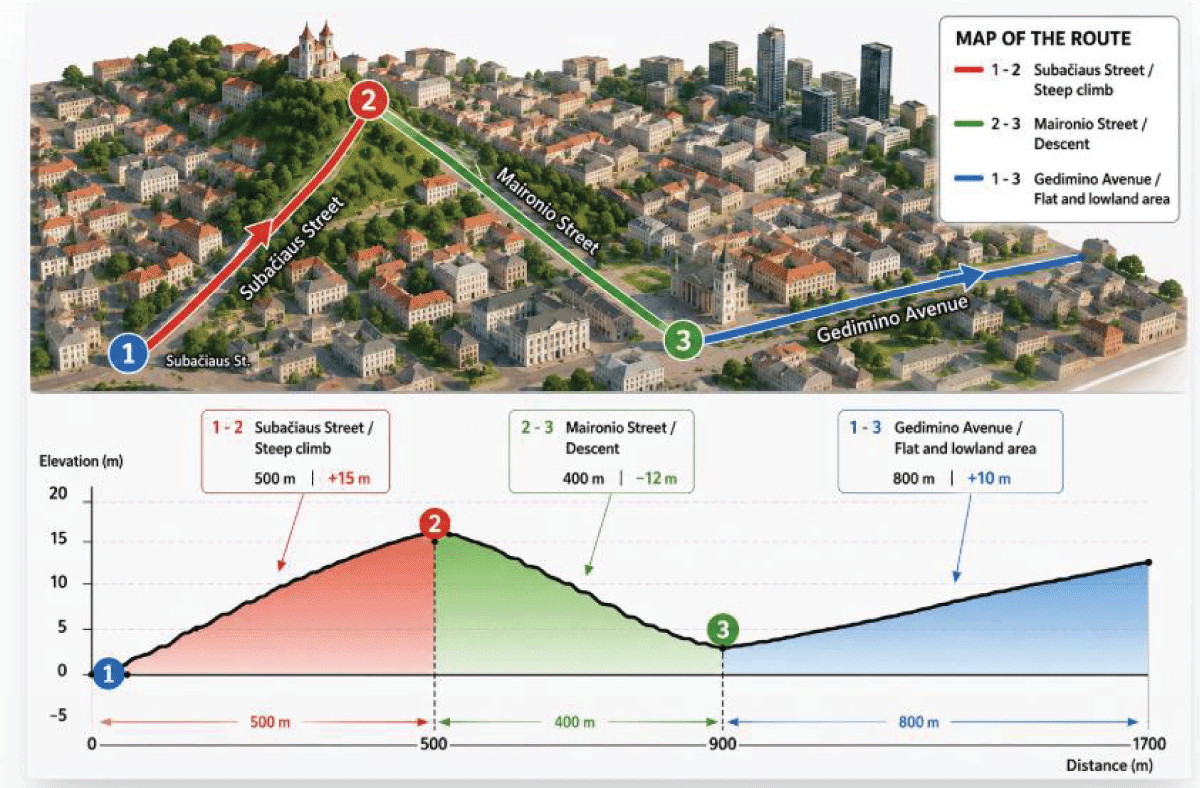
The integration of terrain data is a fundamental part of the proposed model, enabling a transition from a two-dimensional (flat) representation of the city to a three-dimensional, more realistic model. Each node describing the graph is assigned an elevation. In practical implementation, longer routes can be divided into smaller segments to more accurately reflect changes in terrain. This is particularly important in cities with uneven terrain, where the elevation profile can vary significantly even over short distances. Such segmentation allows for more accurate calculation of energy costs and a better assessment of regenerative braking potential. By integrating terrain data, each route becomes not only a geometric trajectory but also an energy function, the value of which depends on the sequence of elevation changes. This allows optimisation algorithms to make decisions based on actual energy costs, rather than just distance or time. The terrain is shown in Figure 2.
Figure 2: The topography of Vilnius.
These values correspond to the actual variations in Vilnius’s topography and the typical gradients of Vilnius’s streets (2–5%). Since the complete city graph is too large for direct optimisation, a network fragment representing typical topographical conditions in Vilnius was used:
The central part of the city (flatter terrain);
The Old Town and New Town areas (hilly terrain);
Residential areas (mixed terrain).
In the case of Vilnius, the influence of terrain is particularly significant due to:
River valleys (Neris, Vilnia);
Hilly areas (e.g., the Old Town);
Sudden changes in elevation even over short distances.
This means that energy models become critically important, and distance-based optimisation is unsuitable.
Simulation scenarios
Two scenarios are analyzed:
Scenario 1 – proposed model:
✔ Optimisation based on energy costs;
✔ The effect of terrain is included;
✔ Regeneration.
Scenario 2 – baseline model:
✔ Optimisation based on distance;
✔ The influence of terrain is not considered.
It is expected that the proposed model will:
✔ Reduce total energy costs;
✔ Select more efficient routes;
✔ Improve the operational efficiency of the micromobility system.
Scenario 1:
Energy consumption is calculated for a 1 km route with varying terrain.
The parameters used correspond to real-world micromobility conditions; that is, they are the model calibration parameters:
Mass: m = 100 kg;
Speed: ν = 5 m/s, 5 m/s = 18 km/h, the typical speed of a city scooter or e-bike, which complies with speed limits in most cities;
Rolling resistance coefficient: Cr = 0.015, because the typical values are: asphalt: 0.010 - 0.020, Bicycles/scooters: most commonly ~0.012–0.018. The medium setting accounts for tyre deformation and is suitable for city roads;
Air density: ρ = 1.2 kg/m3 (standard value at 20°C at sea level);
Aerodynamic coefficient: Cd = 1.0, selected because the default value is: cyclist: 0.9–1.2, scooter (while standing): ~1.0–1.3;
Area: A = 0.5/m2 (typical values: person standing: 0.4–0.7 m²);
Gravity: g = 9.81 m/s2, a standard physical constant.
η regen = 0.6, regenerative efficiency.
The optimisation problem is solved using linear programming methods, integrating a physical energy consumption model into the decision-making process for route allocation. The parameters used in this article were selected based on physical models and typical micromobility values reported in the literature. The proposed energy consumption model is based on established laws of physics that are frequently applied in electric vehicle research, but its application to the allocation of a micromobility vehicle fleet represents a new contribution.
Step 2 – Calculating forces
Rolling force:
Air resistance:
Step 3 – Calculating distances
Calculate Segment 1 (sharp rise):
Gravity (gradient) force:
Segment 2 (descent into a lower zone):
Gravity (gradient) force:
Segment 3 (descent):
Gravity (gradient) force:
Step 4:
To accurately assess the energy balance, regenerative braking is incorporated into the model, which allows for the recovery of some energy when driving downhill.
Change in potential energy:
(12)
Regenerative braking is one of the most important energy management mechanisms in modern electric vehicles, allowing some of the kinetic or potential energy-which is typically lost during braking or when driving downhill-to be recovered and reused. Unlike traditional (mechanical) braking, where energy is dissipated as heat through the brake pads, during regenerative braking the electric motor operates in generator mode. This means that the energy accumulated while the vehicle is in motion is converted into electrical energy and fed back into the battery. In the context of micromobility, such as electric scooters or bicycles, regenerative braking is particularly relevant due to frequent changes in speed and the influence of urban terrain. In cities with hilly terrain, vehicles often climb uphill and descend downhill. Additional energy is consumed during ascents because the force of gravity must be overcome, but during descents, there is an opportunity to recover at least some of this energy. It is precisely here that regenerative braking becomes a key component of the model, as it allows for a more accurate assessment of the actual energy balance. Mathematically, the regeneration effect is modelled only in cases where the elevation change is negative. The inclusion of this model in the optimisation of micromobility fleet distribution is necessary for several reasons. First, it prevents a systematic overestimation of energy costs on routes that include descents. Second, regenerative braking can fundamentally change the selection of the optimal route: routes that appear inefficient based on distance or even a simple energy model can become optimal if they include significant descents. Third, in real-time systems where decisions are made dynamically, incorporating regenerative braking allows for more accurate forecasting of battery discharge and more efficient management of vehicle allocation. Furthermore, regenerative braking has direct practical benefits: it reduces overall energy consumption, extends battery life, and lowers operational costs. This is particularly important in shared micromobility systems, where vehicle charging and relocation constitute a significant part of the infrastructure. By incorporating regeneration into the model, it is possible not only to estimate energy costs more accurately but also to develop more advanced allocation algorithms that leverage the characteristics of the urban terrain to save energy. In this article, regenerative braking is not merely an additional physical effect but an essential part of the model, allowing a transition from a simplified, theoretical energy assessment to a realistic and practically applicable optimisation solution. The modelling of energy consumption for micromobility vehicles in this article is based on fundamental principles of mechanics, aiming to reflect real operating conditions in an urban environment as accurately as possible. Total energy consumption is defined as the work required to overcome all forces acting on the vehicle over a given distance. These forces include rolling resistance, aerodynamic drag, and the gravitational component caused by the terrain. This model allows for a transition from a simplified distance-based assessment to a physically based energy calculation. Rolling resistance arises from tyre deformation and contact with the road surface, and is therefore proportional to the vehicle’s mass and the acceleration due to gravity. Aerodynamic drag depends on the square of the speed, air density, frontal area, and drag coefficient, so its influence increases as speed increases. Meanwhile, the terrain component is directly related to the change in elevation between two points: energy is consumed when climbing, and can potentially be recovered when descending. It is in this context that regenerative braking is incorporated into the model, allowing for the assessment of energy recovery when descending slopes. From a physical standpoint, a vehicle’s potential energy decreases as it descends.
The energy recovered during regeneration is calculated using the formula:
(13)
ηregen – regenerative efficiency describes the proportion of potential energy that can be recovered during braking. Although this value can theoretically reach 1, in practice it is lower due to losses in the electric motor (in generator mode), the power electronics, and the energy storage system. According to scientific sources, typical regeneration efficiency ranges from 0.5 to 0.8. In this article, the value ηregen – 0.6 is used as an average and realistic value suitable for the system being modelled [13].
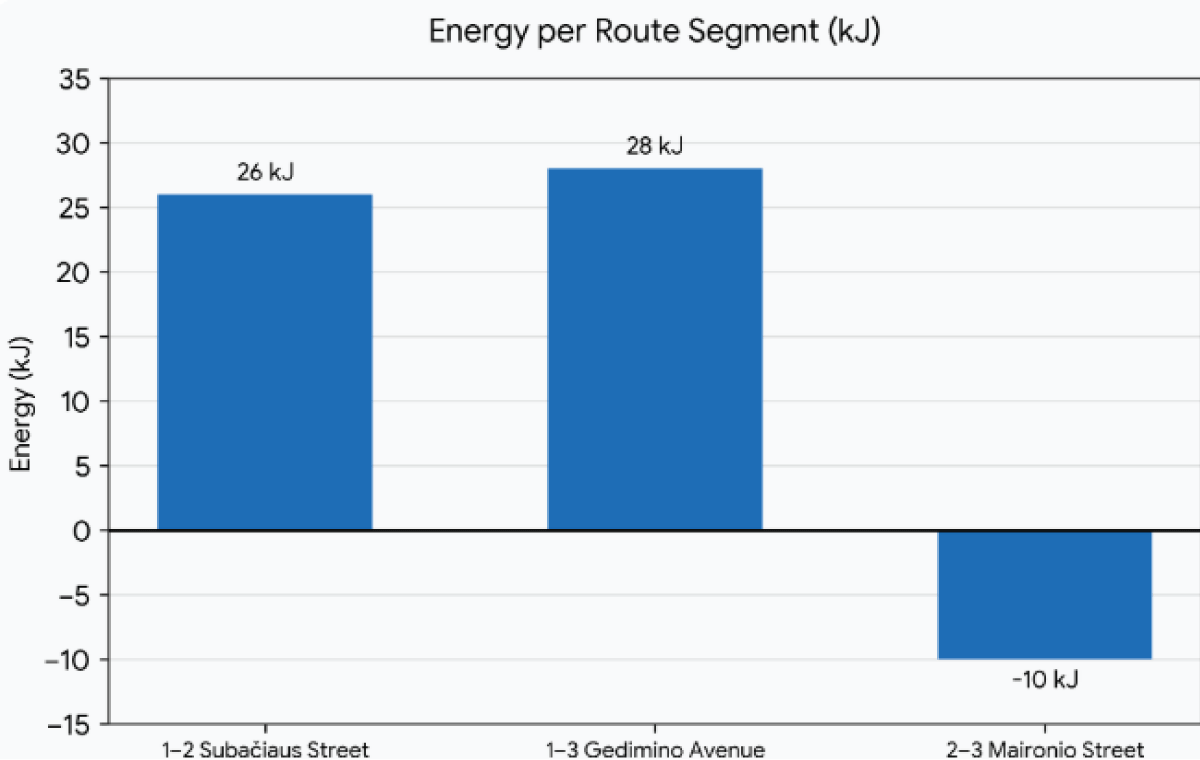
The energy consumption for each route is shown in Figure 3.
Figure 3: Energy consumption.
This graph shows the energy consumed or generated along different segments of the route. The highest energy demand is observed on the segment “1–3 Gedimino Ave.”, where energy consumption reaches approximately 28 kJ. A similarly high amount of energy is consumed when ascending Subačiaus Street (“1–2 Subačiaus”), as this segment features a steep incline. Meanwhile, on the “2–3 Maironio St.” segment, the energy value is negative, as some energy can be recovered or less energy is consumed while descending the slope. The graph clearly shows how changes in terrain affect the energy costs of movement.
Comparison with the classical model (without terrain):
Total energy:
Result:
Change
When terrain is included, total energy consumption increases by approximately 16%.
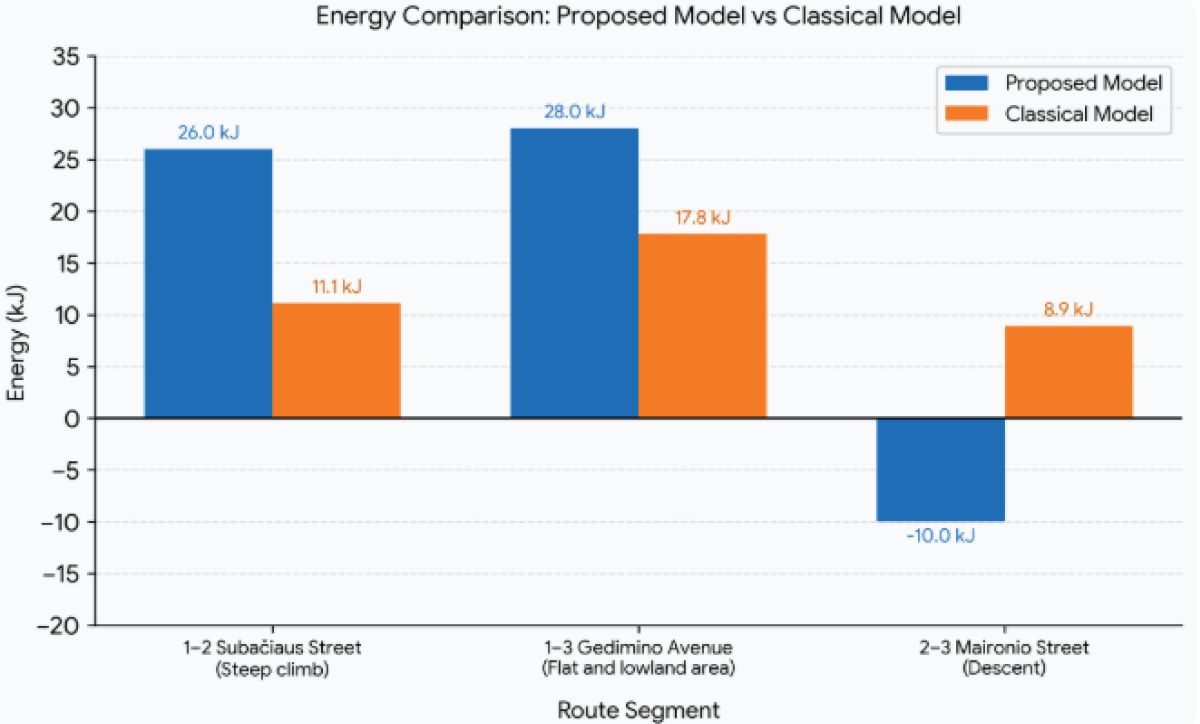
A comparison of the models is shown in Figure 4.
Figure 4: A comparison of the proposed and classic models.
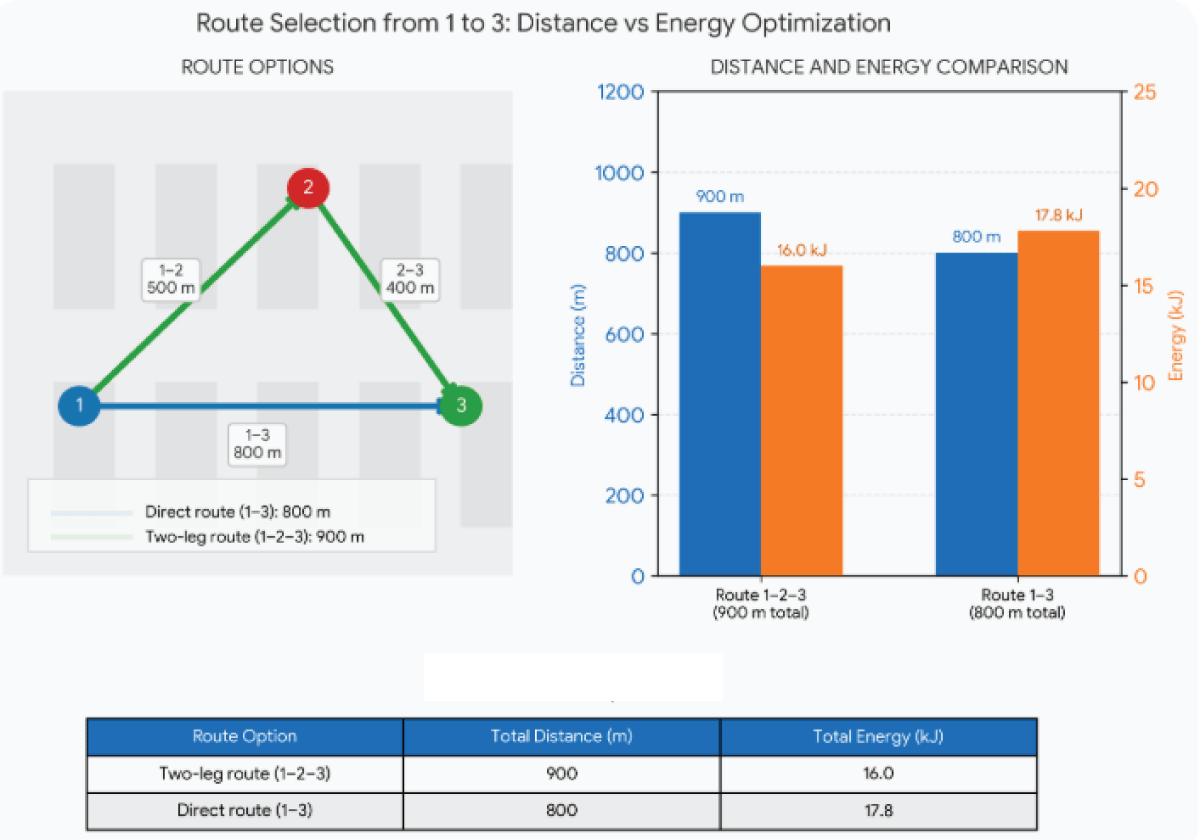
The graph shows that energy consumption is not proportional to distance. Although Gedimino Avenue is the longer route, its energy consumption is significantly lower than that of the section of Subačiaus Street due to the reduced impact of the terrain. Meanwhile, the segment of Maironio Street has the lowest energy consumption due to the significant regenerative braking effect caused by the downhill slope. The results are presented in Figure 5.
Figure 5: Routes.
The results show that:
Terrain can significantly increase energy consumption;
Ramps have a disproportionately large impact;
Classical models systematically underestimate energy consumption.
Optimisation based on energy (rather than distance) yields more realistic solutions. An analysis of Vilnius’s urban network showed that incorporating topography into micromobility modelling fundamentally changes the optimisation results. Even in a simple network, it is evident that energy-optimised routes often do not coincide with the shortest ones. This confirms that, under real-world urban conditions, energy-based models must be applied to effectively manage micromobility fleets. The results obtained show that, under Vilnius city conditions, the influence of terrain can alter optimal route choices; therefore, traditional distance-based models are not suitable for optimising micromobility systems. The optimisation problem is solved using linear programming solvers, yielding an optimal solution that specifies: from which nodes to which nodes to move the vehicles.
For example:
Transport from 1 to 3:
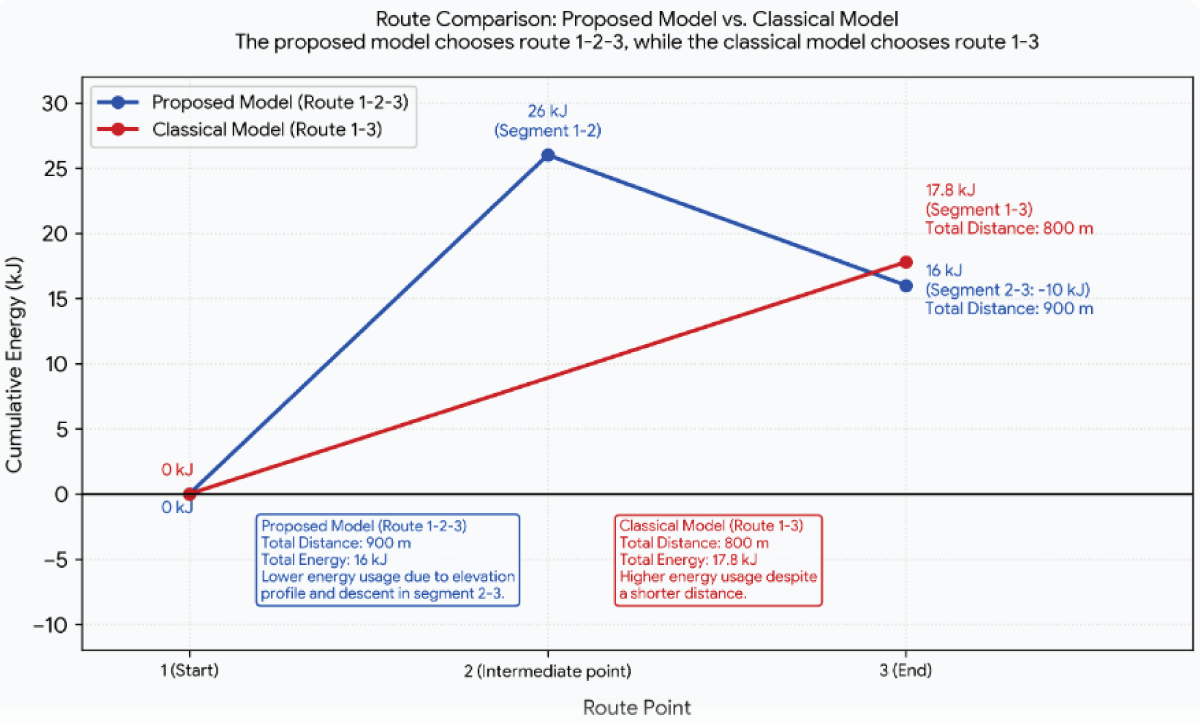
The optimal option according to the proposed model is 1–2–3; although the distance of 900 m is longer, it consumes less energy – 16 kJ.
The base model would select the following route: 1–3: 800 m, 17.8 kJ. Table 2 shows the route selections for both models.
Table 2: Selected routes.
Model
Selected routes
Base / Distance
1 - 3
Energy
1 - 2- 3
The comparison of the models is presented in Figure 6.
Figure 6: The classical and proposed energy models.
The difference: The energy model completely changes the solution; the classical model “sees” only distance, while the proposed model “sees physics,” and the terrain changes the solution. The inclusion of regenerative braking fundamentally changes the behaviour of the energy model. Figure 5 compares two different routes between points 1 and 3, evaluating not only the distance travelled but also the total energy consumption. The graph shows that the direct route 1–3 is shorter, at 800 meters, but its energy requirement reaches as high as 17.8 kJ. Meanwhile, the alternative route 1–2–3 is longer-its total length is 900 meters-but its energy consumption is lower, amounting to approximately 16 kJ. These results show that route efficiency depends not only on distance but also on terrain features, such as uphill or downhill sections. A longer route can be more energy-efficient if it has fewer steep inclines or more downhill sections, which help reduce energy consumption. This comparison reveals that an energy optimisation model can offer a more economical solution than the traditional choice of the shortest route. Such an analysis is particularly important when planning transport routes, the movement of electric vehicles, or logistics systems, where energy costs play a significant role in overall efficiency.
In traditional models that consider only distance or constant forces, all routes are assumed to consume energy in a monotonic manner. However, when terrain and regeneration are factored in, the energy function becomes nonlinear and depends on the elevation profile. This means that routes with higher initial energy costs (e.g., steep climbs) can be offset by subsequent descents, so the total energy balance may be lower than that of alternative, “flatter” routes. This effect is particularly important in the optimisation problem, as it alters the structure of the optimal solution. Classical routing models that minimise distance or time often ignore the influence of terrain, and thus may select energy-inefficient routes. Meanwhile, the model proposed in this article, which integrates regenerative braking, allows for optimisation based on actual energy costs, thereby improving the efficiency of fleet management. Experimental results confirm that incorporating regenerative braking can significantly reduce overall energy consumption. This not only reduces battery drain but also enables more efficient real-time planning of vehicle distribution, particularly in hilly cities. It can be argued that modelling regenerative braking is essential for developing a realistic and practically applicable energy optimisation system for micromobility. Including it allows for a more accurate assessment of the energy balance, improves the quality of optimisation solutions, and enables more effective use of the city’s topographical features. The results confirm that incorporating topography and regenerative braking is essential for accurately modelling micromobility energy costs. Traditional models that ignore these factors may systematically overestimate or underestimate energy demand, particularly in hilly areas. The proposed model enables the optimisation of vehicle allocation based on actual energy costs, thereby reducing battery wear and operational costs. This is particularly relevant for shared micromobility systems, where efficient vehicle management is a critical factor. Nevertheless, the model has certain limitations, such as the assumption of constant speed and the exclusion of traffic conditions. In the future, these aspects could be integrated to further improve the model’s accuracy. The results confirm that the integration of terrain into micromobility distribution models has a significant impact on optimisation results. Unlike classical models, which rely solely on distance, the proposed method accounts for the physical conditions of vehicle movement, particularly the influence of gravitational resistance on energy consumption. This allows for more realistic decisions, especially in cities with uneven terrain. The analysis shows that terrain has a significant impact on route selection: even if a route is longer, energy consumption is lower, so the shortest route is not necessarily the most energy-efficient one. It has been observed that the classical model chooses the shortest path, while the energy model chooses the “energy-optimal trajectory”; this indicates that distance ≠ energy costs. The results confirm that integrating terrain into micromobility distribution models has significant practical benefits. Traditional models, based solely on distance, do not account for physical transport constraints, particularly the effect of gravitational resistance. Urban transport optimisation that ignores topography can lead to systematically incorrect decisions. The proposed model allows for: reducing energy costs, improving battery efficiency, and increasing operational sustainability. Future work: dynamic (real-time) demand, multiple vehicle types, and integration of charging infrastructure. The analysis aimed to assess how terrain-induced energy consumption affects route selection and overall system efficiency. A simple route network was used to illustrate the differences between distance-based and energy-based optimisation methods/models. Energy consumption for each route segment was calculated using a terrain-adjusted energy model, incorporating both distance and gradient effects. The results show a clear difference between the shortest route and the energy-optimised route. The results indicate that route selection based solely on distance can lead to suboptimal and energy-intensive solutions, particularly in urban environments with varied topography. The proposed energy-saving model prioritises routes that require less energy, even if they are longer. Furthermore, the results show that the impact of terrain on energy consumption is highly nonlinear. Small changes in slope can lead to a disproportionately large increase in energy consumption, especially on uphill sections. This once again underscores the importance of incorporating terrain and energy aspects into route optimisation models. Overall, the proposed method provides a more realistic picture of micromobility energy consumption and demonstrates significant potential for efficiency improvements. The results confirm that sustainable urban transport systems need to shift from distance-based to energy-saving route planning strategies. The results of the Vilnius case study clearly show that incorporating terrain-induced energy consumption significantly alters optimal route planning decisions in micromobility systems. Unlike conventional distance-based methods, the proposed energy-saving model reflects the nonlinear impact of elevation changes, which is particularly pronounced in urban environments with heterogeneous topography. The analysis showed that shorter routes are not necessarily more energy-efficient. The results highlight a fundamental limitation of traditional optimisation models: by ignoring physical constraints such as slope and elevation, they systematically underestimate energy consumption on uphill sections and fail to take advantage of potential energy recovery on downhill sections. This leads to suboptimal fleet allocation decisions, increased battery depletion, and reduced operational efficiency. Furthermore, the results show that the relationship between distance and energy is fundamentally nonlinear. Small changes in gradient can cause disproportionately large changes in energy demand, especially on uphill sections. This once again highlights the importance of integrating physics-based models into route planning and dispatch systems. From a practical standpoint, the implications are significant. In cities like Vilnius, where elevation changes frequently, energy-efficient route planning can reduce overall energy consumption. This directly translates to longer vehicle range, less frequent charging, and lower operating costs.
The results of this study revealed that incorporating terrain into micro-mobility vehicle allocation models has a significant impact on energy consumption estimates and the selection of optimal routes. Routes with steep ascents are characterised by significantly higher energy costs, but this effect can be partially or fully offset during descents, especially when regenerative braking is included. Compared to the classical model, in which energy depends solely on distance, the proposed model provides more realistic results and often selects different optimal routes. It has been found that the shortest route is not the most energy-efficient, and longer routes with more favourable terrain may require less energy. It was also observed that regenerative braking has a significant impact on the overall energy balance, especially on routes with steep descents. This allows for a reduction in energy consumption and an improvement in system efficiency. The results show significant differences between the classical (distance-based) model and the proposed energy-based optimisation model. The proposed model allows for an effective assessment of the energy costs of micromobility vehicles by incorporating the effects of terrain and regenerative braking. This approach offers a significant advantage over traditional models and enables more informed optimisation decisions. This article proposes a physics-based system/model for optimising the distribution of a micromobility fleet, explicitly accounting for terrain-induced energy consumption. By integrating elevation data and a detailed energy model into a graph-based representation of the urban transport network, this method enables more realistic and effective decisions compared to traditional distance-based methods. A case study conducted on a representative network in Vilnius showed that topography has a significant impact on energy consumption and route selection decisions, and the results indicate that energy-optimal routes can differ significantly from the shortest-distance routes. These results confirm that distance alone is not a sufficient metric for estimating operating costs in electric micromobility systems. Instead, energy-saving models more accurately reflect real-world conditions, especially in cities with varied topography. A comparison with a classic distance-based model revealed that traditional optimisation methods systematically underestimate the impact of terrain and can lead to inefficient deployment decisions, especially in cities with complex topography. The proposed energy-based model enables more realistic and sustainable decisions, reducing energy consumption, battery wear, and operational costs. The results indicate that energy optimisation should become a key component of micromobility system management within smart city infrastructure. The proposed methodology can be applied in real-time fleet management systems and integrated with solutions for dynamic demand forecasting, traffic analysis, and battery management. The proposed methodology is generalizable and can be applied in other urban environments using widely available data sources, such as OpenStreetMap and digital elevation models. Furthermore, the system could be compatible with real-time optimisation systems and could be expanded to include dynamic demand, traffic conditions, and charging infrastructure. Future research offers the opportunity to expand the model by incorporating dynamic traffic conditions, various types of vehicles, charging infrastructure, and artificial intelligence and reinforcement learning methods for adaptive real-time optimisation. It is also promising to analyse stochastic demand scenarios and large-scale urban networks to assess the model’s applicability under real-world operating conditions. Future research directions include the integration of stochastic demand models, the heterogeneity of road vehicle fleets, and reinforcement learning-based control strategies for adaptive real-time optimisation.
Declaration on the use of Artificial Intelligence
The author used (OpenAI) solely for language editing, grammar correction, and improvement of manuscript readability. All scientific content, methodology, analyses, calculations, interpretations, and conclusions were developed and verified by the author, who takes full responsibility for the final version of the manuscript.
Shaheen S, Cohen A. Shared micromobility policies: a review of North American cities. Transp Rev. 2020;40(2):1‑25. doi:10.1080/01441647.2019.1703847.
Giordano M, Chow JYJ. An e‑scooter service region and fleet allocation design problem with elastic demand. Transp Res Part D Transp Environ. 2024. Available from: https://www.sciencedirect.com/science/article/pii/S136192092400110X.
Jin Z, Ma D, Li P, Li Y, Zhang L. Managing shared electric micromobility systems: allocation planning and battery swapping. Transp Res Part E Logist Transp Rev. 2025. doi:10.1016/j.tre.2025.104108.
Porat O, Fire M, Ben‑Elia E. A comprehensive machine learning framework for micromobility demand prediction. Comput Sci Mach Learn. 2025. Available from: https://arxiv.org/abs/2507.02715.
Korzilius O, Borsboom O, Hofman T, Salazar M. Optimal design of electric micromobility vehicles. Electr Eng Syst Sci Syst Control. 2021. Available from: https://arxiv.org/abs/2104.10155.
Bányai T, Veres P, Bányai A. Real‑time optimisation for a greener micromobility‑based last‑mile logistics. Appl Sci. 2026;16(6):2933. doi:10.3390/app16062933.
Liu H, Zhang A. Electric vehicle path optimisation research based on charging and switching methods under V2G. Sci Rep. 2024;14:30843. doi:10.1038/s41598‑024‑81449‑0.
Xiong H, Xu Y, Yan H, Guo H, Zhang C. Optimising electric vehicle routing under traffic congestion: a comprehensive energy consumption model considering drivetrain losses. Comput Oper Res. 2024. doi:10.1016/j.cor.2024.106710.
Lai K, Sun D, Xu B, Li F, Liu Y, Liao G, Jian J. Energy‑model‑based global path planning for pure electric commercial vehicles toward 3D environments. Machines. 2025;13(12):1151. Available from: https://www.mdpi.com/2075-1702/13/12/1151.
Snoeck A, et al. Energy estimation of last‑mile electric vehicle routes. arXiv preprint. 2024. Available from: https://arxiv.org/abs/2408.12006.
Lim H, Lee JW, Boyack J, Choi JB. EV‑PINN: a physics‑informed neural network for predicting electric vehicle dynamics. Comput Sci Mach Learn. 2024. Available from: https://arxiv.org/abs/2411.14691.
Lim H, Lee JW, Boyack J, Choi JB. VEGA: electric vehicle navigation agent via physics‑informed neural operator and proximal policy optimisation. Comput Sci Robot. 2025. Available from: https://arxiv.org/abs/2509.13386.
Kropiwnicki J, Gawłas T, Eicke A, Smolen S. Regenerative braking process for the urban traffic conditions in Gdańsk and Bremen. Adv Sci Technol Res J. 2025;19(8):217‑31. doi:10.12913/22998624/205027.
Yang X, Wang J, Han S, He S. Micromobility flow prediction: a bike sharing station‑level study via multi‑level spatial‑temporal attention neural network. Comput Sci Artif Intell. 2025. Available from: https://arxiv.org/abs/2507.16020.
Protogyrou D, Hajibabai L. A heuristic for battery‑constrained charging and rebalancing of micromobility devices. Transp Res Rec J Transp Res Board. 2025. doi:10.1177/03611981251366252.
Tan H, Yan H, Yang L, Yang Y. Small fleet, big impact: enhancing shared micromobility efficiency through minimal autonomous vehicle deployment. Comput Sci Multiagent Syst. 2025. Available from: https://arxiv.org/abs/2510.04271.
Bányai A, Kaczmar I, Bányai T. Route optimisation and scheduling for asymmetric micromobility‑based logistics. Symmetry. 2026;17(4):547. doi:10.3390/sym17040547.
Zin MM, Patanukhom K, Demissie MG, Phithakkitnukoon S. Hybrid graph convolutional‑recurrent framework with community detection for spatiotemporal demand prediction in micromobility systems. Mathematics. 2025;14(1):116. doi:10.3390/math14010116.
Trautwein I, Ravlija R, Sonntag M. Data‑based insights into the usage of micromobility sharing. J Electr Syst Inf Technol. 2025. Available from: https://link.springer.com/article/10.1186/s43067-025-00251-8.
He BY, Kluger R. Understanding shared micromobility travel patterns through a deep embedded clustering approach. Environ Plan B Urban Anal City Sci. 2025. doi:10.1177/23998083251413417.
Garus A, Dadashev G, Ciuffo B, Nahmias‑Biran B. Urban micromobility in practice: insights from a full‑year analysis of shared scooter use in Tel Aviv. Smart Cities. 2025;8(6):207. doi:10.3390/smartcities8060207.
De Bartolomeo S, Ottomanelli M, Caggiani L. An equity parking area location model for transition from dockless to docked shared micromobility systems. Sustain Mobil Transp. 2025;2:23. Available from: https://www.nature.com/articles/s44333-025-00038-4.
Koumleh SJA, Paparella. Intermodal network of autonomous mobility‑on‑demand and micromobility systems. Electr Eng Syst Sci Syst Control. 2025. Available from: https://arxiv.org/abs/2504.00716.
Yan S, Kaundanya C, O’Connor NE, Little S, Liu M. Machine learning in micromobility: a systematic review of datasets, techniques, and applications. Comput Sci Mach Learn. 2025. Available from: https://arxiv.org/abs/2508.16135.
Alhanouti M, Gauterin F. A generic model for accurate energy estimation of electric vehicles. Energies. 2024;17(2):434. doi:10.3390/en17020434.
Skuza A, Szumska EM, Jurecki R, Pawelec A. Modelling the impact of traffic parameters on electric vehicle energy consumption. Energies. 2024;17(21):5423. doi:10.3390/en17215423.
Ekici YE, Karadağ T, Akdağ O. Redefining urban mobility: real‑world regenerative braking optimisation via bio‑inspired AI for electric buses energy efficiency. Energy. 2025;338:138854. doi:10.1016/j.energy.2025.138854
Pevcevic I. Optimising the Deployment of a Last-Mile Micromobility Fleet by Accounting for Terrain-Induced Energy Consumption. IgMin Res. July 01, 2026; 4(7): 240-251. IgMin ID: igmin349; DOI:10.61927/igmin349; Available at: igmin.link/p349
Department of Logistics and Transport Management, Vilnius Gediminas, Technical University (VILNIUS TECH), Plytinės 25, Vilnius, LT-10105, Lithuania
Address Correspondence: Inesa Pevcevic, Department of Logistics and Transport Management, Vilnius Gediminas, Technical University (VILNIUS TECH), Plytinės 25, Vilnius, LT-10105, Lithuania, Email: [email protected]
How to cite this article: Pevcevic I. Optimising the Deployment of a Last-Mile Micromobility Fleet by Accounting for Terrain-Induced Energy Consumption. IgMin Res. July 01, 2026; 4(7): 240-251. IgMin ID: igmin349; DOI:10.61927/igmin349; Available at: igmin.link/p349
Figure 1: Location of the analysed street segments within th...
Figure 2: The topography of Vilnius....
Figure 3: Energy consumption....
Figure 4: A comparison of the proposed and classic models....
Figure 5: Routes....
Figure 6: The classical and proposed energy models....
Shaheen S, Cohen A. Shared micromobility policies: a review of North American cities. Transp Rev. 2020;40(2):1‑25. doi:10.1080/01441647.2019.1703847.
Giordano M, Chow JYJ. An e‑scooter service region and fleet allocation design problem with elastic demand. Transp Res Part D Transp Environ. 2024. Available from: https://www.sciencedirect.com/science/article/pii/S136192092400110X.
Jin Z, Ma D, Li P, Li Y, Zhang L. Managing shared electric micromobility systems: allocation planning and battery swapping. Transp Res Part E Logist Transp Rev. 2025. doi:10.1016/j.tre.2025.104108.
Porat O, Fire M, Ben‑Elia E. A comprehensive machine learning framework for micromobility demand prediction. Comput Sci Mach Learn. 2025. Available from: https://arxiv.org/abs/2507.02715.
Korzilius O, Borsboom O, Hofman T, Salazar M. Optimal design of electric micromobility vehicles. Electr Eng Syst Sci Syst Control. 2021. Available from: https://arxiv.org/abs/2104.10155.
Bányai T, Veres P, Bányai A. Real‑time optimisation for a greener micromobility‑based last‑mile logistics. Appl Sci. 2026;16(6):2933. doi:10.3390/app16062933.
Liu H, Zhang A. Electric vehicle path optimisation research based on charging and switching methods under V2G. Sci Rep. 2024;14:30843. doi:10.1038/s41598‑024‑81449‑0.
Xiong H, Xu Y, Yan H, Guo H, Zhang C. Optimising electric vehicle routing under traffic congestion: a comprehensive energy consumption model considering drivetrain losses. Comput Oper Res. 2024. doi:10.1016/j.cor.2024.106710.
Lai K, Sun D, Xu B, Li F, Liu Y, Liao G, Jian J. Energy‑model‑based global path planning for pure electric commercial vehicles toward 3D environments. Machines. 2025;13(12):1151. Available from: https://www.mdpi.com/2075-1702/13/12/1151.
Snoeck A, et al. Energy estimation of last‑mile electric vehicle routes. arXiv preprint. 2024. Available from: https://arxiv.org/abs/2408.12006.
Lim H, Lee JW, Boyack J, Choi JB. EV‑PINN: a physics‑informed neural network for predicting electric vehicle dynamics. Comput Sci Mach Learn. 2024. Available from: https://arxiv.org/abs/2411.14691.
Lim H, Lee JW, Boyack J, Choi JB. VEGA: electric vehicle navigation agent via physics‑informed neural operator and proximal policy optimisation. Comput Sci Robot. 2025. Available from: https://arxiv.org/abs/2509.13386.
Kropiwnicki J, Gawłas T, Eicke A, Smolen S. Regenerative braking process for the urban traffic conditions in Gdańsk and Bremen. Adv Sci Technol Res J. 2025;19(8):217‑31. doi:10.12913/22998624/205027.
Yang X, Wang J, Han S, He S. Micromobility flow prediction: a bike sharing station‑level study via multi‑level spatial‑temporal attention neural network. Comput Sci Artif Intell. 2025. Available from: https://arxiv.org/abs/2507.16020.
Protogyrou D, Hajibabai L. A heuristic for battery‑constrained charging and rebalancing of micromobility devices. Transp Res Rec J Transp Res Board. 2025. doi:10.1177/03611981251366252.
Tan H, Yan H, Yang L, Yang Y. Small fleet, big impact: enhancing shared micromobility efficiency through minimal autonomous vehicle deployment. Comput Sci Multiagent Syst. 2025. Available from: https://arxiv.org/abs/2510.04271.
Bányai A, Kaczmar I, Bányai T. Route optimisation and scheduling for asymmetric micromobility‑based logistics. Symmetry. 2026;17(4):547. doi:10.3390/sym17040547.
Zin MM, Patanukhom K, Demissie MG, Phithakkitnukoon S. Hybrid graph convolutional‑recurrent framework with community detection for spatiotemporal demand prediction in micromobility systems. Mathematics. 2025;14(1):116. doi:10.3390/math14010116.
Trautwein I, Ravlija R, Sonntag M. Data‑based insights into the usage of micromobility sharing. J Electr Syst Inf Technol. 2025. Available from: https://link.springer.com/article/10.1186/s43067-025-00251-8.
He BY, Kluger R. Understanding shared micromobility travel patterns through a deep embedded clustering approach. Environ Plan B Urban Anal City Sci. 2025. doi:10.1177/23998083251413417.
Garus A, Dadashev G, Ciuffo B, Nahmias‑Biran B. Urban micromobility in practice: insights from a full‑year analysis of shared scooter use in Tel Aviv. Smart Cities. 2025;8(6):207. doi:10.3390/smartcities8060207.
De Bartolomeo S, Ottomanelli M, Caggiani L. An equity parking area location model for transition from dockless to docked shared micromobility systems. Sustain Mobil Transp. 2025;2:23. Available from: https://www.nature.com/articles/s44333-025-00038-4.
Koumleh SJA, Paparella. Intermodal network of autonomous mobility‑on‑demand and micromobility systems. Electr Eng Syst Sci Syst Control. 2025. Available from: https://arxiv.org/abs/2504.00716.
Yan S, Kaundanya C, O’Connor NE, Little S, Liu M. Machine learning in micromobility: a systematic review of datasets, techniques, and applications. Comput Sci Mach Learn. 2025. Available from: https://arxiv.org/abs/2508.16135.
Alhanouti M, Gauterin F. A generic model for accurate energy estimation of electric vehicles. Energies. 2024;17(2):434. doi:10.3390/en17020434.
Skuza A, Szumska EM, Jurecki R, Pawelec A. Modelling the impact of traffic parameters on electric vehicle energy consumption. Energies. 2024;17(21):5423. doi:10.3390/en17215423.
Ekici YE, Karadağ T, Akdağ O. Redefining urban mobility: real‑world regenerative braking optimisation via bio‑inspired AI for electric buses energy efficiency. Energy. 2025;338:138854. doi:10.1016/j.energy.2025.138854






 スキャンしてリンクを取得