Welcome to IgMin Research – an Open Access journal uniting Biology, Medicine, and Engineering. We’re dedicated to advancing global knowledge and fostering collaboration across scientific fields.
At IgMin Research, we bridge the frontiers of Biology, Medicine, and Engineering to foster interdisciplinary innovation. Our expanded scope now embraces a wide spectrum of scientific disciplines, empowering global researchers to explore, contribute, and collaborate through open access.
Welcome to IgMin, a leading platform dedicated to enhancing knowledge dissemination and professional growth across multiple fields of science, technology, and the humanities. We believe in the power of open access, collaboration, and innovation. Our goal is to provide individuals and organizations with the tools they need to succeed in the global knowledge economy.
IgMin Publications Inc., Suite 102, West Hartford, CT - 06110, USA
It was shown that delafossite oxide CuY2,33 prepared by solid-state reaction from the pelletized mixture of the nanopowders Y2O3 +2CuO, in air and at firing temperature 809-852 °C, obeys metallic properties. Upon cooling down to +39 °C, the metallic state undergoes a resistive transition, which suggests the first reproducible superconductivity appearing at a temperature higher than that of the ice melting temperature. Klein-Schwinger effect is suggested as a driving mechanism for the creation of electron-hole pairs. Electric properties are interpreted in terms of topological superconductivity.
The discovery of high-Tc superconductivity (SC) in 1986, indicated by transition temperature Tc in the 30 K range, in the fired mixture BaO+La2O3+CuO (Ba-La-Cu-O) [1], and recognized as oxide La2-xBaxCuO4 put forward in 1981, by Raveau and co-workers [2], sparked a paramount research activity. Chu and co-workers [3] substituted lanthanum with yttrium, and promoted the mixed phase Y1,2Ba0,8CuO4–d fired in an oxygen atmosphere at 940-950 °C, which resulted in SC transition temperature Tc = 93 K. The SC phase was recognized as YBa2Cu3O7-x [4]. Several forthcoming reports claimed low resistance states [5], appealing for possible superconductivity extended up to room temperature [RT]. However, samples were of poor stability on temperature cycling and preparation reproducibility. The author of this paper appealed [6,7] for a secondary minor phase of yet unknown composition, and recently repeated preparations of the mixed phase in vacuum revealed the characteristic resistive transitions near RT. High-resolution measurement of the magnetic susceptibility [8] performed by Prester and Drobac undoubtedly stressed a novel Meissner-type phase, in addition to the YBa2Cu3O7–d. An estimation revealed 0,025 percent of the traced secondary phase. The Meissner effect appeared close to the ice melting temperature. An analysis of DSC and TGA data, recorded by fusion of Y2O3 + BaCO3 + CuO in vacuum, revealed the endothermic reaction at 818 °C and an absence of BaCO3 decomposition, which appealed for delafossite-type oxide YnCunOx.
The lowest member n = 1, CuYO2, was first synthesized by Ishiguro and co-workers at 1100 °C in vacuum [9], and the authors suggested more structural polytypes. The unit cell was found to be hexagonal P63/mmc (orthorhombic- 2H), and dimensions are a = 0,6196 nm, c = 1,1216 nm. A hexagonal Cu network is sandwiched between planes consisting of yttrium cations coordinated by edge shared oxygen octahedra YO6, as it is visualized in the inset of Figure 1. Cu-Cu distance is 0,352 nm, which is smaller than the Cu-Cu distance 0,361 nm in pure copper. As pointed out by Cava and co-workers [10], the ionic structure is Y3+Cu1+O2, and the authors reported strong irregularities, like stacking faults and intercalated secondary phases. Energies of faults in stacking sequences differ slightly, and their appearance complicates the preparation of the targeted structure with defined physical properties, like superconductivity. Van Tendeloo and co-workers prepared [11] delafossite in air at 1050 °C, and the forthcoming preparation at 1134 °C [12] resulted in fully oxygenated delafossite CuYO2,5. The subsequent reduction of oxygen revealed CuYO2,33 intercalated with 0,33 mole of oxygen atoms in a hexagonal Cu network. Such a unit formula may be incorporated in the super unit cell Cu6Y6O14, which indicates 6 c-axis stacks. The author proposes in this paper a rather simplified method for the preparation of CuYO2,33 and reports its resistive and magnetic properties.
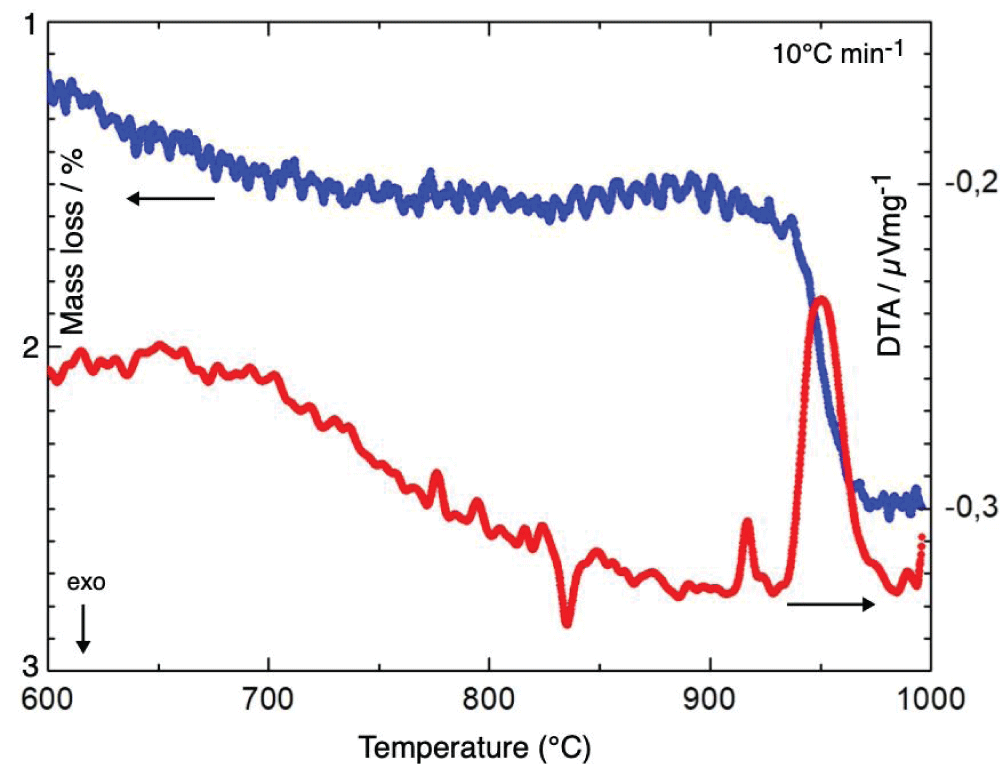
Figure 1: DTA and TGA records of the unfired mixture of nano powders Y2O3 + 2CuO.
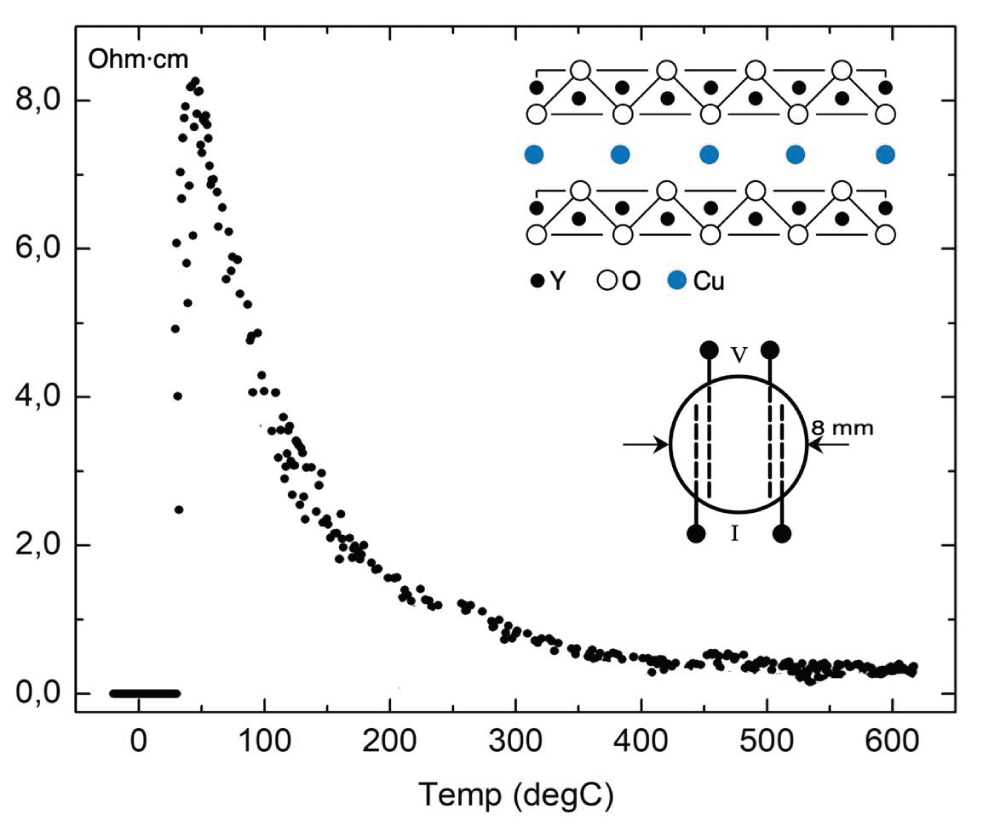
Preparation of CuYO2+d by solid-state reaction at elevated temperatures imposes a complicated procedure and long annealing times at elevated temperatures. In addition, several polytypes of the final fused delafossite differ in the structure and certainly only some of them result in superconductivity. It is commonly known that the formation of stacking faults and other crystal lattice irregularities is more stimulated by firing at higher temperatures [10]. In order to reduce the firing temperature, preparation in these experiments starts with a mixture of 20 nm nano powders of Y2O3 + 2CuO pressed in a steel die to pellets 8 mm in diameter and 0.5 mm thick. The compression force was 3-5 tons, and pellets were maintained in the pressed die at RT for at least 24 hours. Control of the synthesis, described in this work, resides in the measurement of the electrical resistance of the pellet during the heat treatment, and analysis of its temperature dependence may give an important insight into the chemical and physical processes in the sample, which in turn enables a precise discrimination of different structural polytypes. Measurement of the electrical resistance was performed by four-probe contacts ensured by 100 microns gold wires pressed together with nano powders. Two types of samples were prepared: pure CuYO2,33 and CuYO2,33 alloyed with insulating YBa2Cu3O6,5 in w/w proportions ranging from 2 to 10 percent. As pointed out in reference [10], intercalation of oxygen in CuYO2,33 is a similar process to that in YBa2Cu3O6,5. In addition, alloying favours reduction of CuO, reduces the number of annealing cycles, and ensures stabilization of the structure. Firing was performed in air at temperatures ranging from 812-815 °C. Resistance of the pressed powders at RT was several mega-ohms, and by heating in an air atmosphere the resistance decreased continuously with temperature until it suddenly turned down to 3,5 ohms at 815 °C, which agrees with DTA data presented in ref [8]. The annealing time at this temperature was 42 hours. Figure 1 presents the DTA-TGA data recorded on the pelletized mixture Y2O3 + 2CuO in air. DTA shows an endothermic feature at 818 °C, followed by an exothermic peak at 910 °C, obviously the result of the decomposition of CuYO2.33 to Y2O3 + CuO. CuO is further decomposed to Cu2O, which is visible as the sudden drop in weight at 955 °C. The temperature dependence of the resistivity of the non-alloyed sample after firing at 818 °C in air, cooling to RT, and subsequently heating up to 635 °C in 5 heating-cooling cycles is shown in Figure 2. Insets show the stacked structure of undoped CuYO2 in the c-axis direction with copper cations sandwiched between YO6 layers, while the specimen configuration is shown in the same diagram pellet was estimated by its decomposition at 400 °C in a 2 bar H2 atmosphere. The final formula may be expressed as CuYO2+d, d ~ 0, 28–0,36.
Figure 2: Temperature dependence of the electric resistivity of non-alloyed Y2O3 +2CuO, fired at 818°C in air, cooled to RT, and subsequently subjected to 5 heating-cooling cycles in air between RT and 635 °C. The width of the transition to the low-resistance state at RT was 8,4 deg. Insets represent: the idealized structure of the delafossite consisting of Cu planes sandwiched between Y-O6 planes, and a pellet pressed together with 100 microns gold wires serving as contacts for four-probe resistance measurement during the heat treatment.
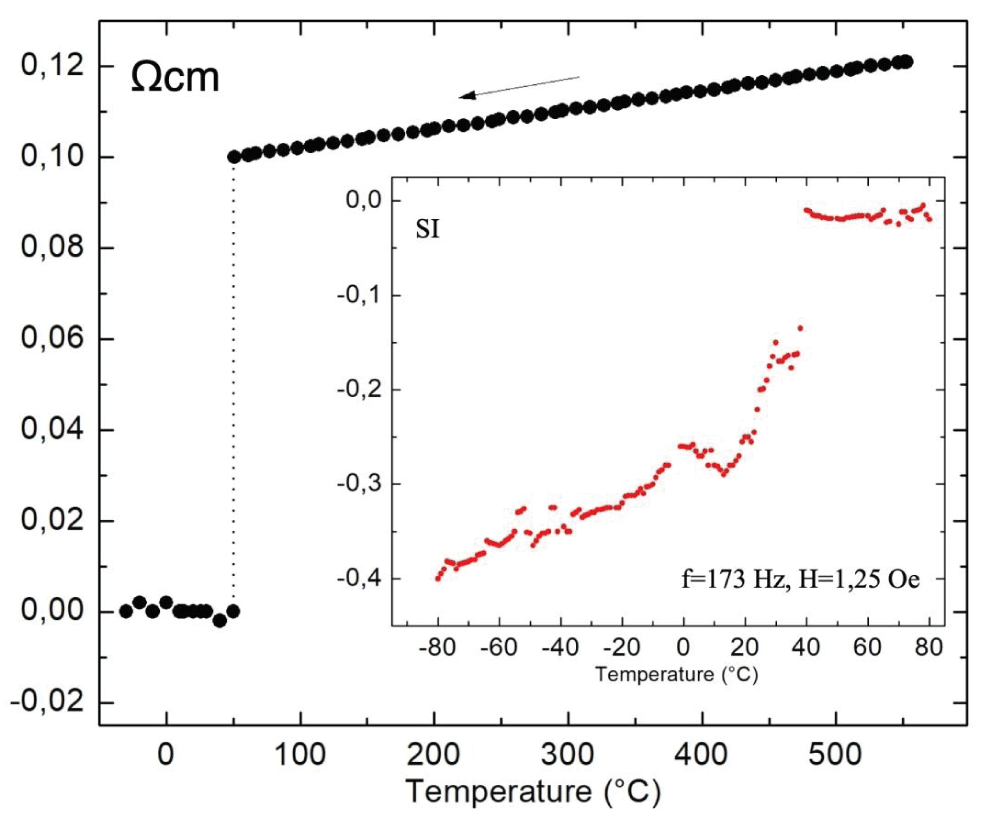
The next 4 heating-cooling cycles were indicated by further decrease of the electric resistance measured by I = 10 mA, and Figure 3 shows the linear dependence on temperature by cooling at T< 565 °C. Resistivity decreased to 0,10 Ohm·cm at 100 °C, which was followed by transition to the SC state at +39 °C, when resistivity falls below 10–7 W·cm after cooling to –32 °C. The width of the transition is of the order of 0.1 deg and the sharp decrease of the resistivity is characteristic in all sample preparations, which indicates the short coherence length in the linear chain conductivity, or alternatively a possible topological state. The inset presents the temperature dependence of the magnetic AC susceptibility measured by use of the primary and two oppositely connected secondary coils.
Figure 3: Temperature dependence of the electric resistivity of no-alloyed CuYO2,33 recorded after the 9th heating-cooling run, ranging from RT- 635 °C. The width of the transition is of the order of 0.1 deg, while the dotted line serves as a guide to the eye. The inset shows the temperature dependence of the AC magnetic susceptibility measured by use of primary and two oppositely connected secondary coils. Oxygen content in the pellet was estimated by its decomposition at 400 °C in a 2 bar H2 atmosphere. The final formula may be expressed as CuYO2+ δ, δ ~0,28–0,36.
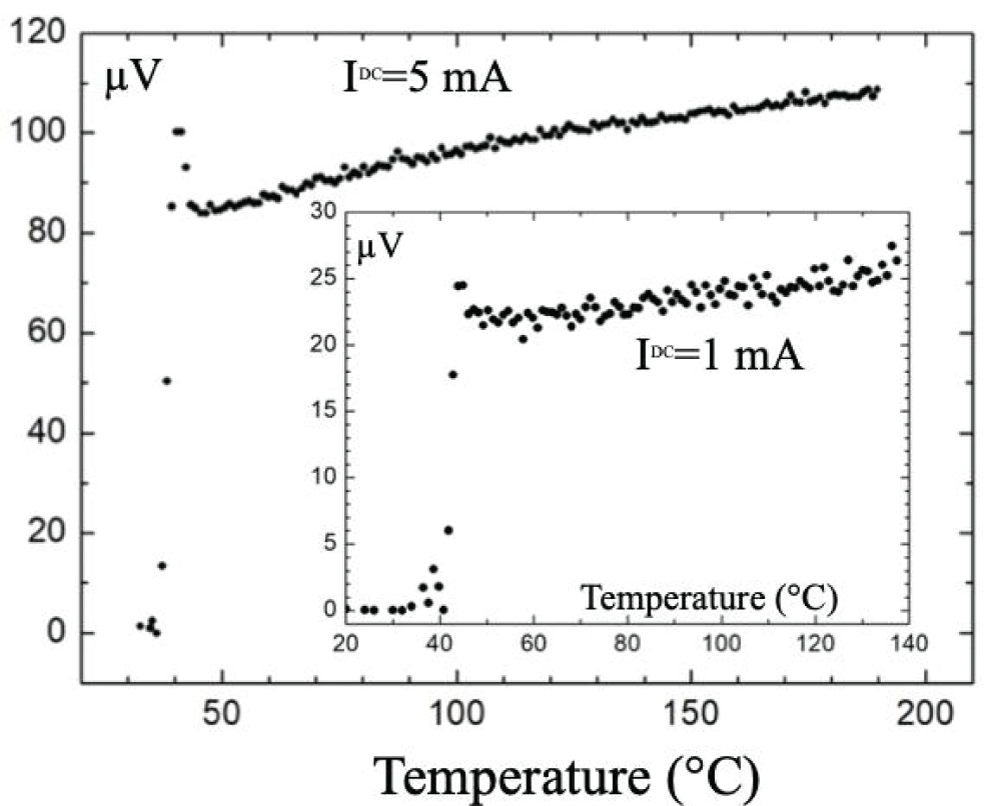
Temperature dependence of the resistance of the pellet fired at 809 °C in air, cooled to RT and subsequently subjected to an additional 9 heating-cooling cycles (Figure 4).
Figure 4: Temperature dependence of the resistance of CuYO2+x fired at 809 °C in air. The heating-cooling process was repeated 10 times in 10 days of the preparation time. Heating up to firing temperature was performed in 2 hours, while cooling lasted 24 hours. Resistance was measured using two DC currents: 5 and 1 mA.
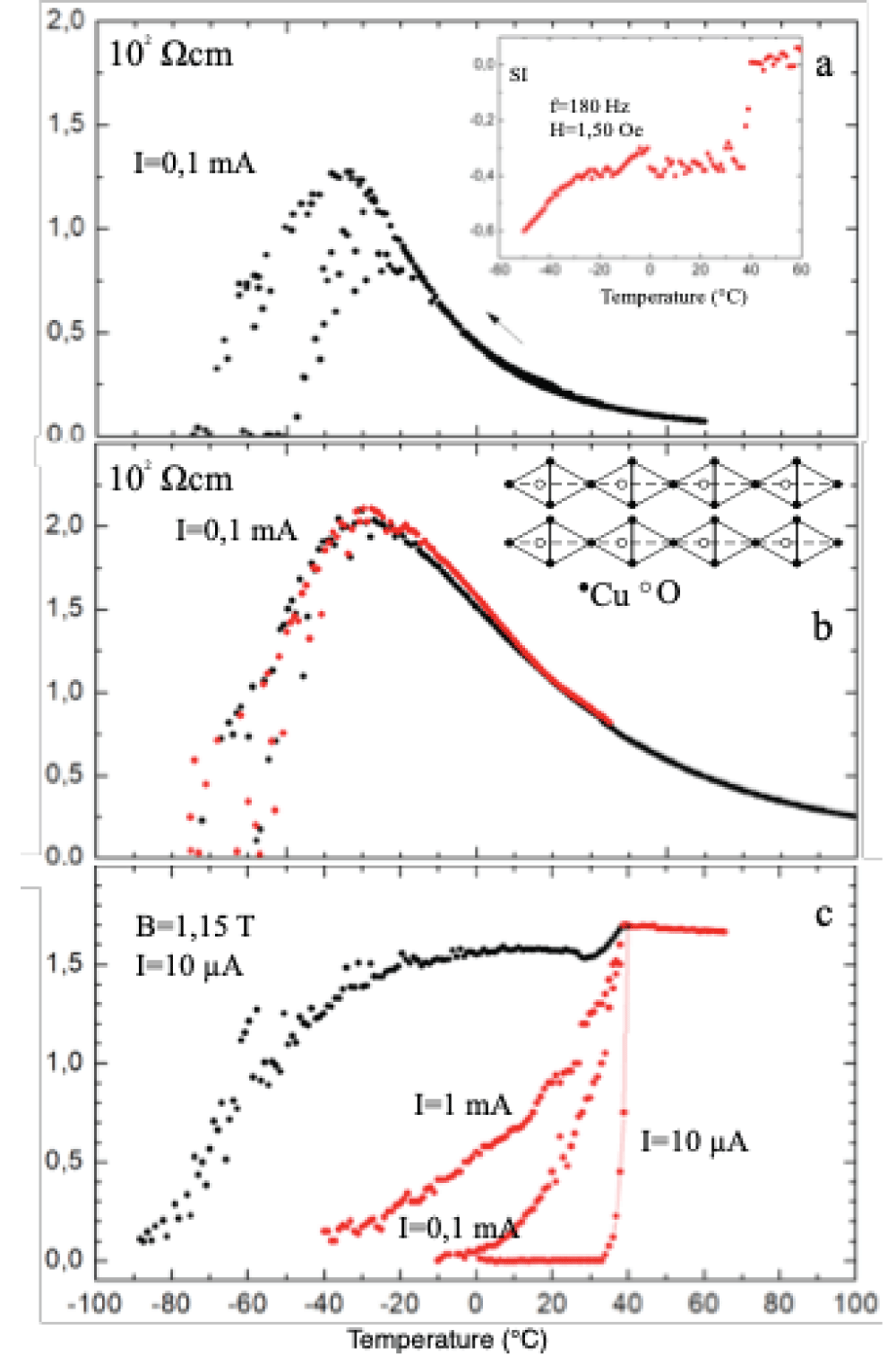
The next set of preparations includes samples alloyed by 3 different concentrations of YBa2Cu3O6. Samples were fired in an air atmosphere at a temperature range of 842-845 °C for 40 hours, then reheated from RT up to 415 °C in air, annealed at this temperature for 12 hours, and cooled to RT. Figure 5a shows the temperature dependence of the resistivity of the sample alloyed by 2 w/w percent. Transition to the SC state is indicated by two independent curves in the single cooling run, and the probable reason for this splitting is oxygen O1 transfer between polytypes, which manifests as two independent transition temperatures.
Figure 5: Temperature dependence of the electric resistivity of 3 samples CuYO2, 33, which differ by YBa2Cu3O6 alloying levels expressed as w/w percentages: Diagrams show electric resistivity of samples CuYO2, 33: (a) in a single cooling run alloyed 2%, (b) in the single cooling run alloyed 5%, (c) electric resistivities of the 10% alloyed sample measured by three different currents and current I = 10 µA in a magnetic field 1, 15 Tesla. All measured resistivities are normalized at + 39 °C. Insets of diagrams present: (a) temperature dependence of the AC magnetic susceptibility of the sample presented in diagram (c), (b) the possible Cu-O chain structure stretched along the crystallographic b-axis
Alloying performed at a 5 percent concentration results in two transition curves merging into a nearly single transition, as it is shown in Figure 5b. The inset represents the possible Cu-O chain construction stretched along the crystallographic b-axis. Finally, a concentration of 10 w/w percent results in the sample exhibiting a sharp resistive transition at a measuring current of 10 mA, to SC at +39 °C, as it is shown in Figure 3c. The magnetic field 1,15 Tesla partly recovers the normal state by cooling, while the application of two higher measuring currents 0,1 and 1 mA, recovers the normal resistivity. The temperature dependence of a magnetic AC susceptibility is shown in the inset of Figure 5a.
According to measured data, delafossite oxide CuYO2 becomes metallic if Cu planes, sandwiched between octahedral Y-O planes, are doped up to 0,33 molar oxygen. Metallic conductivity may be achieved either in the chains spanned along the b-axis, or by topological mechanisms promoted in the past two decades. Strong lateral localization of the chains may prevent the formation of the topological state. However, according to Pauling [13], px and py orbitals may rotate in the a-b plane and remove localization in this case. 1D superconductivity at Tc > 30 K has not been reported so far, and I discuss the evaluated data in terms of topological models, despite the fact they offer, currently, scarce number of measurable physical quantities.
Attempting to put the listed properties in the frame of RT superconductivity, when the transition temperature is comparable to the Debye temperature Q, requires the revoking of the Cooper pairing mechanism. According to BCS theory [14], the SC transition temperature is expressed as Tc = 1,14·Q ·exp[–1/V·D(EF)], and Tc ~ Q implies an extremely high pairing potential V, far beyond the acoustical energy range, which in turn removes the role of the phonons in pairing. Searching for the pairing mechanism in the higher energy range, beyond the BCS theory, imposes several hints listed in the forthcoming text.
Doping oxygen anions O1 are in the centres of equilateral and corner-sharing triangles and are indicated by two important properties. Firstly, contraction of the Cu-Cu distance doesn’t result in electrical conductivity, and CuYO2 is an insulator. Secondly, strong contraction of the Cu-Cu distance supports the role of relativity put forward by Pyykkö [15] when the Cu bonds d10–d10 are reduced in the presence of the small-sized (0,09 nm) Y cation. The author evaluated the energy of Cu-Cu contraction ~ 41 kJ/mole = 0,44 eV/atom, which is close to the spinon-holon energy in a linear chain [16]. Otherwise, contraction energy may be considered as elastic stress caused by the contraction of the Cu-Cu distance. Young modulus of copper is ~ 1,3 · 1011 N/m2, and the derived energy change is DW ~ 0,65 eV/ atom. It is supposed that this energy equals the chemical potential m. It is noteworthy that very similar, but insulating, oxide SrCuO2 exhibits no relativistic Cu-Cu contraction because the Sr ionic radius is 0,11 nm, which is considerably higher than that of Y. Two basic approaches to the problem of unconventional superconductivity may be of particular importance: particle-hole pair formation and pairing mechanism. Secondly, modern models of topological superconductivity based on Dirac-Weyl-Majorana theories attract growing interest in the scientific community.
The recent report of Schmitt and co-workers [17] is based on the Klein-Schwinger (KS) effect [18,19] and the corresponding annihilation of the photon field to an electron-positron pair. However, annihilation needs an enormous electric field, of the order of 1018 V/m, currently inaccessible in the laboratory. Alternatively, the authors supposed that the KS effect may be analogous to the creation of an electron-hole pair in solids, when the velocity of light is replaced by the Fermi velocity. According to QED, an electron emits virtual photons which are absorbed, and such a mechanism could be, per analogy, applied to emission and absorption of virtual phonons [20]. Required field strength could be reduced to the order of 107 V/m. Such a field is accessible in pinchoff of ballistic graphene transistors, and the authors report Schwinger conductance ~0,6 mS.
A question arises on the source of the field, and it may be recognized in the vacuum energy fluctuations giving rise to spontaneous photon emission [21]. A popular manifestation of such fluctuations is the Casimir force [22,23] acting between two conducting and uncharged plates, Fcas =p·c·h·S/480·d4. S and d are the area and plate distance, respectively. An estimation of the electric field between two Cu planes, distant d = 0,57 nm in CuYO2,33, may be considered as the equivalent force between two capacitor plates Fcap = e··e0·S·E2·d/2, and by assumption of identity Fcas = Fcap, the result gives E~5·1010 V/m, while introduction of this field in the Thomas-Fermi expression for the spin-orbit coupling.
H = e(dV/dr)S M/2 m2c2r S = hs/4pM = rxp (1)
gives H ~ 0,52 eV, which is a considerable enhancement when compared to spin-orbit coupling in copper ~0,08-0,1 eV. Strong spin-orbit coupling, driven by the Casimir vacuum field, is essential for the appearance of the possible topological insulator in CuYOx. Stacks, stretched along the c-axis as it is shown in the inset of Figure 1, appeal to the model of heterostructure stacks proposed by Burkov and Balents [24]. The authors derived several possible scenarios for the appearance of the topological phases in such a stacked structure.
The next observation arises about dynamics within the Cu-O chain. Lieb and Wu solved exactly the 1D Hubbard t-J Hamiltonian [25]. However, as pointed out by Anderson [26], transport phenomena in chains may not be explained only by the standard Hubbard model, and some additional potential must be introduced, giving t-J-V. Recently, V.V. Val'kov and co-workers [27] put forward the t-J-V model promoting topological superconductivity in low-dimensional systems. The crystal lattice of YCuO2 is indicated by inversion symmetry, which means that it satisfies the condition to represent a topological material. The authors evaluated the energy spectrum
(2)
D is the effective pair potential or superconducting gap parameter, while chemical potential m will be used here as a tunable trial parameter for testing the compatibility of the cited experiments with existing theoretical models. In the case that it is identical with the Cu-Cu contraction energy, the first term is zero when k = p , the gap in the spectrum closes, and a topological phase appears.
Recent models of topological superconductivity dominantly reside on the models of Bogoliubov and de Gennes, paying attention to the particle-hole symmetry that must be preserved [28]. In addition, an important achievement is offered by the reduction of the Hilbert space acting in the linear chain with 2N components to 2N components. The effective Bogoliubov-de Gennes Hamiltonian is given in the simplified form of a 4x4 matrix [29]
(3)
In the case ek ~ m, the diagonal elements are zero, and this may have twofold significance. Firstly, it may be worthy to suggest a rather plausible speculation about the appearance of the Majorana zero mode when energy disappears, and no ground state is established. Secondly, cancellation of diagonal elements simplifies the particle-hole symmetry test using the anti-unitary operator [30]
(4)
K is the complex conjugation operator, and particle-hole symmetry is verified using the expression:
C HBdG (k) C–1 = –HBdG(-–k) (5)
In Majorana representation, C = 1.
The next research will be devoted to additional preparations, experiments, and study of the possible common points between the fermions of Dirac, Weyl, and Majorana.
In the previous paper [8], it has been argued that insulating delafossite compound CuYO2 doped with oxygen up to CuYO2,33 becomes, by cooling below 39 °C, metallic and superconducting, while subsequent preparations of dozens of samples confirm the full reproducibility. An application of high compaction force to the 20 nm nano powders Y2O3 and CuO facilitates the preparations in air at temperatures 809-852 °C. Heating of the pressed pellets was monitored by simultaneous measurement of the electrical resistance, which in turn enables a precise discrimination of different polytypes. It remains to analyse the possible role of flowing DC in the merging of structural polytypes and ordering of the intercalated oxygen atoms. The metallic conductivity in delafossite CuYO2,33 proceeds in Cu–O planes sandwiched between Y-O6 planes. It is assumed that the reinterpreted Klein-Schwinger effect offers a possible driving mechanism necessary for the formation of electron-hole pairs. Presumably, relativistic Cu-Cu contraction energy plays the role of the chemical potential, which competes with the electron energy and gives rise to the electron-hole symmetry. It is suggested that the Casimir vacuum field, excited between the conducting Cu-O planes and stacked along the c-axis, enhances the spin-orbit coupling, which is essential for the formation of the topological state.
Data availability statement: Data are available upon request.
Funding: This research received no external funding.
Acknowledgment
The author is indebted to Dr M. Prester and Dr Dj. Drobac for providing the AC susceptibility data presented in ref [8] and for continuous interest throughout the course of the final preparation method presented in this paper.
Conflicts of interest: There is no conflict of interest.
Bednorz JG, Müller KA. Possible high Tc superconductivity in the Ba‑La‑Cu‑O system. Z Phys B Condens Matter. 1986;64:189‑93.
Er‑Rakho L, Michel C, Provost J, Raveau B. A series of oxygen‑defect perovskites containing CuII and CuIII: The oxides La3‑xLnxBa3[CuII5‑2yCuIII1+2y]O14+y. J Solid State Chem. 1981;37:151‑6.
Wu MK, Ashburn JR, Torng CJ, Hor PH, Meng RL, Gao L, Huang ZJ, Wang YQ, Chu CW. Superconductivity at 93 K in a new mixed‑phase Y‑Ba‑Cu‑O compound system at ambient pressure. Phys Rev Lett. 1987;58:908‑10.
Cava RJ, Battlogg B, van Dover RB, Murphy DW, Sunshine S, Siegrist T, Remeika JP, Rietman EA, Zahurak S, Espinosa GP. Bulk superconductivity at 91 K in single‑phase oxygen‑deficient perovskite Ba2YCu3O9‑δ. Phys Rev Lett. 1987;58:1676‑9.
Chu CV. New York Times. 1987 Mar 10.
Djurek D, Prester M, Knezović S, Drobac Dj, Milat O. Low resistance state up to 210 K in a mixed compound Y‑Ba‑Cu‑O. Phys Lett A. 1987;123:481‑4.
Djurek D, Prester M, Knezović S, Drobac Dj, Milat O, Brničević N, Furić K, Medunić Z, Vukelja T, Babić E. Treatment of Y‑Ba‑Cu‑O superconductors by pulsed electric fields and currents. Physica B. 1987;148:196‑9.
Djurek D. Search for novel phases in Y‑Ba‑Cu‑O family. Condens Matter. doi:10.3390/c.
Ishiguro T, Ishizawa N, Mizutani N, Kato M. A new delafossite‑type compound CuYO2. J Solid State Chem. 1983;49:232‑6.
Van Tendeloo G, Garlea O, Darie C, Bougerol‑Chaillout C, Bordet P. The fine structure of YCuO2+x delafossite determined by synchrotron powder diffraction and electron microscopy. J Solid State Chem. 2001;156:428‑36.
Garlea VO, Darie C, Isnard O, Bordet P. Synthesis and neutron powder diffraction structural analysis of oxidized delafossite YCuO2.5. Solid State Sci. 2006;8:457‑61.
Pauling L. The application of quantum mechanics to the structure of the hydrogen molecule‑ion and related problems. Chem Rev. 1928;5:173‑213.
Bardeen J, Cooper LN, Schrieffer JR. Theory of superconductivity. Phys Rev. 1957;108:1175‑204.
Pyykkö P. Relativistic effects in structural chemistry. Chem Rev. 1988;88:563‑94.
Kim C, Matsuura AY, Shen ZX, Motoyama N, Eisaki H, Uchida S, Tohyama T, Maekawa S. Observation of spin‑charge separation in one‑dimensional SrCuO2. Phys Rev Lett. 1996;77:4054‑7.
Schmitt A, Vallet P, Mole D, Rosticher M, Taniguchi K, Watanabe E, Bocquillon G, Feve JM, Berroir C, Volsin J, Cayssol MO, Goerbig J, Troost E, Baudin E, Plaçais B. Mesoscopic Klein‑Schwinger effect in graphene. Nat Phys. 2023;19:830‑5.
Klein O. Die Reflexion von Elektronen an einem Potentialsprung nach der relativistischen Dynamik von Dirac. Z Phys. 1929;53:157‑65.
Schwinger JS. On gauge invariance and vacuum polarization. Phys Rev. 1951;82:664‑79.
Nimtz G. On virtual phonons, photons and electrons. Found Phys. 2009;39:1346‑55.
Garrison JC, Chiao RY. Quantum optics. Oxford: Oxford University Press; 1974. p.60.
Casimir HBG, Polder D. The influence of retardation on the London‑van der Waals forces. Phys Rev. 1948;713:360‑72.
Casimir HBG. On the attraction between two perfectly conducting plates. Presented at: Colloque sur la théorie de la liaison chimique; 1948 Apr 29; Paris.
Burkov AA, Balents L. Weyl semimetal in a topological multilayer. Phys Rev Lett. 2011;107:127205.
Lieb EH, Wu PY. Absence of Mott transition in an exact solution of the short‑range model in one dimension. Phys Rev Lett. 1968;20:1445‑8.
Anderson PW, Ren Y. The one‑dimensional Hubbard model. In: Anderson PW. The theory of superconductivity in the high‑Tc cuprates. Princeton (NJ): Princeton University Press; 1997. p.132‑60.
Vol'kov VV, Shustin MS, Aksenov SV, Zlotnikov AO, Fedoseev AD, Mitskan VA, Kagan MYu. Topological superconductivity and Majorana states in low‑dimensional systems. Phys Usp. 2022;65:2‑39.
Ziegler K. Topological phases of the Bogoliubov–de Gennes Hamiltonian. arXiv [Preprint]. 2026. Available from: arXiv:2510.26128v2.
Elliott SR, Franz M. Colloquium: Majorana fermions in nuclear, particle, and solid‑state physics. Rev Mod Phys. 2015;87:137.
Sato M, Ando Y. Topological superconductors: a review. Rep Prog Phys. 2017;80:076501.
Djurek D. On a Novel Bulk Superconductor: Oxygen-Doped Delafossite Oxide CuYO2,33. IgMin Res. August 31, 2026; 4(8): 366-371. IgMin ID: igmin360; DOI:10.61927/igmin360; Available at: igmin.link/p360
Alessandro Volta Applied Ceramics (AVAC), 49247 Zlatar Bistrica, Augusta Šenoe 14. Croatia
Address Correspondence: Danijel Djurek, Alessandro Volta Applied Ceramics (AVAC), 49247 Zlatar Bistrica, Augusta Šenoe 14. Croatia, Email: [email protected]
How to cite this article: Djurek D. On a Novel Bulk Superconductor: Oxygen-Doped Delafossite Oxide CuYO2,33. IgMin Res. August 31, 2026; 4(8): 366-371. IgMin ID: igmin360; DOI:10.61927/igmin360; Available at: igmin.link/p360
Figure 1: DTA and TGA records of the unfired mixture of nan...
Figure 2: Temperature dependence of the electric resistivity...
Figure 3: Temperature dependence of the electric resistivity...
Figure 4: Temperature dependence of the resistance of CuYO2+...
Figure 5: Temperature dependence of the electric resistivity...
Bednorz JG, Müller KA. Possible high Tc superconductivity in the Ba‑La‑Cu‑O system. Z Phys B Condens Matter. 1986;64:189‑93.
Er‑Rakho L, Michel C, Provost J, Raveau B. A series of oxygen‑defect perovskites containing CuII and CuIII: The oxides La3‑xLnxBa3[CuII5‑2yCuIII1+2y]O14+y. J Solid State Chem. 1981;37:151‑6.
Wu MK, Ashburn JR, Torng CJ, Hor PH, Meng RL, Gao L, Huang ZJ, Wang YQ, Chu CW. Superconductivity at 93 K in a new mixed‑phase Y‑Ba‑Cu‑O compound system at ambient pressure. Phys Rev Lett. 1987;58:908‑10.
Cava RJ, Battlogg B, van Dover RB, Murphy DW, Sunshine S, Siegrist T, Remeika JP, Rietman EA, Zahurak S, Espinosa GP. Bulk superconductivity at 91 K in single‑phase oxygen‑deficient perovskite Ba2YCu3O9‑δ. Phys Rev Lett. 1987;58:1676‑9.
Chu CV. New York Times. 1987 Mar 10.
Djurek D, Prester M, Knezović S, Drobac Dj, Milat O. Low resistance state up to 210 K in a mixed compound Y‑Ba‑Cu‑O. Phys Lett A. 1987;123:481‑4.
Djurek D, Prester M, Knezović S, Drobac Dj, Milat O, Brničević N, Furić K, Medunić Z, Vukelja T, Babić E. Treatment of Y‑Ba‑Cu‑O superconductors by pulsed electric fields and currents. Physica B. 1987;148:196‑9.
Djurek D. Search for novel phases in Y‑Ba‑Cu‑O family. Condens Matter. doi:10.3390/c.
Ishiguro T, Ishizawa N, Mizutani N, Kato M. A new delafossite‑type compound CuYO2. J Solid State Chem. 1983;49:232‑6.
Van Tendeloo G, Garlea O, Darie C, Bougerol‑Chaillout C, Bordet P. The fine structure of YCuO2+x delafossite determined by synchrotron powder diffraction and electron microscopy. J Solid State Chem. 2001;156:428‑36.
Garlea VO, Darie C, Isnard O, Bordet P. Synthesis and neutron powder diffraction structural analysis of oxidized delafossite YCuO2.5. Solid State Sci. 2006;8:457‑61.
Pauling L. The application of quantum mechanics to the structure of the hydrogen molecule‑ion and related problems. Chem Rev. 1928;5:173‑213.
Bardeen J, Cooper LN, Schrieffer JR. Theory of superconductivity. Phys Rev. 1957;108:1175‑204.
Pyykkö P. Relativistic effects in structural chemistry. Chem Rev. 1988;88:563‑94.
Kim C, Matsuura AY, Shen ZX, Motoyama N, Eisaki H, Uchida S, Tohyama T, Maekawa S. Observation of spin‑charge separation in one‑dimensional SrCuO2. Phys Rev Lett. 1996;77:4054‑7.
Schmitt A, Vallet P, Mole D, Rosticher M, Taniguchi K, Watanabe E, Bocquillon G, Feve JM, Berroir C, Volsin J, Cayssol MO, Goerbig J, Troost E, Baudin E, Plaçais B. Mesoscopic Klein‑Schwinger effect in graphene. Nat Phys. 2023;19:830‑5.
Klein O. Die Reflexion von Elektronen an einem Potentialsprung nach der relativistischen Dynamik von Dirac. Z Phys. 1929;53:157‑65.
Schwinger JS. On gauge invariance and vacuum polarization. Phys Rev. 1951;82:664‑79.
Nimtz G. On virtual phonons, photons and electrons. Found Phys. 2009;39:1346‑55.
Garrison JC, Chiao RY. Quantum optics. Oxford: Oxford University Press; 1974. p.60.
Casimir HBG, Polder D. The influence of retardation on the London‑van der Waals forces. Phys Rev. 1948;713:360‑72.
Casimir HBG. On the attraction between two perfectly conducting plates. Presented at: Colloque sur la théorie de la liaison chimique; 1948 Apr 29; Paris.
Burkov AA, Balents L. Weyl semimetal in a topological multilayer. Phys Rev Lett. 2011;107:127205.
Lieb EH, Wu PY. Absence of Mott transition in an exact solution of the short‑range model in one dimension. Phys Rev Lett. 1968;20:1445‑8.
Anderson PW, Ren Y. The one‑dimensional Hubbard model. In: Anderson PW. The theory of superconductivity in the high‑Tc cuprates. Princeton (NJ): Princeton University Press; 1997. p.132‑60.
Vol'kov VV, Shustin MS, Aksenov SV, Zlotnikov AO, Fedoseev AD, Mitskan VA, Kagan MYu. Topological superconductivity and Majorana states in low‑dimensional systems. Phys Usp. 2022;65:2‑39.
Ziegler K. Topological phases of the Bogoliubov–de Gennes Hamiltonian. arXiv [Preprint]. 2026. Available from: arXiv:2510.26128v2.
Elliott SR, Franz M. Colloquium: Majorana fermions in nuclear, particle, and solid‑state physics. Rev Mod Phys. 2015;87:137.
Sato M, Ando Y. Topological superconductors: a review. Rep Prog Phys. 2017;80:076501.






 スキャンしてリンクを取得