


Help ?

IGMIN: あなたがここにいてくれて嬉しいです. お願いクリック '新しいクエリを作成してください' 当ウェブサイトへの初めてのご訪問で、さらに情報が必要な場合は.

すでに私たちのネットワークのメンバーで、すでに提出した質問に関する進展を追跡する必要がある場合は, クリック '私のクエリに連れて行ってください.'

Search

Organised by  IgMin Fevicon

Regional sites

Browse by Subjects

Welcome to IgMin Research – an Open Access journal uniting Biology, Medicine, and Engineering. We’re dedicated to advancing global knowledge and fostering collaboration across scientific fields.

Browse by Sections

At IgMin Research, we bridge the frontiers of Biology, Medicine, and Engineering to foster interdisciplinary innovation. Our expanded scope now embraces a wide spectrum of scientific disciplines, empowering global researchers to explore, contribute, and collaborate through open access.

Members

We focus on enhancing knowledge exchange between disciplines to achieve rapid innovation.

Articles

We focus on enhancing knowledge exchange between disciplines to achieve rapid innovation.

Explore Content

We focus on enhancing knowledge exchange between disciplines to achieve rapid innovation.

Identify Us

We focus on enhancing knowledge exchange between disciplines to achieve rapid innovation.

IgMin Corporation

Welcome to IgMin, a leading platform dedicated to enhancing knowledge dissemination and professional growth across multiple fields of science, technology, and the humanities. We believe in the power of open access, collaboration, and innovation. Our goal is to provide individuals and organizations with the tools they need to succeed in the global knowledge economy.

Publications Support
[email protected]
E-Books Support
[email protected]
Webinars & Conferences Support
[email protected]
Content Writing Support
[email protected]
IT Support
[email protected]

Search

Select Language

Explore Section

Content for the explore section slider goes here.

Abstract

要約 at IgMin Research

We focus on enhancing knowledge exchange between disciplines to achieve rapid innovation.

Medicine Group Research Article 記事ID: igmin323

Comparing Forecasting Models for Predicting Infant Mortality: VECM vs. VAR and BVAR Specifications

Epidemiology Public Health DOI10.61927/igmin323 Affiliation

Affiliation

    School of Statistics and Planning, Makerere University, Kampala, Uganda

71
VIEWS
18
DOWNLOADS
Connect with Us

要約

This study investigates infant mortality in Uganda, a persistent public health challenge in many developing countries where economic disparities limit access to healthcare. It compares the forecasting performance of three econometric models; Vector Error Correction Model (VECM), Vector Autoregressive (VAR), and Bayesian VAR (BVAR) using annual data on infant mortality rates (IMR), neonatal mortality rates (NMR), GDP, and GDP per capita (GDPP) from 1954 to 2016. Model accuracy was evaluated using Mean Squared Error (MSE), Root Mean Squared Error (RMSE), and Theil’s U-statistic.
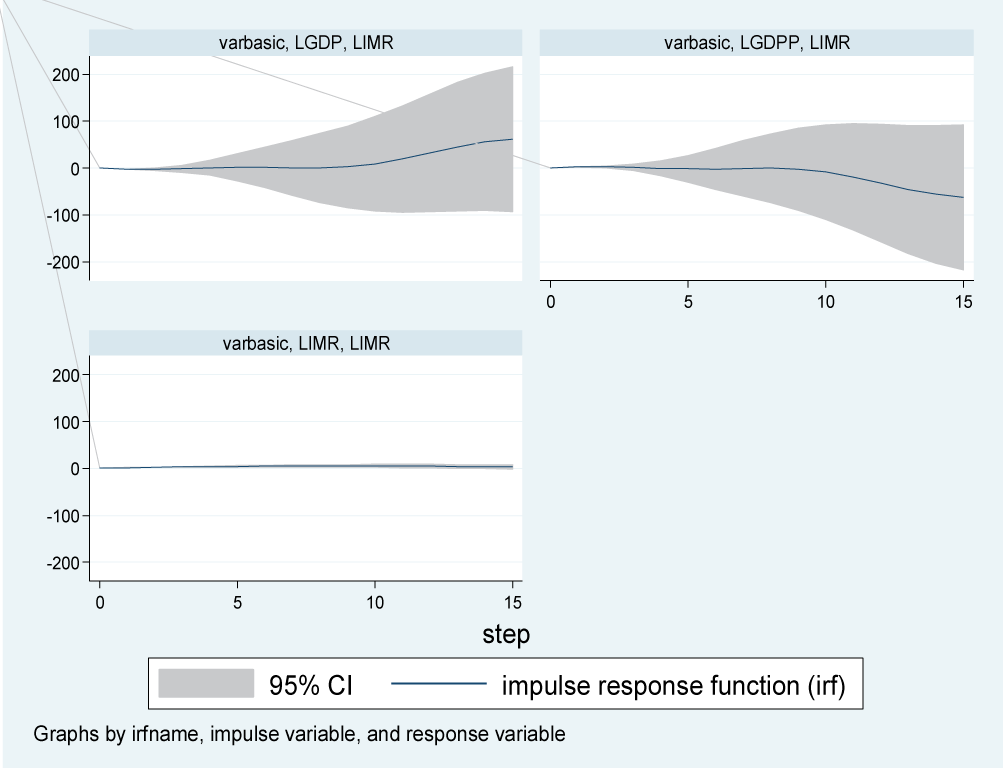
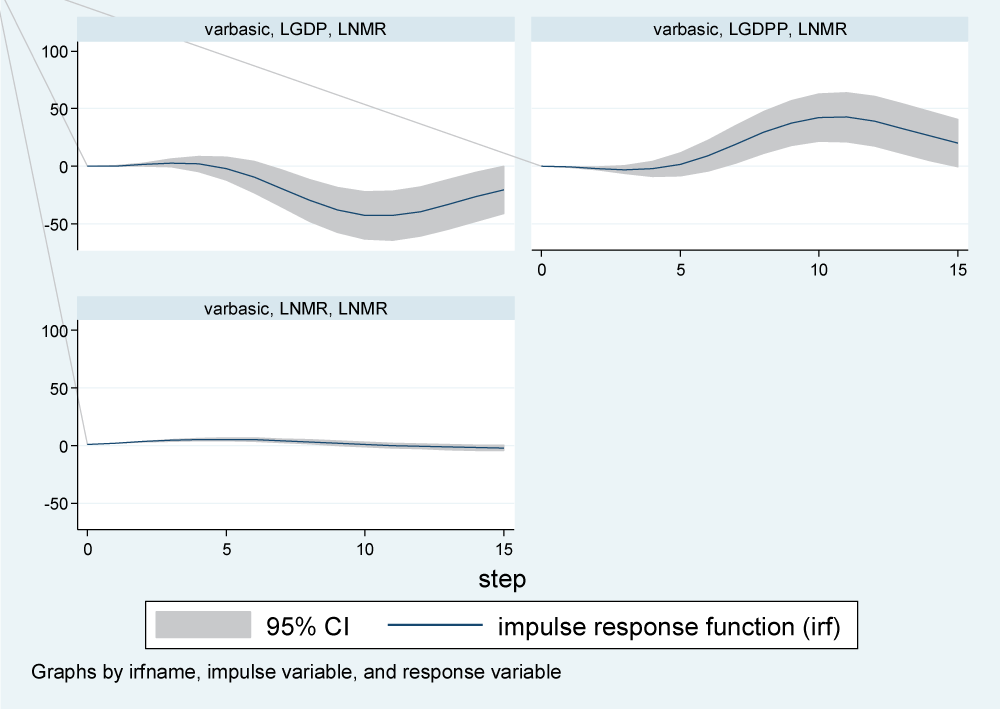
The results show strong long-term relationships among IMR, NMR, GDP, and GDPP. VECM provides the most reliable long-term forecasts, with an adjusted R-squared of 97.7%. Impulse response analysis indicates that GDP increases IMR in the short run, while GDPP exerts a stronger long-term reducing effect. For NMR, GDP has a negative impact, whereas GDPP shows a gradual positive response over time. Granger causality tests reveal bidirectional causality between GDPP and IMR, and a unidirectional influence of IMR on GDP.
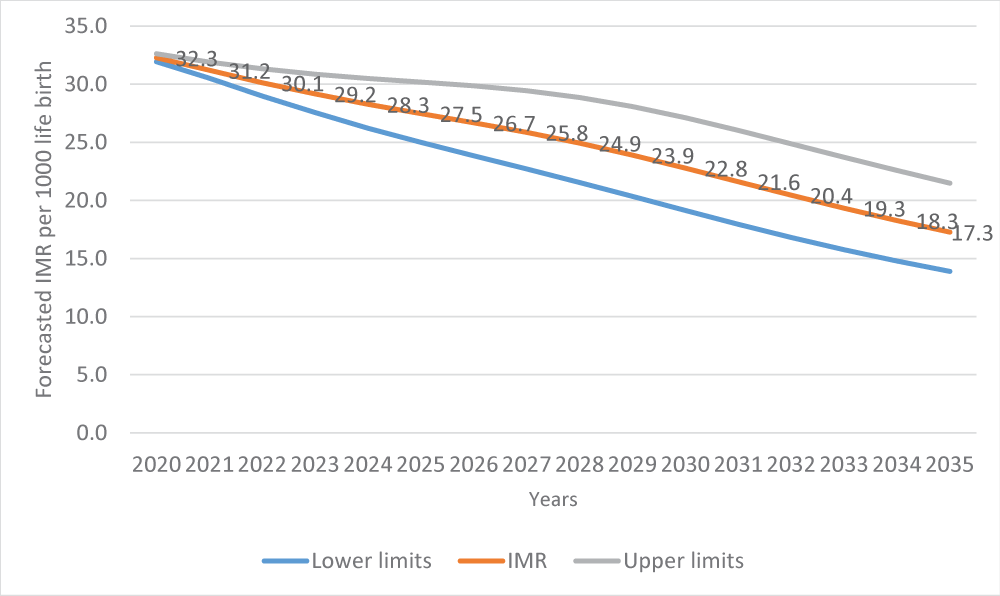
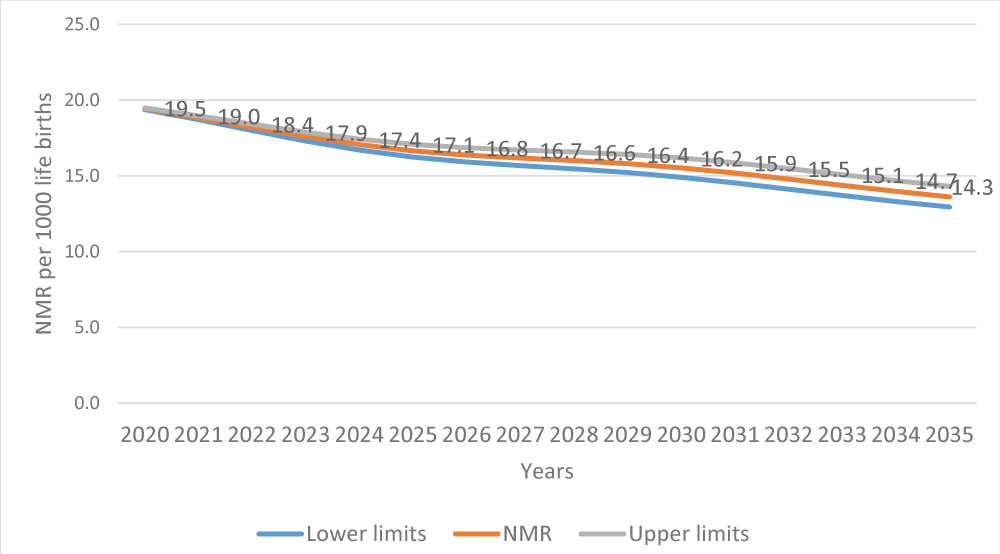
Uganda’s IMR is projected to fall to about 17 deaths per 1,000 live births by 2035, though NMR declines will slow. Policymakers should use VECM for long-term planning due to its superior accuracy and the strong cointegration among IMR, NMR, GDP, and GDPP, while VAR/BVAR can guide short-term monitoring. Because GDPP most strongly reduces mortality, welfare-enhancing strategies such as social protection and employment are crucial. GDP gains should fund maternal and neonatal health, and systems must be strengthened to withstand economic shocks.
数字

参考文献

    1. Sharrow D. Open access article under the CC BY 4.0 license. 2022. doi:10.1016/S2214-109X(21)00515-5.
    2. Baraki A, Kedir H, Geda T. The impact of preventable neonatal encephalopathy and infections on neonatal mortality in developing countries. Int J Pediatr. 2020;8(5):72–79.
    3. World Health Organization. Neonatal mortality: the silent epidemic. Geneva: World Health Organization; 2017.
    4. Khelfaoui M, Zougari S, Douma L. The impact of maternal education and economic factors on infant mortality in Uganda. J Dev Econ. 2022;87(4):89–104.
    5. Ensor T, Gafur S. The effect of GDP fluctuations on maternal and infant mortality rates in developing nations. J Health Econ. 2010;22(3):223–235.
    6. Levels and trends in child mortality: report 2017. New York: United Nations Children’s Fund; 2017.
    7. Arshia A, Ulf-G G. The causal effect of maternal and child mortality on GDP in high-income and upper-middle-income countries. Int J Health Econ Manag. 2013;13(2):121–136.
    8. Erdil E, Yildirim A. The Granger-causality approach to examining GDP and health expenditures per capita. Appl Econ Lett. 2010;17(12):1151–1155.
    9. Njenga F. Bayesian VAR models for mortality rate forecasts in Australia. Aust J Econ Model. 2015;12(1):67–79.
    10. Fu W, Smit B, Brewer P, Droms S. Markov-switching Bayesian vector autoregression model in mortality forecasting. Risk. 2023;11(9). doi:10.3390/risks11090152.
    11. Mishra S, Sahanaa R, Manikandan S. Forecasting IMR in India from 1971 to 2016 using ARIMA models. Int J Health Forecast. 2019;26(2):145–159.
    12. Shafi KM, Samreen F, Syeeda S. Modeling and forecasting infant mortality rates of Asian countries from the perspective of GDP (PPP). Int J Sci Eng Res. 2019;10(3).
    13. Usman A. Application of ARIMA models to analyze newborn mortality trends in Nigeria. Int J Health Forecast. 2019;28(5):171–182.
    14. Lin W, Lee C. Exploring the relationship between healthcare spending and life expectancy using VECM. Int J Public Health Econ. 2016;49(2):112–130.
    15. Sulaiman T, Salleh M. Forecasting infant mortality in developing countries using the vector error correction model (VECM). J Health Econ. 2019;19(4):210–218.
    16. Zhou H. Mortality rate modeling using VECM: an approach for improving forecast accuracy. J Forecast. 2014;33(1):56–63.
    17. Arnold F, Sherris J. Application of VECM in assessing cause-of-death mortality rates. J Popul Health. 2013;56(3):459–478.
    18. Siahanidou T. Analysis of IMR trends in Greece from 2004 to 2016 using VECM. Eur J Popul. 2019;35(6):787–799.
    19. Liao TF. Analysis of the relationship between health expenditures and health outcomes in China using vector autoregressive (VAR) models. Asian J Public Health. 2017;37(5):209–220.
    20. The effects of health expenditure on infant mortality in sub-Saharan Africa: evidence from panel data analysis. J Public Aff. 2018.
    21. Faye O. Assessing the relationship between health expenditure, GDP, and IMR in the Philippines using a vector autoregressive (VAR) model. Glob Health Action. 2014;7(1):28–36.
    22. Lane S. The impact of public health expenditure on national health outcomes: a statistical analysis. J Public Health Policy. 2013;34(3):396–405.
    23. Chung H, Muntaner C. The effect of income inequality on infant mortality across various countries. Am J Public Health. 2006;96(10):1780–1786.
    24. Robert BL. Forecasting with Bayesian vector autoregressions: five years of experience. J Bus Econ Stat. 1986;4(1):25–38. doi:10.2307/1391384.
    25. Kholid H. Forecasting health outcomes in low-income countries using Bayesian VAR models. Int J Health Forecast. 2019;45(3):168–182.
    26. Elliott G, Rothenberg T, Stock J. Efficient tests for an autoregressive unit root. J Econom. 2016;55(1):1–24.
    27. Guibert L, Lopez B, Piette J. Forecasting mortality rates using Bayesian VAR: improving forecast accuracy in uncertain environments. J Forecast. 2019;40(4):290–302.
    28. Fernández C. Comparison of VAR and BVAR models in forecasting macroeconomic variables. J Forecast. 2018;37(5):529–546.
    29. Granger CWJ, Newbold P. Spurious regressions in econometrics. J Econom. 1974;111–120. doi:10.1016/0304-4076(74)90034-7.
    30. Danao M. Statistical methods for time series analysis: issues in regression and co-integration models. Econ J Southeast Asia. 2002;24(3):111–132.
    31. Box G, Jenkins G. Time series analysis: forecasting and control. 2nd ed. San Francisco: Holden-Day; 1976.
    32. Dickey D, Fuller W. Likelihood ratio statistics for autoregressive time series with a unit root. Econometrica. 1981;49(4):1057–1072.
    33. Dickey D, Fuller W. Distribution of the estimators for autoregressive time series with a unit root. J Am Stat Assoc. 1979;74(366):427–431.
    34. Economic growth, financial and trade globalization in the Philippines: a vector autoregressive analysis. 2014.
    35. Alkema L, New J. Progress toward global reduction in under-5 mortality: a bootstrap analysis of uncertainty in Millennium Development Goal 4 estimates. PLoS Med. 2012;9(12):e1001355.
    36. Lütkepohl H. New introduction to multiple time series analysis. Berlin: Springer; 2005.
    37. Enders W. Applied econometric time series. 4th ed. Hoboken: Wiley; 2015.
    38. Kilian L, Lütkepohl H. Structural vector autoregressive analysis. Cambridge: Cambridge University Press; 2017.
    39. Kurniasih W. Evaluation of the accuracy of ARIMA, Holt–Winters, and the α-Sutte indicator in forecasting mortality rates. Asian J Forecast. 2018;25(2):205–218.
    40. Bhowmik M. Relationship between GDP, health expenditure, and the Human Development Index in the SAARC region. J Dev Stud. 2019;17(1):35–48.
    41. Carolyn N, Michael S. Modeling mortality with a Bayesian vector autoregression. Insurance Math Econ. 2020.
    42. David S. A systematic analysis by the UN Inter-agency Group for Child Mortality Estimation. Elsevier; n.d. doi:10.1016/S2214-109X(21)00515-5.

類似の記事

Kinetic Study of the Removal of Reafix Yellow B8G Dye by Boiler Ash
Peterson Filisbino Prinz, Mariane Hawerroth, Liliane Schier de Lima and Juliana Martins Teixeira de Abreu Pietrobelli
DOI10.61927/igmin127
Diagnostic Challenges in Pancreatic Tumors
Ionuţ Simion Coman, Elena Violeta Coman, Costin George Florea, Teodora Elena Tudose, Cosmin Burleanu, Anwar Erchid and Valentin Titus Grigorean
DOI10.61927/igmin185

Why publish with us?

  • Global Visibility – Indexed in major databases

  • Fast Peer Review – Decision within 14–21 days

  • Open Access – Maximize readership and citation

  • Multidisciplinary Scope – Biology, Medicine and Engineering

  • Editorial Board Excellence – Global experts involved

  • University Library Indexing – Via OCLC

  • Permanent Archiving – CrossRef DOI

  • APC – Affordable APCs with discounts

  • Citation – High Citation Potential

Submit Your Article

Advertisement