



要約
Objective: We compared the prevalence of abnormal glucose status between Senegalese migrants and their relatives staying in their villages in Fuuta (a rural region in the Northern part of Senegal).
Design and methods: We led an exhaustive study on all the Senegalese migrants present in Saint-Die (Vosges, France) (SD) at a 1-year interval. We led a similar study at the same period on their relatives in their villages of Fuuta (F). Study parameters were Weight (W), height, Body Mass Index (BMI), Waist/Hip Ratio (WHR), and Fasting Capillary Glycaemia (FCG) expressed in total blood glucose. We classified patients into normal (N: FCG ≤ 1.00 g/l), Impaired Fasting Glycaemia (IFG: FCG between 1.00 g/l and 1.09 g/l), diabetic (D: FCG > 1.10 g/l when fasting or ≥ 1.80 g/l when not fasting), or abnormal glucose status (IFG + D). SD sample included 74 subjects (58.1% female) of mean age 41.7+/-12.7 years. The sample included 847 subjects (66.9% female) of mean age 37.3+/-17.8 years.
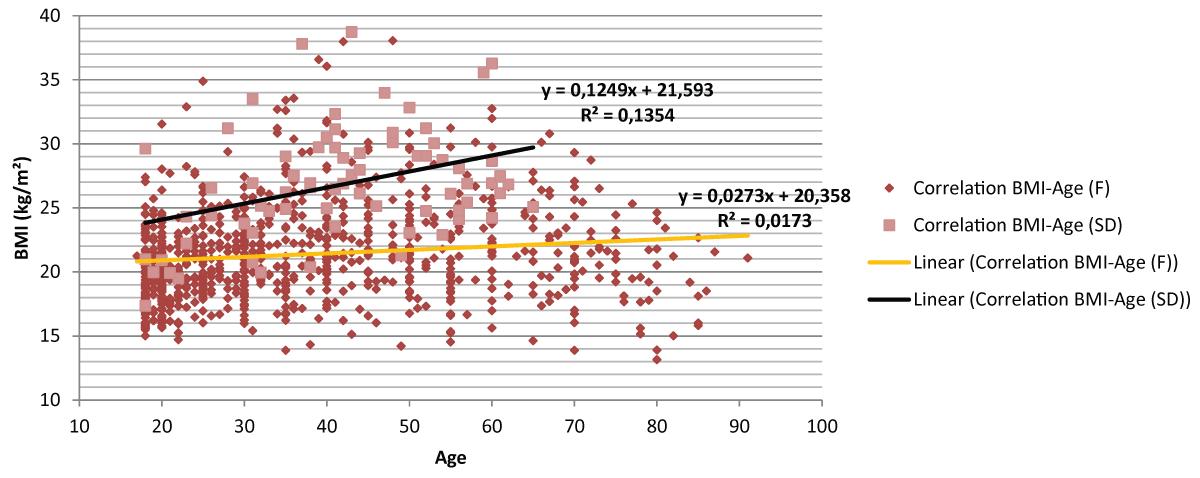
Results: In the SD group, W was 76.8+/-11.4 kg (BMI = 26.80+/-4.30 kg/m2); 57 (77.03%) had normal blood glucose, and 17 (22.97%) had IFG+D, among whom 12 (70.6%) were diabetic. In the F group, W was 60.8+/-10.9 kg (BMI = 21.37+/-3.70 kg/m2); 791 (93.39%) had normal blood glucose, and only 56 (6.61%) had IFG+D, among whom 35 (62.5%) were diabetic. Prevalence of IFG+D between SD and F was significantly different (p < 0.01%). There are still significant differences after standardization on age.
Conclusion: As described in other countries, Senegalese migrants have a much higher risk of developing diabetes mellitus than their relatives remaining in their birth country. The main reason seems to be the nutritional transition (diet and sedentary lifestyle).