


Help ?

IGMIN: あなたがここにいてくれて嬉しいです. お願いクリック '新しいクエリを作成してください' 当ウェブサイトへの初めてのご訪問で、さらに情報が必要な場合は.

すでに私たちのネットワークのメンバーで、すでに提出した質問に関する進展を追跡する必要がある場合は, クリック '私のクエリに連れて行ってください.'

Search

Organised by  IgMin Fevicon

Regional sites

Browse by Subjects

Welcome to IgMin Research – an Open Access journal uniting Biology, Medicine, and Engineering. We’re dedicated to advancing global knowledge and fostering collaboration across scientific fields.

Browse by Sections

At IgMin Research, we bridge the frontiers of Biology, Medicine, and Engineering to foster interdisciplinary innovation. Our expanded scope now embraces a wide spectrum of scientific disciplines, empowering global researchers to explore, contribute, and collaborate through open access.

Special Issues

Our purpose is to support shared research goals that lead to quicker innovation.

Members

Our purpose is to support shared research goals that lead to quicker innovation.

Articles

Our purpose is to support shared research goals that lead to quicker innovation.

Explore Content

Our purpose is to support shared research goals that lead to quicker innovation.

Identify Us

Our purpose is to support shared research goals that lead to quicker innovation.

IgMin Corporation

Welcome to IgMin, a leading platform dedicated to enhancing knowledge dissemination and professional growth across multiple fields of science, technology, and the humanities. We believe in the power of open access, collaboration, and innovation. Our goal is to provide individuals and organizations with the tools they need to succeed in the global knowledge economy.

Publications Support
[email protected]
E-Books Support
[email protected]
Webinars & Conferences Support
[email protected]
Content Writing Support
[email protected]
IT Support
[email protected]

Search

Select Language

Explore Section

Content for the explore section slider goes here.

Abstract

要約 at IgMin Research

Our purpose is to support shared research goals that lead to quicker innovation.

Engineering Group Review Article 記事ID: igmin346

Machine Learning-Driven Discovery of Novel Lithium-Based Battery Materials

Machine Learning DOI10.61927/igmin346 Affiliation

Affiliation

    1Computational and Data Sciences (CDS), George Mason University, Fairfax, VA, USA

    2US Naval Research Laboratory, Washington, DC, 20375 USA

1.7k
VIEWS
322
DOWNLOADS
Connect with Us

要約

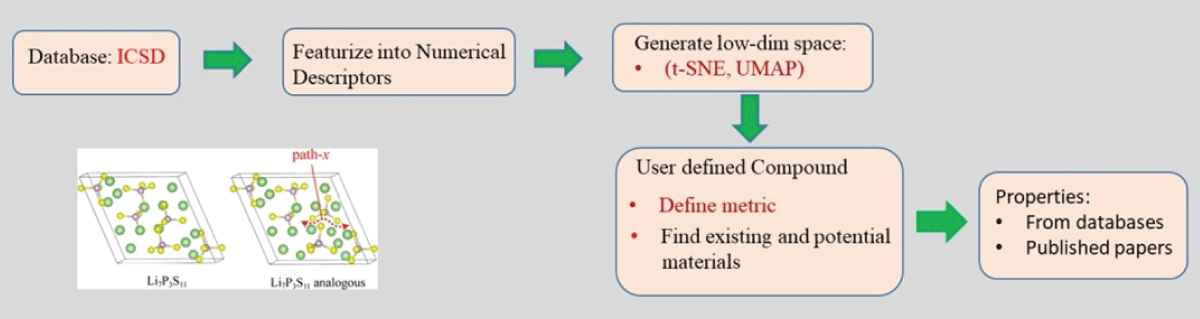
The discovery of novel functional materials is frequently accelerated by machine learning (ML) techniques that visualize vast chemical spaces in low-dimensional projections. However, projecting high-dimensional materials data into a fixed 2D space can introduce significant distortions, hindering the reliable identification of new candidates. In this work, we present a robust statistical framework for unsupervised materials discovery that mitigates these challenges. Our methodology combines Principal Component Analysis with information criteria to determine the optimal dimensionality for representing a given material's dataset, thereby minimizing information loss. We apply this approach to a library of thousands of Li-based compounds, described by their chemical and structural features. Following dimensionality reduction to the statistically optimal space, we employ a non-linear unsupervised learning algorithm to identify novel materials in proximity to a user-defined reference compound. The efficacy of our methodology is demonstrated by its ability to identify candidate materials that have been experimentally reported to exhibit properties similar to the chosen reference, validating our approach as a more reliable pipeline for accelerated materials discovery
数字

参考文献

    1. Kim HJ, Krishna TNV, Zeb K, Rajangam V, Gopi CVVM, Sambasivam S, Raghavendra KVG, Obaidat IM. A comprehensive review of Li-ion battery materials and their recycling techniques. Electronics (Basel). 2020 Jul.
    2. Kim S, Hegde VI, Yao Z, Lu Z, Amsler M, He J, Hao S, Croy JR, Lee E, Thackeray MM, Wolverton C. First principles study of lithium cobalt spinel oxides: correlating structure and electrochemistry. ACS Appl Mater Interfaces. 2018;10:13479‑13490.
    3. Weston L, Stampfl C. Machine learning the band gap properties of kesterite I2‑II‑IV‑V4 quaternary compounds for photovoltaics applications. Phys Rev Mater. 2018;2:085407.
    4. Ward L, et al. Matminer: an open‑source toolkit for materials data mining. Comput Mater Sci. 2018;152:60‑69.
    5. Wegman EJ. Lecture notes: geometric methods in statistics. Fairfax (VA): George Mason Univ; 2016.
    6. Chen B, et al. Mapping materials and molecules. Acc Chem Res. 2020;53:1981‑1991.
    7. Faber F, Lindmaa A, von Lilienfeld OA, Armiento R. Crystal structure representation for machine learning models of formation energies. arXiv. 2015 Mar;1503.07406v1.
    8. Hastie T, Tibshirani R, Friedman J. The elements of statistical learning: data mining, inference, and prediction. 2nd ed. New York: Springer; 2011. (Springer Series in Statistics).
    9. James G, Witten D, Hastie T, Tibshirani R. An introduction to statistical learning with applications in R. New York: Springer; 2013. (Springer Series in Statistics).
    10. Goswami S, Wegman EJ. Comparison of different classification methods on glass identification for forensic research. J Stat Sci Appl. 2016;4:65‑84.
    11. Gentle JE. Statistics and computing: elements of computational statistics. New York: Springer; 2002.
    12. Goswami S, Wegman EJ. Detection of excessive activities in time series of graphs. J Appl Stat. 2020;47(1):176‑200.
    13. Goswami S. Influential nodes and anomalous topic activities in social networks using multivariate time series and topic modeling. Commun Stat Theory Methods. 2020;51:1‑26.
    14. McInnes L, Healy J, Melville J. UMAP: uniform manifold approximation and projection for dimension reduction. arXiv. 2020 Sep;1802.03426v3 [stat.ML].
    15. Nitta N, Wu F, Lee JT, Yushin G. Li‑ion battery materials: present and future. Mater Today. 2015;18.

Why publish with us?

  • Global Visibility – Indexed in major databases

  • Fast Peer Review – Decision within 14–21 days

  • Open Access – Maximize readership and citation

  • Multidisciplinary Scope – Biology, Medicine and Engineering

  • Editorial Board Excellence – Global experts involved

  • University Library Indexing – Via OCLC

  • Permanent Archiving – CrossRef DOI

  • APC – Affordable APCs with discounts

  • Citation – High Citation Potential

Submit Your Article

Advertisement